
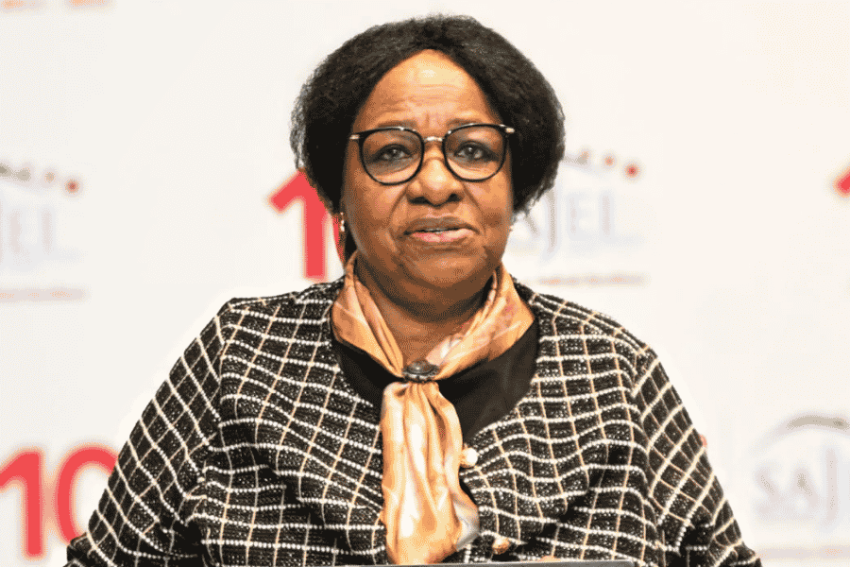
Former Justice Minister Brigitte Mabandla has told the Khampepe Commission she never ordered the National Prosecuting Authority (NPA) to put apartheid-era cases on ice, pushing back against claims of political interference in the post-TRC prosecutions.
Appearing before the commission in Newtown on Wednesday, Mabandla said she did not instruct the NPA to pause or discontinue cases linked to the Truth and Reconciliation Commission (TRC) in 2004.
Under oath, she maintained that prosecutors should have been allowed to execute their mandate without political direction.
“The NPA should have acted according to the law,” she testified, rejecting suggestions that she directed prosecutors to abandon or freeze matters.
Her version clashes with that of former senior NPA official Dr Silas Ramaite, who previously told the inquiry that Mabandla instructed him in 2004 to halt TRC-related investigations pending guidance from an outside Amnesty Task Team.
Mabandla disputed that account. She said she never told Ramaite to stop prosecutions of apartheid-era cases and could not recall details of meetings from that period because she no longer has access to her ministerial notes and diaries.
The Commission of Inquiry, chaired by retired Constitutional Court Justice Sisi Khampepe, is probing allegations that senior political leaders deliberately stalled justice for victims of apartheid crimes where amnesty was not granted by the TRC.
In her testimony, Mabandla sought to contextualise the environment inside the state at the time, pointing to open hostility between then National Director of Public Prosecutions Vusi Pikoli and then National Police Commissioner Jackie Selebi.
She told commissioners that tensions were high because Selebi had been indicted at the time, creating friction between the two institutions central to any prosecution of TRC matters.
The testimony comes days after former President Thabo Mbeki appeared before the same commission on 19 October 2026. Mbeki denied claims that he entered into secret agreements with apartheid-era generals to protect them from prosecution, instead laying the blame for the lack of progress squarely on the NPA.
Mabandla’s evidence followed a similar thread – that the Executive did not block cases, and that any failure to prosecute rested with the prosecuting authority.
But the commission has been presented with starkly different narratives. Ramaite’s testimony suggests a direct ministerial instruction to stop investigations, a move that families of victims argue amounted to a political decision to sacrifice justice for political stability.
For more than two decades, hundreds of cases referred by the TRC for prosecution have remained largely untouched, leaving families without closure and fuelling allegations of a behind-the-scenes deal.
Mabandla insisted that if such delays occurred, they were not on her instruction.
Commissioners are expected to interrogate her lack of recall and the missing paper trail, which remains central to establishing whether a formal instruction to halt prosecutions was ever issued.
The commission adjourned on Wednesday and will resume tomorrow. However, Mabandla will be required to return for cross-examination if applications to do so are granted.