
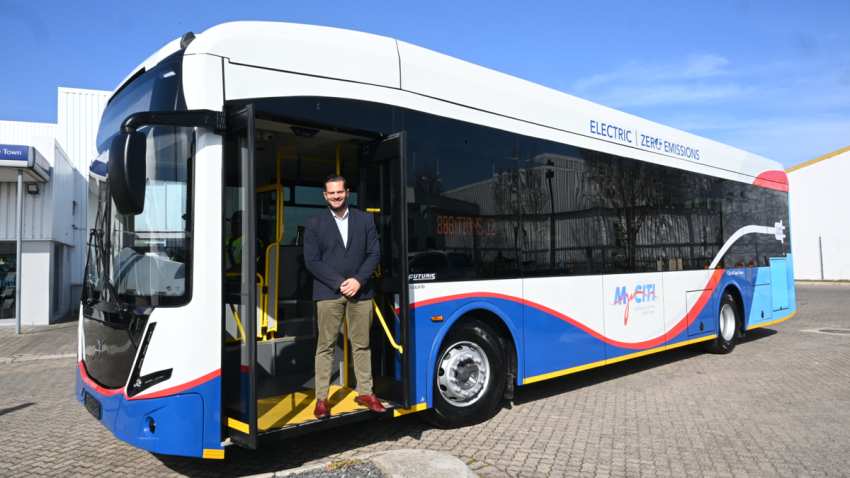
Cape Town has received its first battery-electric MyCiTi bus as the City prepares for a wider rollout of zero-emission public transport from 2027.
The prototype bus will soon begin operating on test routes across the metro.
The testing phase will assess how the vehicle performs in Cape Town’s conditions, including steep roads, peak-hour traffic and longer commuter routes.
The City of Cape Town has ordered 38 low-floor battery-electric buses for the expanded MyCiTi network serving the metro south-east.
The vehicles are expected to arrive during the current calendar year, with passenger services scheduled to start in 2027.
Local design and manufacturing
The 12-metre Volvo BZRLE buses are also significant because they are the first MyCiTi buses to feature bodies designed in South Africa and manufactured locally in Gauteng.
Mayoral Committee Member for Urban Mobility Rob Quintas said the arrival of the first electric bus was a major moment for the service.
“The MyCiTi service is now 16 years old. The arrival of our first e-bus is a major highlight in this journey,” Quintas said.
He said the project supports Cape Town’s shift toward cleaner and more sustainable public transport.
Quintas added that electric buses could also be cheaper to operate and maintain.
Tough routes to test performance
Residents may soon see the branded prototype travelling across several parts of Cape Town.
The test routes include Hospital Bend, the N2, Camps Bay, Polkadraai Road and Jip de Jager Drive.
The trials will measure battery performance, charging times, energy use and passenger loads.
Engineers will also assess how the bus handles Cape Town’s terrain and climate.
Quintas encouraged residents to look out for the low-floor bus, saying it will be clearly branded.
Rollout planned for 2027
The research is being conducted with the University of Cape Town.
It will also examine maintenance needs, charging infrastructure, driver training and long-term fleet planning.
If the pilot produces the expected results, the first electric MyCiTi buses are expected to enter scheduled passenger service from 1 July 2027.
They are expected to operate between Mitchells Plain and Khayelitsha, Wynberg and Claremont, and within the Cape Town CBD.
The findings will help shape future investment decisions as the City considers expanding its electric bus fleet.
Further expansion will depend on funding from national government.