
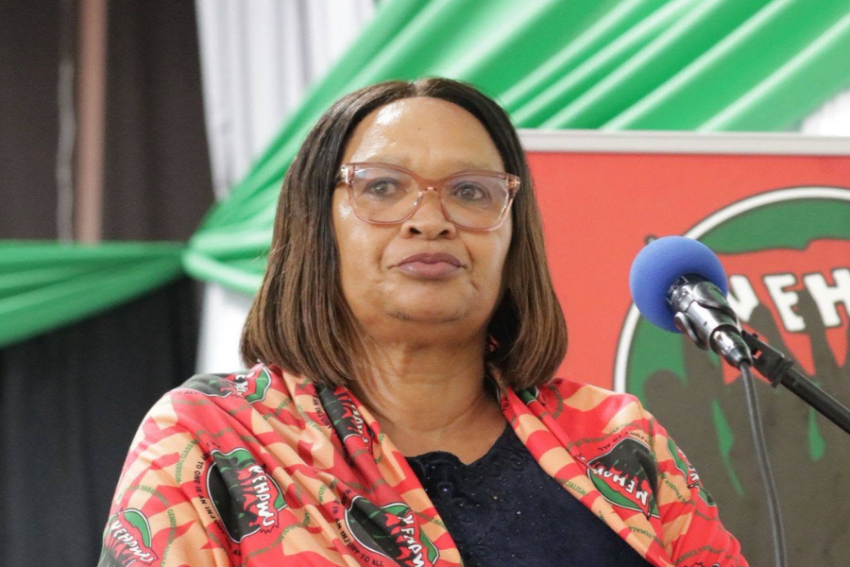
In a move that is shaking the foundations of South Africa’s tripartite alliance, the National Education, Health and Allied Workers’ Union (NEHAWU) has made its most explicit break yet with decades of loyalty to the African National Congress (ANC).
The trade union has thrown its full weight behind the South African Communist Party (SACP) ahead of the 2026 local government elections.
The declaration, made at NEHAWU’s National Congress held at the Birchwood Hotel and Conference Centre in Boksburg in June 2026, is not merely a political statement — it is a seismic realignment that analysts say threatens to fracture the Congress of South African Trade Unions (Cosatu) from within, pitching affiliate against affiliate in the most bruising internal battle the federation has seen in years.
Nyameka Macala, NEHAWU’s newly elected president, said the 13th National Congress had ratified a resolution endorsing the SACP’s decision to contest the elections independently — with or without areconfigured alliance. The working class, she made clear, had run out of patience.
“The National Congress has ratified the resolution that was taken by the 12th National Congress on supporting the South African Communist Party in its electoral contestation,” Macala said. “We welcome the decision taken by the South African Communist Party at its 15th National Congress to contest the elections with or without the reconfigured alliance, as part of building class hegemony in all key sites of power.”
For decades, the ANC, the SACP and Cosatu have operated as a three-legged stool, each propping up the others. But NEHAWU’s congress resolution pulls one of those legs decisively sideways, and the cracks are showing.
THE ALLIANCE UNDER SIEGE
The SACP’s decision to go it alone in the 2026 local government elections, confirmed at its Augmented Central Committee meeting at the same Birchwood Hotel in late November 2025, has set off a chain reaction that has left the ANC furious and Cosatu scrambling for a mediating role it is struggling to fill.
The ANC’s National Executive Committee (NEC) responded in April 2026 by passing a resolution invoking constitutional provisions that bar members from joining or supporting a rival political party.
ANC secretary-general Fikile Mbalula warned that members cannot serve two political bosses. Those who campaign for the SACP, the ANC warned, would face disciplinary action and could find themselves effectively expelled from ANC structures.
The ultimatum has landed like a live grenade inside Cosatu’s alliance arrangements. The federation, which has tried to position itself as a “big brother” mediator in the dispute, finds itself caught between two warring parents, and its own affiliates are choosing sides.
Cosatu’s leadership, including first deputy president Mike Shingange, appealed as recently as December 2025 for unity, urging both parties not to use Cosatu platforms to attack each other. The federation warned that the divisions could fatally undermine the interests of workers.
But NEHAWU, at its 13th National Congress in June 2026, turned the knife, hitting out at what it described as ideological “flip-flopping” within the federation and a dangerous drift toward reformism.
The federation’s national elective conference, scheduled for September 2026, is expected to bring these divisions to a boiling point, with the question of the SACP endorsement set to be a defining battle for the soul of South Africa’s largest labour federation.
A PRESIDENT WHO CORRECTS THE RECORD
Though her election is being celebrated as a landmark for women in the labour movement, she was at pains to correct any suggestion that she is NEHAWU’s first female president.
“I want to correct you on that. I am not the first one,” she said firmly. “The first one was Comrade Noluthando Mayende-Sibiya, who was the first woman president of this organisation.”
She painted a picture of workers ground down by stagnant wages and high turnover rates on the shop floor, their living standards hollowed out by a government she says has repeatedly failed to honour its commitments.
THE 2018 WOUND THAT NEVER HEALED
Central to NEHAWU’s rage, and its political pivot, is the unresolved ghost of Public Service Coordinating Bargaining Council (PSCBC) Resolution 1 of 2018. The agreement, signed between public sector unions and the government led by the ANC, promised cost-of-living salary adjustments across three consecutive financial years, including a CPI-plus-1% increase for lower-level public servants on the last leg of the deal.
When April 2020 arrived, and public servants did not receive their expected increases, NEHAWU and its Cosatu allies immediately declared a dispute and dragged the matter to the Constitutional Court. The case wound through the legal system for years, generating statement after statement from NEHAWU’s leadership.
“The government, on the last leg of that agreement, reneged on its implementation,” Macala said, her voice carrying the weight of accumulated grievance. “That angered the workers around the non-implementation of Resolution 1 of 2018 to the fullest.”
It is precisely this betrayal — a government that signed an agreement and then walked away from it — that has fuelled NEHAWU’s decision to look beyond the ANC. The union’s members are public sector workers: nurses, healthcare support staff, educators and allied workers who kept the country running through a pandemic, only to find their government unwilling to honour a bargained salary commitment.
THE VANGUARD ARGUMENT
The party, she argues, is the custodian of working-class interests, the political formation that must step forward when labour is under siege.
“We believe that the South African Communist Party is the vanguard of the working class,” she said. “So when the working class is under siege, it has to come in and be on the side of the workers and the working class in general.”