
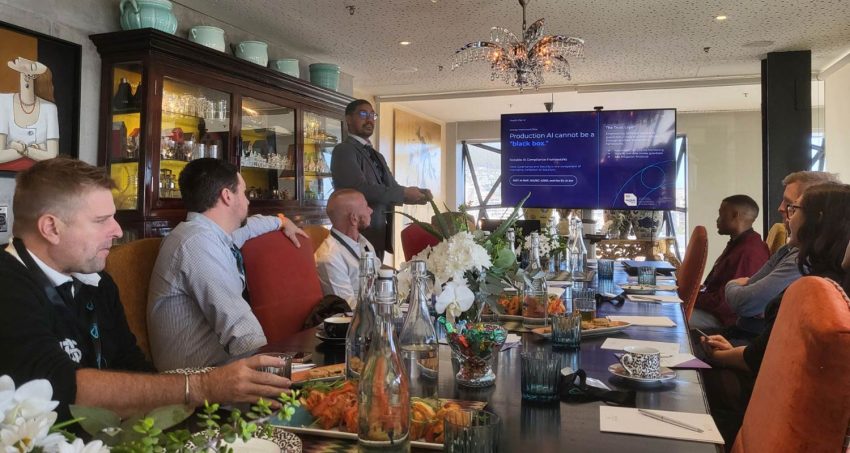
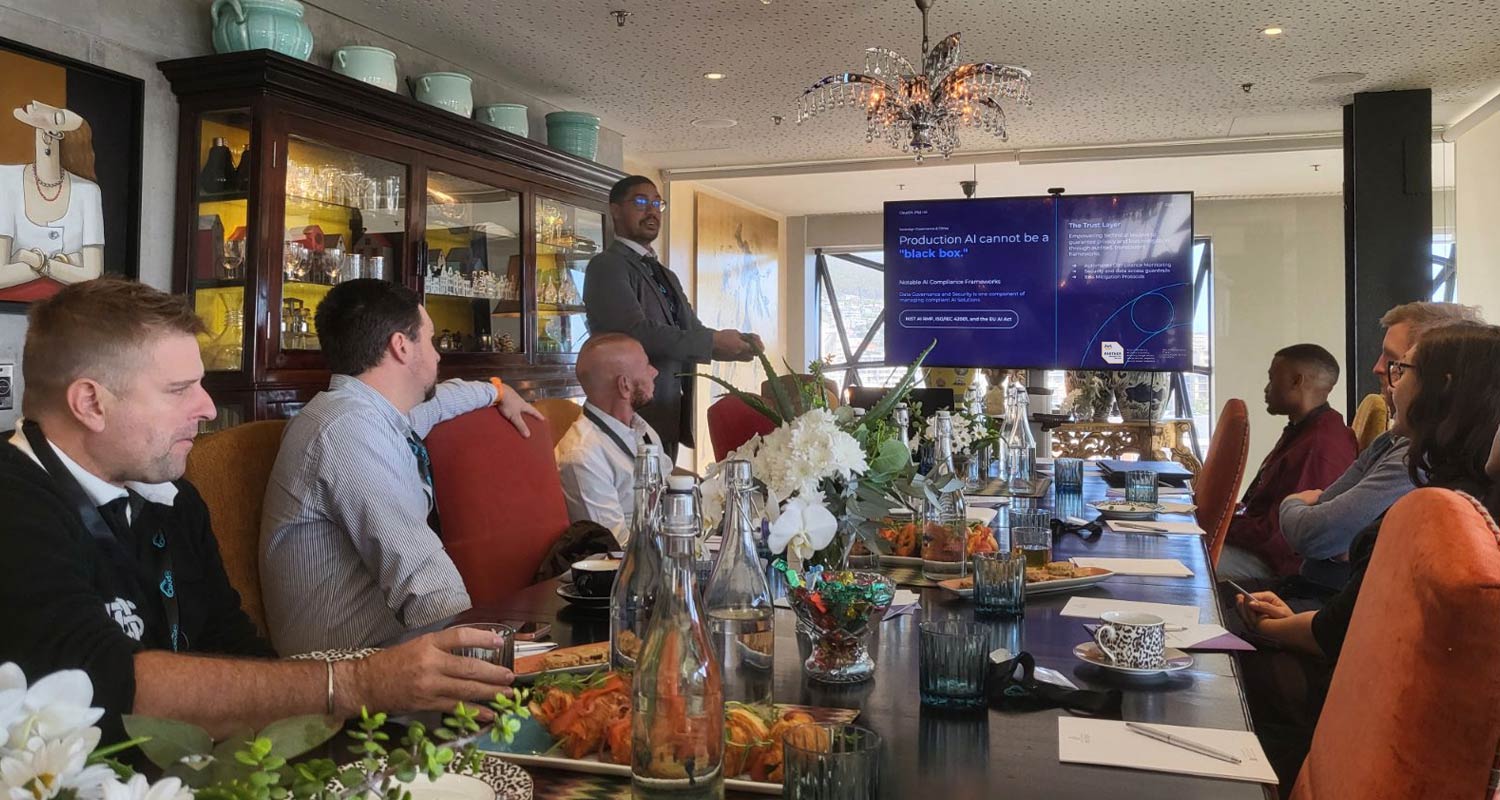
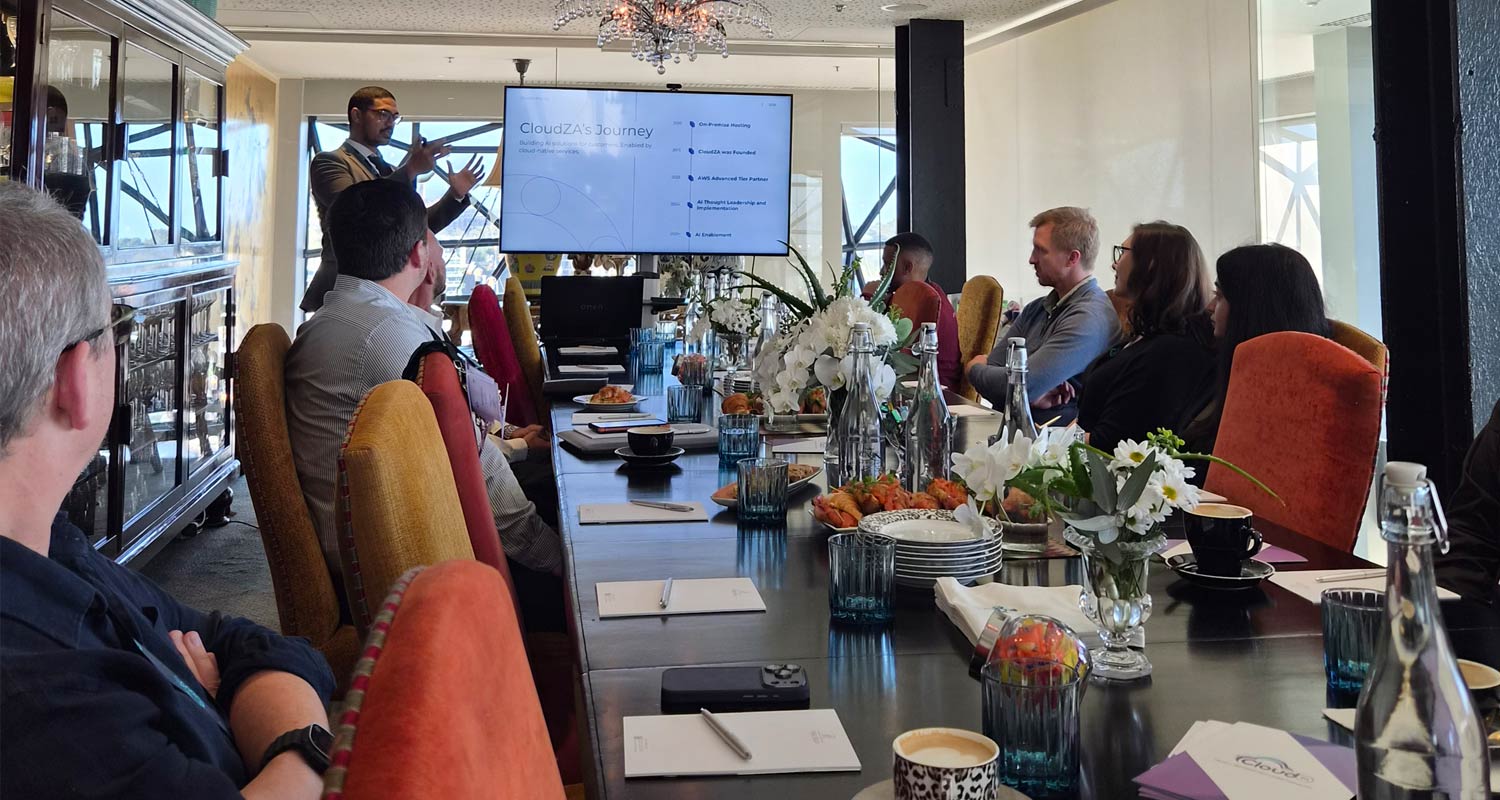
CloudZA, an AWS Advanced Tier Services Partner with specialised designations in generative AI and agentic AI, recently co-hosted a closed-door AI executive roundtable with Amazon Web Services.
Aimed at South African enterprise and technology leaders – heads of AI, CEOs, CIOs, CTOs and heads of innovation – the session focused on the defining technical challenge of 2026: moving from isolated, chat-based pilots to the production-ready data architectures needed to run fully autonomous agentic AI at enterprise scale.
For technical decision-makers, the main bottleneck to production-grade AI has shifted away from public foundation models and onto underlying enterprise data infrastructure. The roundtable opened by diagnosing a persistent problem: enterprise data remains fragmented across legacy silos, depriving engineering teams of the real-time visibility and data orchestration needed to scale advanced AI. Outdated infrastructure introduces performance bottlenecks, limits scalability and creates security vulnerabilities across ageing technology stacks.
Foundational architecture
To bridge the gap between fragmented data and usable corporate intelligence, CloudZA set out a four-layer foundational architecture for scaling generative AI:
- The data layer: Unifying disparate data lakes, data warehouses and databases into a single, immutable source of truth.
- The platform layer: Drawing on cloud-native machine-learning tools and foundational AWS services.
- The model layer: Accessing enterprise-grade foundation models and managing fine-tuning securely.
- The application layer: Deploying production decision systems, scalable interfaces, interactive dashboards and autonomous workflows.
To avoid rigid, high-overhead extract, transform, load (ETL) pipelines that bloat engineering budgets, CloudZA argued for a shift towards “architectural liquidity”. Replacing legacy infrastructure with a composable zero-ETL fabric, it said, lets enterprise data flow seamlessly into real-time analytics streams and automated retrieval-augmented generation (RAG) workflows.
The data modernisation journey
Making the transition, CloudZA said, requires a structured, risk-mitigated framework in four phases:
- Assessment: Evaluating the current technical state, resource capacity and structural gaps.
- Strategy: Designing the target cloud architecture and a cost-optimised migration road map.
- Implementation: Executing cloud-native migration with minimal operational disruption.
- Optimisation: Continuous pipeline tuning, token efficiency and unlocking scale.
Redefining productivity with measurable returns
A major theme was the shift from human-dependent AI “copilots” to autonomous agentic AI systems. In 2026, CloudZA argued, corporate productivity is being rewritten by swarms of autonomous agents able to execute complex, multi-step workflows with minimal human oversight – cutting manual administrative overhead by up to 70% while making real-time strategic pivots based on live market data.
To show that enterprise AI is a force multiplier rather than an isolated IT cost centre, CloudZA presented production metrics from its work in the field:
| Case study | Technology stack | Operational bottleneck | Outcome |
| SA fintech | Salesforce Agentforce, AWS security guardrails | Legacy know-your-customer (KYC) workflows and fragmented data orchestration | 99.9% accuracy in technical resolution; 4x faster processing, from 30 minutes to real time |
| Intelligent fraud detection | Amazon Bedrock, Amazon SageMaker | Manual audit of high-throughput, multi-document applications | Review times cut from 4 hours to under 3 minutes per document; 722 complex applications processed simultaneously |
| Smart quality assurance | Amazon Connect, Amazon Bedrock, AWS Transcribe | Manual call transcription, compliance scoring and QA | 60% reduction in QA processing time; 30% rise in agent success; 65% increase in customer satisfaction (CSAT) |
The fraud-detection pipeline holds its efficiency through a three-layer signal-classification approach – deterministic rules, heuristics and AI scoring – to eliminate false positives while protecting margins.
Enforcing the trust layer and curbing ‘shadow AI’
As infrastructure scales to handle millions of daily inferences, data governance and security become non-negotiable. The roundtable cited IBM’s Cost of a Data Breach Report, which found that 20% of organisations suffered serious data breaches tied to ungoverned “shadow AI”, with 65% of those breaches involving personally identifiable information (PII) and 40% compromising intellectual property.
To counter this, CloudZA detailed its Trust Layer consultancy framework, which implements:
- Automated compliance monitoring and audit trails.
- Stringent security policies and data-access guardrails.
- Automated bias-mitigation and hallucination protocols.
The framework is designed to keep enterprise AI transparent, fully auditable and aligned with international governance frameworks, including the NIST AI RMF, ISO/IEC 42001 and the EU AI Act. Production AI, CloudZA said, can no longer operate as an unauditable “black box”.
Hard-hitting realities: the boardroom discussion
The forum closed with an open-floor session in which delegates debated the friction points of scaling production environments:
- Ingestion versus budget: what breaks first when provisioning real-time RAG pipelines across deep customer history – the ingestion layer, schema flexibility or the budget.
- Explainable AI (XAI): whether local organisations are running XAI in production, or still relying on hope that the “black box” behaves predictably.
- Justifying the spend to finance: aligning large language model (LLM) token and inference costs against bottom-line margin expansion to satisfy the CFO.
- CI/CD pipeline stability: version-controlling prompts with the same rigour as core application code to prevent model drift, rather than treating prompt engineering as a bespoke process.
Book an enterprise AI road map assessment
CloudZA is opening a limited number of strategic AI assessment sessions for organisations looking to move from proof-of-concept to secure production.
The two-hour technical consultation with CloudZA’s cloud architects delivers an actionable, risk-mitigated integration blueprint tailored to a client’s infrastructure and budget, across four steps:
- Use-case discovery and agentic readiness: mapping current workflows to identify high-yield automation targets.
- Architectural and ingestion feasibility: assessing data availability, legacy silos and schema flexibility to confirm the infrastructure can support real-time RAG pipelines.
- ROI modelling and financial guardrails: building a predictable cost model that offsets LLM token and inference costs against margin expansion.
- Deliverable handover: a finalised, production-ready AI assessment and architectural road map aligned with international compliance frameworks (NIST AI RMF, ISO/IEC 42001).
Capacity is limited, and sessions are reserved for enterprises preparing for 2026 production deployment.
To book a session, contact CloudZA:
About CloudZA
CloudZA is an AWS Advanced Tier Services Partner with more than 15 years’ expertise across hosting, data storage and server environments. Holding recognised designations in generative AI and agentic AI, it builds production-ready autonomous systems protected by enterprise-grade guardrails. Winner of the GenAI Award for its LLM-powered statement of work (SOW) engine, CloudZA bridges the gap between fragmented legacy data and secure, scalable enterprise intelligence. It is an AWS Competency Partner in DevOps, Data and Analytics, Generative AI and Security. Learn more at cloudza.io.