
For years, digital transformation strategies have rested on a simple assumption: more data creates better decisions. Today many organisations are discovering the opposite can also be true.
As enterprises deploy AI platforms, analytics environments and increasingly sophisticated automation systems, a new challenge is emerging. The problem is no longer a lack of data; it is identifying which data actually matters.
Across industries, organisations generate vast volumes of operational information every day. Vehicles, utility networks, logistics assets, infrastructure, facilities and industrial equipment continuously produce data streams that feed dashboards, reports and analytics platforms. Yet despite this abundance, operational blind spots remain surprisingly common.
Infrastructure failures are often detected only after damage occurs. Water leaks can run for weeks before intervention. Critical assets disappear before exceptions are flagged. Maintenance teams frequently operate reactively rather than proactively. The issue is not visibility alone; it is signal quality.
“Many organisations are focusing heavily on intelligence layers, analytics platforms and AI capabilities without first asking whether the underlying operational signals are providing the right information,” says Gregory Rood, CEO of Sigfox South Africa. “If the operational signal layer is incomplete, no amount of analytics can fully compensate for it.”
Broader shift
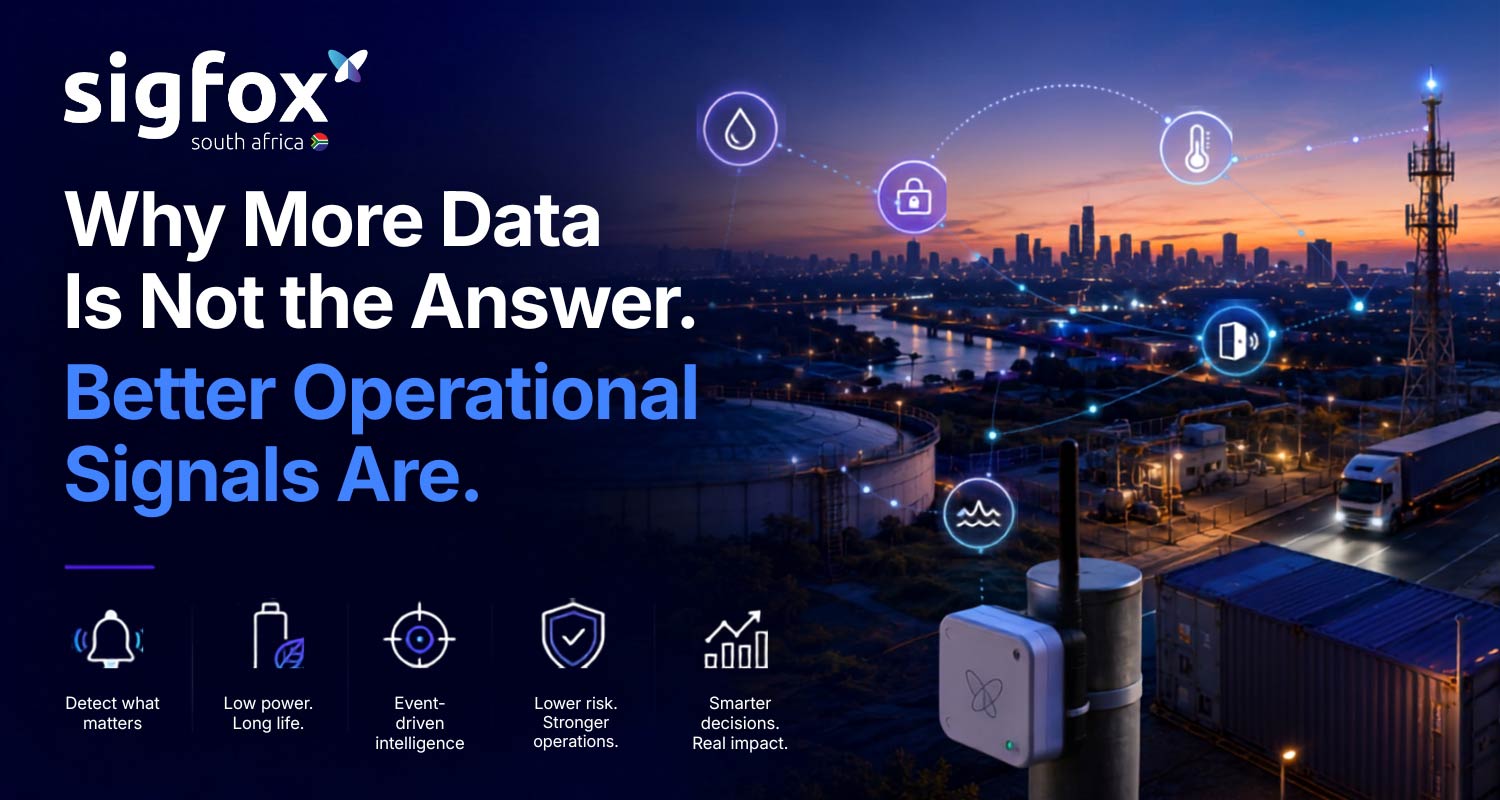
This is driving a broader shift in how organisations think about telemetry. Historically, connected systems were designed around continuous communication: more sensors generated more data, and more reporting was considered inherently valuable. That model is increasingly being challenged. In many operational environments, a single event can be worth more than millions of routine data points.
Consider a logistics container moving through a global supply chain. Conventional thinking suggests continuous tracking is essential, yet the most valuable operational event may simply be that the container was opened unexpectedly. That single event can immediately trigger investigations, reduce insurance exposure, improve accountability and prevent significant losses.
The same principle applies across numerous industries. For a municipality, the critical signal may not be continuous reporting from every section of a water network but immediate notification when abnormal flow begins. For pharmaceutical logistics operators, the most valuable event may be a temperature-threshold breach. For infrastructure operators, it may be an alert that a cable is being tampered with. For facilities teams, it may be the moment environmental conditions move outside acceptable operating ranges.
This shift towards event-driven operational intelligence is creating new opportunities to connect environments that were previously considered commercially impractical. Low-power wide-area network (LPWAN) technologies allow businesses to monitor assets, infrastructure and operational environments at a fraction of the cost traditionally associated with IoT deployments.
As a result, organisations can extend visibility into previously disconnected environments, including water networks, cable infrastructure, remote facilities, stormwater systems, returnable logistics assets, temporary infrastructure, utility networks and large-scale industrial environments.
Global adoption of these models is accelerating. Japanese utility operators are using low-power telemetry to optimise gas distribution through automated meter monitoring and route planning. European municipalities are deploying sensor networks to monitor stormwater infrastructure and trigger interventions only when required. Airports are using battery-powered telemetry to track critical support equipment and improve operational efficiency. These deployments show that meaningful operational intelligence often comes from targeted event detection rather than continuous data collection.
South Africa presents a particularly compelling case. Many organisations operate across geographically distributed assets, constrained maintenance resources and infrastructure environments where operational failures carry significant financial consequences. In these conditions, operational resilience becomes a strategic requirement rather than a technology initiative.
“The future is not necessarily about collecting more information,” says Sean Laval, head of product and solutions at Sigfox South Africa. “It is about identifying the operational events that genuinely matter and ensuring organisations become aware of them immediately.”
What’s worth listening to
That distinction may become increasingly important as AI adoption accelerates, because successful AI strategies will ultimately depend on something far more fundamental than algorithms: whether organisations have access to accurate, relevant and timely operational signals in the first place.
The organisations that gain the greatest competitive advantage may not be the ones collecting the most data. They may simply be the ones that have learned which signals are worth listening to.
For more information, visit www.sigfoxsa.co.za.