
Eight million taxpayers bankroll 1.3m public servants while services collapse …
The public service wage bill is set to climb by another R40 billion, reaching R853 billion – a 4.6% increase, compared to inflation at 3.2%.
Yet personal income tax collections from individuals are projected at just R845 billion for the 2026-27 tax year.
In other words, the total contribution of roughly eight million taxpayers cannot cover the salaries of 1.3 million public sector workers.
“This is a two-fold problem,” warned Frank Blackmore, chief economist at KPMG, following Finance Minister Enoch Godongwana’s Budget 2026 speech.
ALSO READ: Budget 2026: R850bn public sector wage bill is government’s biggest expense
Efficiency problem
First there is an efficiency problem. If taxpayers had clean running water 24 hours a day, no power cuts, a growing economy and fully functioning infrastructure there would be very few gripes. That it is not the case.
“One then asks why we are spending so many resources on inefficiencies.”
The second problem is that valuable resources that should have been directed towards service delivery are now used to pay public sector workers.
Blackmore believes the size of this budget component is critical because any change affects what remains of the budget.
Fewer pay more
Joubert Botha, head of tax at KPMG, said there are currently 14.2 million registered taxpayers, and only 8.3 million contribute and pay taxes. They are responsible for almost 40% of all tax collections.
Of the eight million taxpayers, just 644 000 or 7.7% contribute almost half of the R845 billion and about 20% of total tax collections.
If the 644 000 higher-end taxpayers represented 20% of the working population in the country, it would have made sense.
“But we know that is not the case given our high unemployment rate,” says Botha. “So the burden is falling on a small number of taxpayers.”
While the tax base is shrinking, the burden is increasing.
Blackmore calculates SA’s tax-to-GDP ratio to be at 29.6% when counting back the South African Customs Union (Sacu) payments.
ALSO READ: Budget 2026: Slight relief for overburdened individual taxpayers
Disproportionate
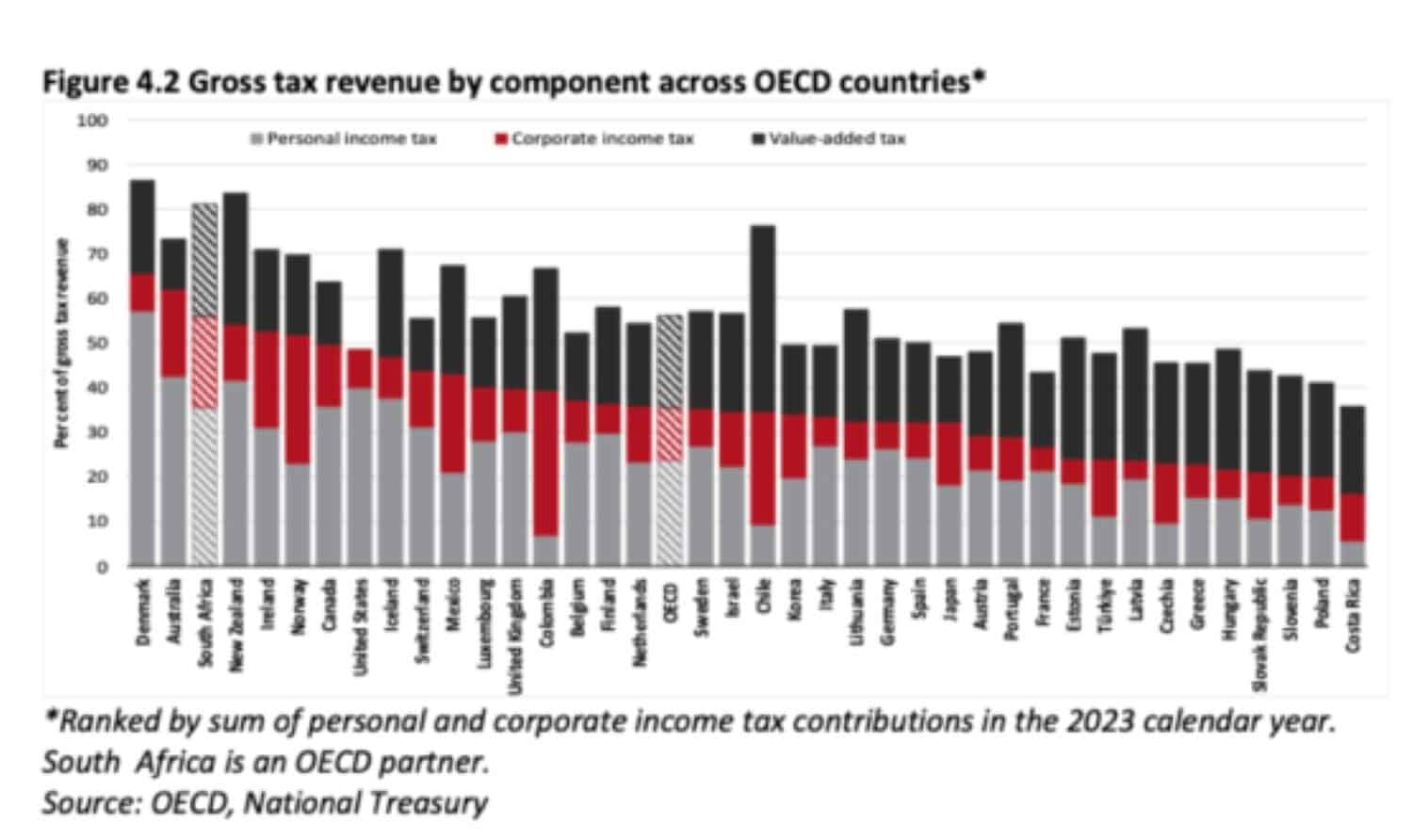
Both personal and corporate income tax contributions to total tax revenue are higher in South Africa than the average across Organisation for Economic Co-operation and Development (OECD) countries.
Blackmore added that a necessary condition for the growth of the tax base is economic growth.
However, one must also be realistic because growing the economy does not necessarily mean unemployment will come down.
“The unemployment rate is there for a reason because of the different skills required in the current economy and other technical reasons.
“But we need growth as a necessary condition to grow the base and decrease the burden on those 644 000 taxpayers specifically and the eight million in general.”
No tolerance
Sarieka Rautenbach, partner in global mobility services and employment tax at KPMG, says there is no tolerance for taxpayers to pay more.
“One must realise that tax, for those who actually contribute, is not their only cost.”
In addition to tax, they also contribute to private medical aid, school fees and security costs. In other economies these costs will have been caught up within the tax they are contributing.
“People will only have a tolerance for more tax if they do not need to incur additional costs,” she added.
This year, for the first time in two years, government announced “full inflationary” adjustments to personal income tax brackets and medical tax credits. It also adjusted tax thresholds and limits for the impact of inflation to assist small businesses and to encourage savings.
Jackie Arendse, a professor in taxation – speaking after a tax, economic and geopolitical analysis webinar hosted by The Tax Faculty – said she does not subscribe to the notion of full inflationary adjustments.
“In some instances, we need four years of inflationary adjustments and not [just] a single year,” she said.
The degree of compliance and the degree of reliance on a small pool of taxpayers became an overriding issue during the 2026 Budget Review.
“We see this as becoming ever more problematic,” said Arendse. “That small pool is getting increasingly agitated and understandably so.”
ALSO READ: Ramaphosa approves salary increases: Here’s how much ministers, MPs and premiers will now earn
Resentment rising
Arendse added that small and large businesses are under a lot of economic and regulatory pressures.
“There is increasing anger about the amount of tax they are paying in comparison to the services they receive.”
During The Tax Faculty webinar, Frans Cronjé, political and economic analyst and founder of Frans Cronjé Private Clients, set out certain scenarios facing the country in the medium term.
One is where businessman Patrice Motsepe enters the race to become ANC leader. “Our advice to clients is that he will run, he will win, and he will become the president of SA.”
According to Cronjé, Motsepe will lead a reform process that will see the country get its growth rate back on track in the early 2030s.
If the economy recovers under his leadership South Africans will see a rise in their living standards, last experienced almost two decades ago.
This article was republished from Moneyweb. Read the original here.