
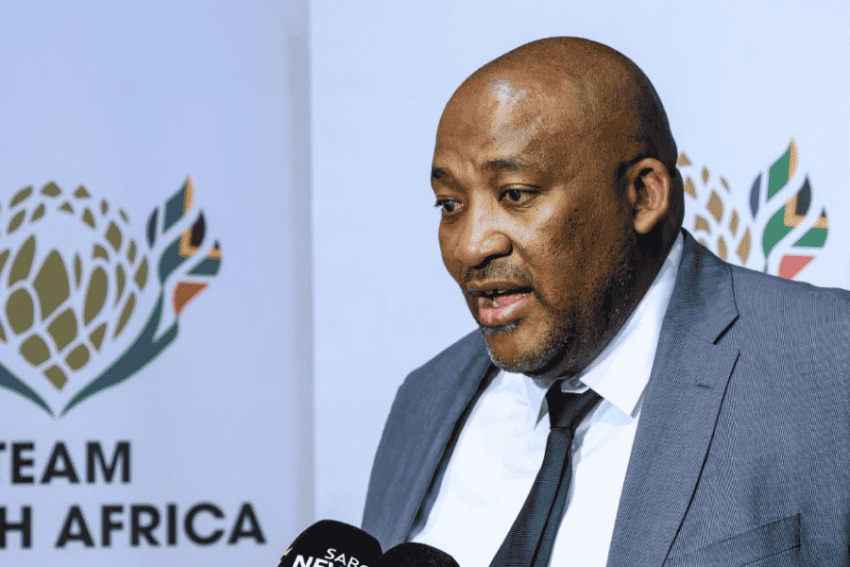
Tax payers could have saved about R260 million over three years if Sport, Arts and Culture Minister Gayton McKenzie had not scrapped a merger of arts and heritage entities.
That’s according to National Treasury figures presented to Parliament on Tuesday.
Instead, taxpayers are still paying for 24 separate boards. And the department has already spent about R5 million on a merger that isn’t happening.
That includes R728 000 paid to a contractor for the rest of a contract the department no longer needed.
The merger was recommended in the Revised White Paper on Arts, Culture and Heritage, which Cabinet approved. It would have cut the number of boards from 24 to seven, and board members from 232 to 78.
The department’s own study found the boards cost about R21.8 million a year in fees and travel.
After the merger, that would have dropped to about R8 million. Those figures date from 2020.
Once staff and audit costs are included, the study put the saving at R68 million a year.
EFF MP Eugene Mthethwa said the merger was meant to get more money to artists.
“The funds that are supposed to go into programmes and projects that should change the lives of creative and cultural practitioners don’t go to the people,” he told the Portfolio Committee on Sport, Arts and Culture.
“These entities will tell you they don’t have a budget, but they never run out of budget for salaries.”
He said that was the point of merging the entities.
“Let’s refocus the money, reduce the number of entities, reduce the number of boards, so that the money that is said to go to programmes can go to the actual intended beneficiaries,” Mthethwa said.
He said artists were left out of the process.
“The core stakeholders of any department or any entity are the creative and cultural sector itself,” he said.
He asked whether DSAC had studied how the years of uncertainty since 2018 had affected artists.
“No, Chair, there is no study that was undertaken to ascertain those facts,” said DSAC’s Sibusiso Tsanyane.
“In the midst of all your decisions and activities, you forget the actual people who have suffered,” Mthethwa replied.
The department’s slides said the entities are carrying on as before.
“The status quo remains, and they still continue to receive their annual allocation in terms of baselines from National Treasury,” Tsanyane said.
The department said it has spent about R5 million on the merger since 2018/19.
About R3 million went on a feasibility study by Learning Strategies.
Just over R2 million went to a second company hired to carry it out.
An official said that when the department cancelled, R728 000 was still left on that contract.
“The service provider had to be paid the balance of that contract,” Tsanyane said.
Mthethwa asked whether that money could be fruitless and wasteful expenditure.
Treasury’s Mabele Mdhluli said he was there only to observe. He said Treasury would answer in writing.
McKenzie told the Minister of Finance about the cancellation in a letter dated 2 September 2024. That was two months after he took office.
He also signed a notice withdrawing a Government Gazette from 24 May 2024.
That gazette had merged the William Humphreys Art Gallery and the National Museum in Bloemfontein into Iziko Museums. It had also merged the KwaZulu-Natal Museum into Ditsong.
ANC MP Gaolatlhe Kgabo read the notice into the record.
“It does not speak of holding, it does not speak of abandoning, it does not speak of suspending. It says withdrawal,” Kgabo said.
“Even though you enjoy executive authority as a Minister, you can’t just wake up and take a decision which has implications for a legislative process,” he said.
Kgabo asked Advocate Benedict Mukubedi, DSAC’s acting head of legal services, whether Cabinet had reversed its decision to merge the entities.
“No, sir,” Mukubedi said.
He asked whether McKenzie asked for legal advice before withdrawing the gazette and whether legal services advise him before he did it?
“No sir. It’s unfortunate that on this one, counsel was not sought from legal services,” Mukubedi said.
Mukubedi also admitted that a policy approved by Cabinet holds superiority. He said a minister who wanted to go against it would need a review process.
But he would not say whether McKenzie had acted outside his powers. He said the Minister may have relied on exceptions that legal services did not know about.
Kgabo then turned to Deputy Minister Peace Mabe and asked her if she was told before the gazette was withdrawn?
“No, honourable member, I was not made aware. But I recall being in meetings where this item was discussed, both in the department and in the portfolio committee,” Mabe said.
She said nothing on paper backed the decision.
“There isn’t any concrete, solid document that backs the argument for the Minister,” Mabe said.
She blamed officials.
“We were briefed yesterday, but officials, honestly, have failed us in this matter. They did not do what was expected of them,” she said.
Asked whether she knew the decision had legal implications, Mabe said: “I was aware. That is why I say it was supposed to be tested.”
The department said it cancelled because integration costs were “higher than anticipated”. It gave no figure. Treasury had put the cost of implementation at R40 million over two years.
The same presentation admitted that the merger will potentially offer long-term cost savings. It said a team is now preparing laws for a future merger of some of the same entities.
Mthethwa was not impressed.
“It’s like buying furniture for a house that is still an architectural drawing,” he said.
McKenzie logged on, told MPs he had been sick in bed for three days, and then left.
MPs want him and the director-general back in person. They also want a signed list, within 14 days, of what has been cancelled and what the merger has cost.