
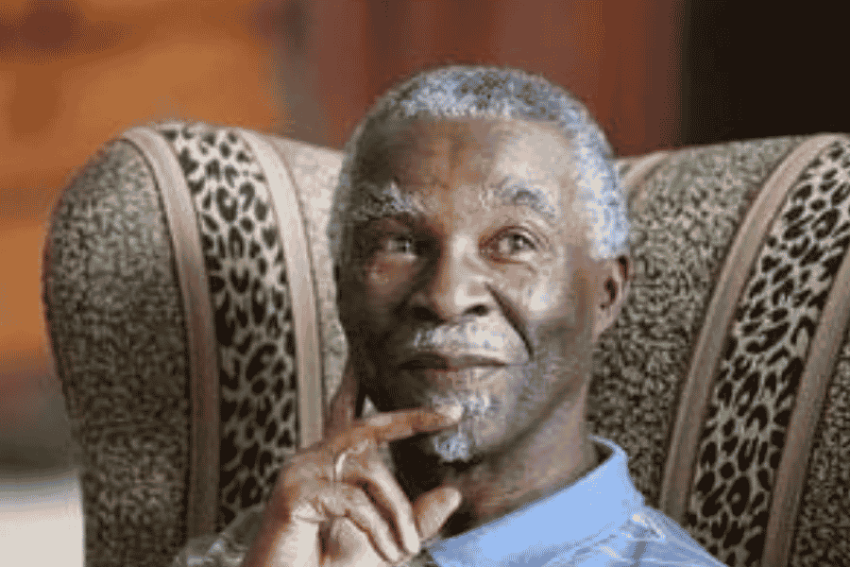
Former President Thabo Mbeki is set to testify on Monday before the judicial commission probing alleged political interference in TRC cases, where he is expected to defend the Government of National Unity and accuse prosecutors retained from the apartheid era of deliberately stalling justice.
Mbeki was summoned to appear after his legal bid to have Commission Chairperson, retired Justice Sisi Khampepe, recuse herself failed. He has denied in his written submission that the democratic executive ever blocked or interfered with the investigation and prosecution of cases referred by the TRC.
The Commission is investigating whether there were deliberate attempts to delay, hinder or stop the investigation and prosecution of apartheid-era crimes and whether any officials or institutions were complicit.
In his submission, seen by Africa Daily, Mbeki argues that the National Prosecuting Authority (NPA), staffed by prosecutors from the old order, sought to protect perpetrators of apartheid crimes.
He accuses them of being determined to “hide the truth” and to “manufacture whatever story they can to bury the truth.”
“They have therefore concocted a whole panoply of lies about obstruction by the National Executive which never happened,” Mbeki states.
“They sought to protect their criminal offence from discovery by surrounding it with the bodyguard of lies.”
Mbeki’s central argument is that the TRC and its amnesty model must be understood within the context of the negotiated transition from settler colonialism and apartheid to democracy.
He says the 1993 Interim Constitution’s clause on National Unity and Reconciliation was deliberately crafted as a “historic bridge” between a past “characterised by strife, conflict, untold suffering and injustice” and a future “founded on the recognition of human rights, democracy and peaceful co-existence.”
According to Mbeki, the amnesty-for-truth model was not about forgetting, but a strategic necessity to secure the transition. He recalls that in its August 1996 submission to the TRC, the ANC had considered three options: Nuremberg-style trials, blanket forgiveness, or conditional amnesty.
“We, however, reached the conclusion that neither of these would be the correct decision to take,” the ANC noted at the time.
Mbeki argues this compromise was essential to prevent the new democracy from collapsing under the weight of retribution. He relies heavily on the Constitutional Court’s AZAPO judgment delivered by the late Deputy President Justice Ismail Mohamed, which upheld the constitutionality of amnesty.
The court found that without the incentive of amnesty, perpetrators would never disclose the truth about crimes committed in secrecy, leaving families “substantially ignorant about what precisely happened to their loved ones.”
“If the Constitution kept alive the prospect of continuous retaliation and revenge, the agreement of those threatened by its implementation might never have been forthcoming,” Justice Mohamed ruled.
Mbeki says it was precisely this logic – amnesty for reform, not just amnesty for truth – that made the Government of National Unity necessary.
Citing scholar Professor Mahmood Mamdani, he argues: “The key to the post-apartheid transition was not an exchange of amnesty for truth but of amnesty for reform – the dismantling of juridical apartheid and the introduction of majoritarian politics.”
He contends that prosecutors who served the apartheid state could not be trusted to drive that reform agenda and instead worked to discredit the executive.
Mbeki also denies an allegation by the Calata Group that a secret 1998 meeting took place between senior ANC and military officials to discuss criminal liability for past crimes. He says the meeting was about Afrikaner self-determination.
“An ANC delegation met some Afrikaners to address an important matter raised by the latter. This was about the place of the Afrikaners in a post-apartheid South Africa and the issue of self-determination. This is a matter of historical records and had nothing to do with anybody’s criminal liability arising from the past,” he submits.
On the contentious three-year moratorium between 2003 and 2005, during which TRC cases were allegedly not pursued while an Amnesty Task Team drafted a prosecution policy, Mbeki says the claim is “false.”
“This is false as my 2003 speech and the said Prosecuting Policy related to amnesty applications to the President, made after the TRC had completed its work,” he says.
Mbeki concedes mistakes were made after the TRC wound down in 2002. He notes the Amnesty Committee received over 7,000 applications, granting only 849 and refusing 5,392.
“It would seem that our country made a major mistake in the way it handled these iconic amnesties,” he says.
“Once they were granted, these amnesties were treated as though they were a private matter between the erstwhile violator and the victim. And yet it was exactly these amnesties which were the golden bricks baked to build the new edifice of national unity and reconciliation, founded on ubuntu! It would have been right that once each amnesty was granted, it should have been communicated to the nation by the public broadcaster.”
He adds: “It may be that the old saying applies in this case, that it is never too late to mend.”
Mbeki also questioned the conduct of former National Director of Public Prosecutions, Advocate Vusi Pikoli, who claimed in a 2015 affidavit that his decision to pursue apartheid-era perpetrators who had not applied for amnesty contributed to his suspension. Mbeki argues Pikoli acted contrary to government’s approach that such cases be handled in a manner akin to the TRC process.
Mbeki is appearing after Judge President Selby Baqwa dismissed applications by Mbeki and former President Jacob Zuma for Khampepe’s recusal on a technicality, finding they had failed to obtain Chief Justice Mandisa Maya’s consent. Both had argued Khampepe was biased due to her previous work for the TRC and the NPA.
Zuma, who was discharged from St Anne’s Hospital in Pietermaritzburg on Saturday after falling ill, was scheduled to appear after Mbeki. It remains unclear whether he will still testify.