

The South African Revenue Service says AI has already blocked more than R100-million in impermissible outflows – and that is just the start of an ambition that stretches to AI agents potentially handling the bulk of taxpayer interactions.
Speaking during a media Q&A at a Sars event in Pretoria previewing the 2026 filing season on Thursday, commissioner Johnstone Makhubu sketched out a two-track AI strategy: one already bearing fruit in compliance and fraud prevention, the other aimed squarely at transforming how ordinary taxpayers experience the organisation. The season itself opens with auto-assessments from 1 July, with individual filing running from 13 July to 23 October.
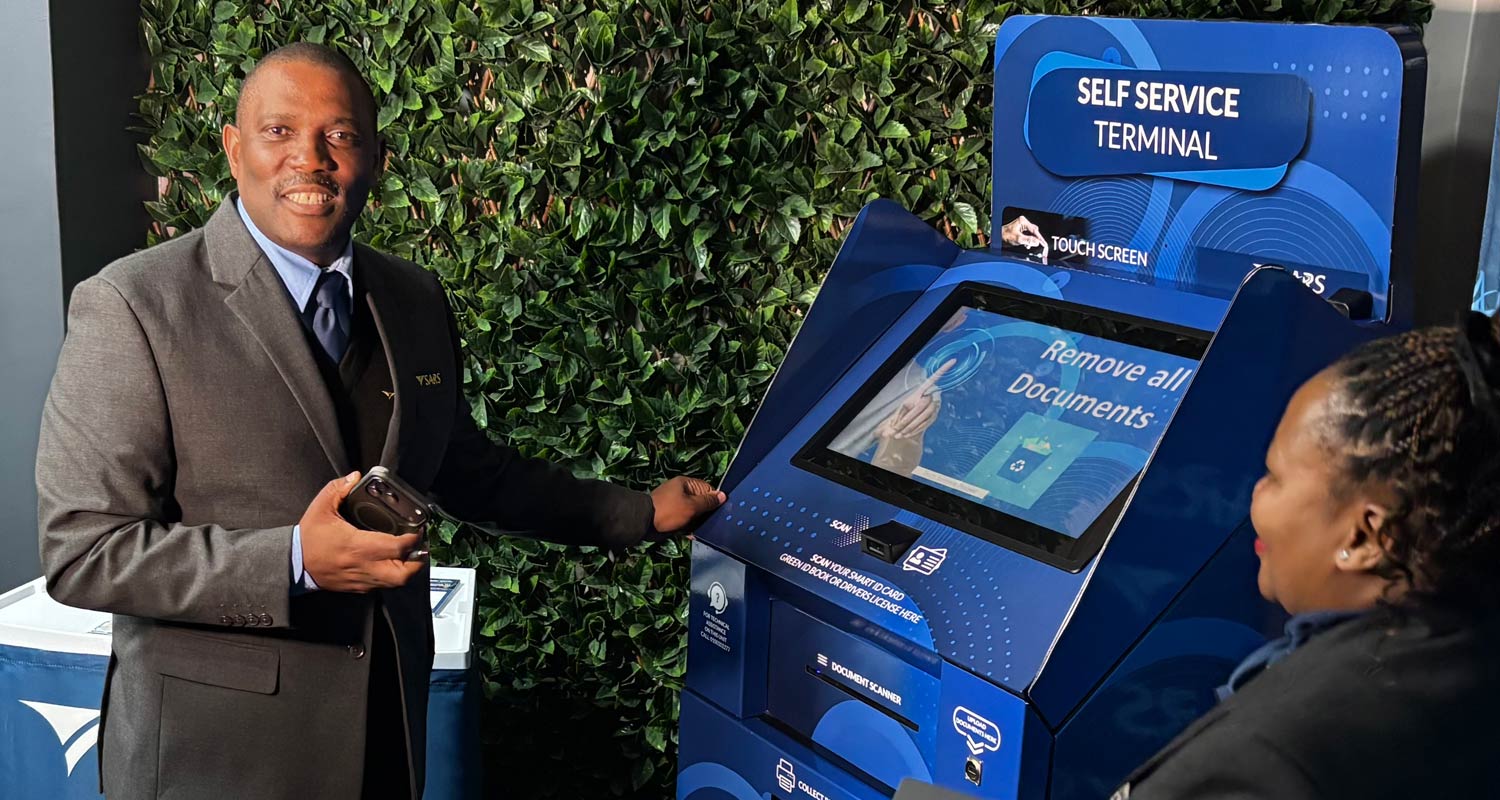
At the event, Makhubu led delegates on a walking tour of the technologies lined up for the season, among them a 4×4 mobile service unit for reaching rural areas, an upgraded self-service terminal, Sars’s digital channels – WhatsApp, the mobile app, USSD and the “Ask Lwazi” chatbot – and a wall of QR codes that let taxpayers resolve common queries without setting foot in a branch.
“This is a step-change for Sars. We are moving away from being an administrator to being a service provider, and from complexity to simplicity,” Makhubu said.
The strategy is not a sudden pivot. In a written response to questions from TechCentral earlier this week, Sars said it had been embedding machine learning into its compliance operations for the past decade, adding capabilities across risk detection, case prioritisation and operational efficiency. It also sits within the broader Modernisation 3.0 overhaul unveiled earlier this year, which pairs AI-driven compliance with biometric taxpayer identities and a planned instant-payment system.
Stopping improper payouts
On the compliance side, the numbers are concrete. “We have stopped in excess of R100-million of impermissible funds from going out by ensuring that our algorithms are able to read from various sources of data through LLMs (large language models) and be able to guide the decisions that are made,” Makhubu said.
Sars confirmed to TechCentral that its systems cross-check multiple data sources at once – including bank statements, VAT returns and Companies and Intellectual Property Commission (CIPC) data – using matching algorithms and analytics to flag anomalies and misdeclarations.
Read: Tech push helps Sars deliver R78-billion revenue boost
Crucially, Sars was emphatic that AI does not make compliance decisions on its own. “AI therefore supports and augments decision-making but does not autonomously trigger any compliance actions,” it said. Risk signals from its machine-learning models are passed to Sars’s case selection division, which weighs them against other inputs and applies established business rules before any verification, audit or investigation is opened – all within a data governance framework that Sars says keeps its use of data and analytics “lawful, proportionate and subject to oversight”.
The customer-facing push is the more striking ambition – and the one that leans on newer, generative AI. Sars has already deployed Ask Lwazi, an AI assistant on its website with hyper-personalisation planned, that lets taxpayers ask questions in a controlled environment.
But Makhubu signalled that is only the opening move. Citing China’s tax authority as a benchmark, he said: “We know that the likes of China, for instance, are able to use AI to handle 80% of the incoming volume of call queries. We think we will also be able to do so, and quite accurately.”
He pointed to e-verification as a near-term target, describing AI agents that process submitted documents using optical character recognition (OCR) without human involvement. “We can use an AI agent to actually look at documentation through OCR to be able to process documents faster and more efficiently,” he said.
What’s already live
Deputy commissioner Carl Scholtz said several AI initiatives are running beyond the fraud-prevention work, with AI used extensively to match and clean the third-party data Sars receives from employers, banks, medical aids and other institutions. “The more accurate the data is, the more we can match it, the more accurate the outcomes of the assessments will be,” Scholtz said. AI-assisted verification is in its third phase of internal testing, he added, with “some of these … starting to come into the production environment over the next 12 months”.
Marius Papenfus, Sars’s head of enterprise data management, gave the most technical account. He described consuming multiple data sources and building probabilistic models to predict both revenue outcomes and compliance risk:
- One model ranks cases by the probability and feasibility of collection.
- Another predicts whether individuals should be registered for tax based on economic activity flowing through their bank accounts, comparing this against the existing taxpayer register.
- A third estimates how far taxpayers may have under-declared income, drawing on company-ownership data, government tender records and directorship linkages. “We compare this to people already on the register,” Papenfus said, describing how the models surface potential non-compliance that would be hard to spot manually – which human agents then verify.
Taken together, the picture is of a revenue authority well past proof-of-concept on AI and now planning a more visible, consumer-facing transformation: faster verifications, smarter risk targeting and a system built to handle far more taxpayer interactions without human intervention.
Read: Sars to give every taxpayer a digital identity in sweeping tech overhaul
Sars’s insistence that humans retain the final say in compliance decisions will reassure taxpayers and businesses. Whether it can execute the broader automation ambition at scale – and hold that line of human oversight as the systems grow more capable – is the central question from here. – © 2026 NewsCentral Media