
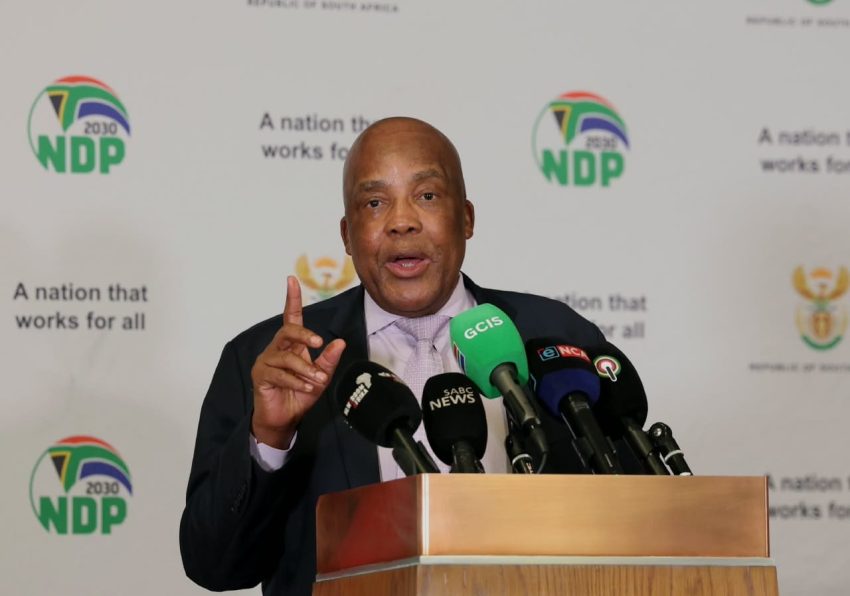
Health Minister Aaron Motsoaledi has corrected a DA MP who told Parliament that girls aged nine to 15 were dealing with cervical cancer.
No case has ever been recorded in that age group, he said.
DA MP Nicola Susanna du Plessis raised it at the NCOP Select Committee on Social Services on Wednesday, while criticising the department for not linking cervical cancer to gender-based violence.
“Then with regards to cervical cancer, and this links to something that my colleague before me mentioned: we are not talking about GBVF. We are not talking about abuse. We are not talking about these things, and the fact that it is a triple burden of disease within South Africa. When we are talking about nine- to 15-year-old girls with cervical cancer, it’s a tragedy. When we’re talking about the fact that the highest HIV infections are in young girls between 10 and 17, that’s a tragedy. But we’re not touching on it,” Du Plessis said.
Motsoaledi cut in. “Is Honourable du Plessis saying there are nine- to 15-year-old girls who were found to have cervical cancer? Can I be clarified on that question?” he asked.
Du Plessis said she had read it in the department’s presentation.
“It’s on the presentation, Honourable Minister. It says 377,237 young girls between the ages of nine and 15, that mortality from cervical cancer has been decreased by that, or that was the aim. And 72,763 were not addressed because of a lack of parental consent. So it does say that in the presentation. And I’m very concerned about the age group,” she said.
The slide she referred to listed the number of girls vaccinated against HPV, the virus that causes cervical cancer. It did not list cancer cases.
Motsoaledi said he was worried the exchange would mislead the public.
“It looks like we gave an impression that we are screening kids between nine and 15 years for cervical cancer. We are not doing such a thing. Up to now, no cervical cancer has been reported in anybody between the ages of nine and 15. It starts in the 30s upwards,” he said.
“So it was found that if you eradicate the papilloma virus early in life, that young girl is very unlikely to have cervical cancer when she grows up. So what we did in 2014, we were the first country on the whole continent of Africa to start giving a vaccine against human papillomavirus. It is called the HPV vaccine.
“As I’m speaking now, Honourable, we are very proud that we have vaccinated six million girls. That means there are six million schoolgoing girls who, when they grow into adulthood, have a very, very low chance of getting cervical cancer, if not non-existent,” he continued.
He said the vaccine works best before a girl’s first sexual experience, which is why the department targets that age group.
“Definitely we can’t screen them for cervical cancer, because it has never been found there,” Motsoaledi said.
He said cervical cancer is the second-biggest killer of women after breast cancer. South Africa sponsored the World Health Assembly resolution to eliminate it.
The department missed its 2025/26 HPV vaccination target. It vaccinated 377,237 girls against a target of 450,000. Officials said 72,763 girls were missed because parents did not sign consent forms.
The World Health Organization’s elimination formula is “90-70-90”: 90% of girls vaccinated by 15, 70% of women screened, and 90% of women with cervical disease treated.
The department screened just over 980,000 women in 2025/26, above its target of 900,000.