
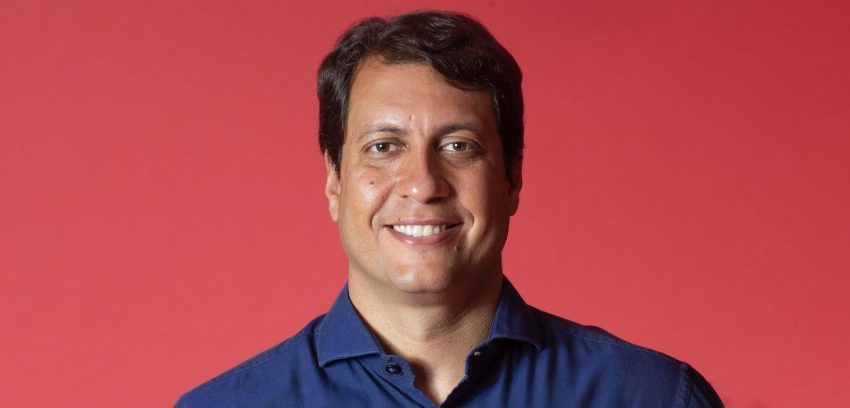

Two years into the four-year window that decides whether Fabricio Bloisi collects a US$100-million “moonshot” share award, the prize looks further off than when it was set. The combined Naspers and Prosus market capitalisation that must double for the award to pay out has gone backwards over the past year, Naspers’s integrated annual report shows.
When Bloisi became CEO of both companies in July 2024, the group’s aggregate market value stood at $84-billion. It climbed to $100-billion by March 2025 but slipped to $94-billion by March 2026 – barely above where it began. To trigger the award, that figure must reach $168-billion by June 2028 and hold there for a further year, to June 2029. From $94-billion, hitting the target implies annual growth approaching 30%, well above the 19%/year the doubling represented at the outset.
The moonshot – first disclosed when Bloisi was appointed in July 2024, and contested by shareholders ever since – pays out only if two conditions are met together: the market cap doubling, and a group total shareholder return (TSR) that beats the median of a global technology peer group over the four years. Any value is delivered 70% in Prosus shares and 30% in Naspers shares. On the second condition the group is closer – its TSR is tracking around the median of a peer set running from Alphabet and Meta at the top to Snap at the bottom – but both hurdles must be cleared for anything to pay.
The award is no longer the CEO’s alone. At the 2025 AGM it was extended, on the same terms, to two new executive directors: chief financial officer Nico Marais, with a face value of $11-million, and Naspers South Africa CEO Phuthi Mahanyele-Dabengwa, at $5-million. That takes the group’s combined moonshot exposure to about $116-million across three executives, all riding on the same doubling.
Shareholder revolt
The award has drawn a sustained shareholder revolt. At Naspers’s August 2025 AGM, the remuneration policy and its implementation report were both endorsed by more than 90% of total votes — but that majority rested almost entirely on Naspers’s high-voting A shares, which backed the company 100%.
Among ordinary N shareholders — the free float — about 71% voted against the policy and 71% against the implementation report. The votes are advisory and so passed regardless.
Read: Food delivery helps fire Prosus to 84% profit surge
Dutch investors have been similarly critical at sister company Prosus, where pension manager PGGM voted against the policy and governance forum Eumedion objected that the moonshot, now embedded in the policy itself, carries no stated maximum and can be handed to new executive directors at the remuneration committee’s discretion, without separate shareholder approval. PGGM also noted Bloisi’s pay was already around 217 times that of the average Prosus employee, before the award.
Prosus has defended the structure. It says the CEO’s award is capped at $100-million, paid solely in shares and “binary” — either both hurdles are cleared or nothing pays — and that the smaller awards to Marais and Mahanyele-Dabengwa replace their other long-term incentives rather than adding to them.

For the 2026 financial year itself, Bloisi’s single-figure remuneration was a relatively modest $1.85-million – he draws no annual long-term incentive beyond the substantial one-time award granted when he joined – while Marais received $5.88-million and Mahanyele-Dabengwa about $2.02-million.
The annual bonus scorecard carried its own sting: the executives scored zero on the goal of cutting the group’s holding-company discount, recorded at 42.8%, and the chief financial officer scored zero again on a portfolio-simplification and asset-disposal target. The discount miss was not new – Bloisi scored zero on the same measure in FY2025, despite the share buyback, making it two years running that the target has gone unmet.
Read: Profits arrive at Takealot, but Naspers stays cautious
The discount the executives are paid, in part, to close is still there. And on the prize that dwarfs the rest of the package, the arithmetic has become more difficult: having nudged the group’s value up just $10-billion since he took the job, Bloisi has roughly two years left to find the other $74-billion. – © 2026 NewsCentral Media