
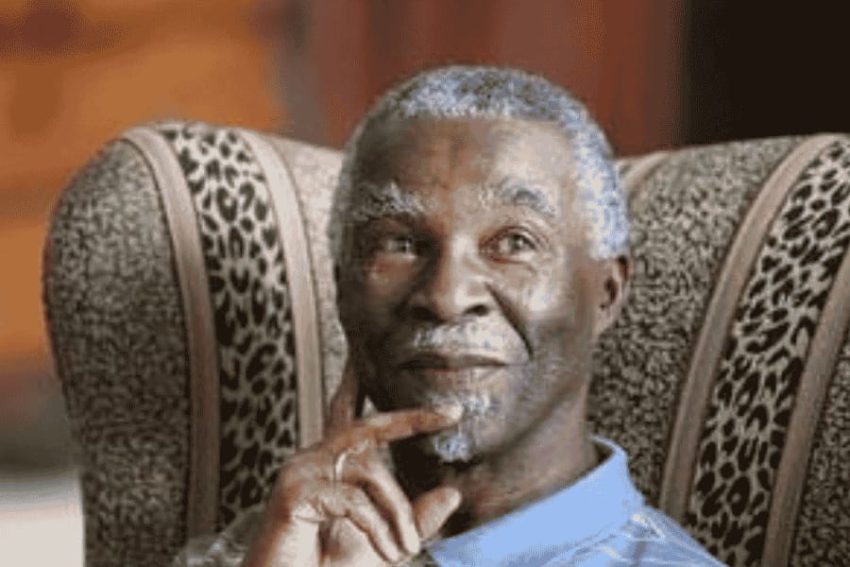
Former President Thabo Mbeki closed the Fourth Cape Town Conversation with a challenge that cut through two days of polished debate and made it clear that discussion alone is no longer enough.
In a valedictory address that started on Monday’s opening themes and ended with a demand for action, Mbeki told delegates gathered by the Thabo Mbeki Foundation and the Observer Research Foundation that the Conversation would be judged not by how well it discussed Africa, India, BRICS, artificial intelligence and global transformation, but by what it said should happen next.
“I don’t have to remind you about various important issues that brought on our agenda,” Mbeki said.
“We discussed Africa and Africa and infrastructure. We discussed the partnership for development on the continent. We discussed importance of Africa India relations and all of that. We discussed BRICS and and future and world transformation, maritime gateway and all of, and of course have artificial intelligence.”
“Not only that we discuss those all of those important, but having discussed them, what then do we do?”
It was the question he returned to repeatedly, with growing impatience.
“Some of you receive a report to say we came down conversation, we discussed all of the things, and then they person asked, having discussed those things, what then they say should happen?” Mbeki said.
“Because there are many pressing problems.”
Mbeki said the Conversation had an excellent agenda and excellent people to address it, but needed an excellent outcome.
“We’ve got an excellent agenda. We’ve got excellent people to address that agenda, but we have an excellent outcome on this last year,” he said.
His proposal was blunt: future Conversations must end each major discussion with a concrete position that can be taken to institutions like the African Union.
“I am suggesting I should look. The exercise that we’ve just gone through now, very correct decision. We must try and answer the same issue. What must change?” Mbeki said.
“What must change?” became the refrain of his address, linking high-level geopolitics to the daily reality of poverty, hunger and inequality.
Mbeki pointed to Cape Town itself as proof that history is still visible in the present. From high ground on a clear day, he said, you can see the patterns of human settlement created by centuries of colonialism and apartheid.
“That legacy accumulated over three and a half centuries. Colonialism apartheid is still disrepolitic to this day,” he said.
“But there is other legacy with you of poverty, of hunger, ill health, education, gender inequality, water and sanitation challenges and all of that.”
“You can’t avoid this confusion. That what I see represents the same parts of the city poverty under crime.”
For Mbeki, that was why the Conversation could not remain an intellectual exercise.
“In the end, colleagues, I think we gather every year, once a year, maybe for the first time now, and I will be able to shift at least. I’m saying these excellent minds that are in this room. Any idea to discuss this? At the end of all of the topics we’re discussing, what we’re about is changing the human condition for the best,” he said.
“It doesn’t matter what we discuss. In the end, that’s what it’s about. That is what we are: is to change this human condition for the better.”
He then turned to the global failure that, in his view, should haunt every such gathering: the Sustainable Development Goals.
Mbeki cited the High Level Political Forum of the UN Economic and Social Council, held in New York in July this year, which reviewed progress towards the 2030 Agenda. Four years from the deadline, he said, the picture was bleak.
“They said we are four years away from benefits. Agenda number one, number two, number three, air quality, number four, education, number five, strength, and six, steam water sanitation,” he said.
He quoted the UN’s 2026 report as saying more than two and a half billion people continue to suffer from hunger.
“The topics were discussing here about through the eradication. You can’t have so many suffering just from hunger means when people go to bed every day when they wake up in the morning behind the corners of their lives on everything,” Mbeki said.
Worse, he said, only a small fraction of SDG targets were on track.
“In reality, the only thing that was certain about is that only 15% of the target set for the SDGs will be achieved,” he said.
And closing that gap would require massive resources.
“What is required in terms of capital that’s required in order to meet this sustainable development goal? It’s $4 trillion a year from now until today. 4 trillion,” Mbeki said.
“But what is it going to come from? What is this brain power concentrated in this room? What we say about should we exercise in our minds about to say we can’t continue the situation where there are human beings in the world to stay in our own extreme poverty.”
Mbeki said the SDGs remained the world’s best blueprint, quoting the UN Under-Secretary-General for Economic and Social Affairs:
“He says The SDGs remain our most effective blueprint for peace, prosperity, and sustainability. The SDGs remain our most effective blue, prosperity, and sustainability. We must eventually turn them to the centre of government.”
“I don’t think anyone of us will convince this day, and perhaps somebody will come and say, ‘No, no, no, no, no! It’s not the SDGs that remain our most effective government of this prosperity, but it’s artificial in that maybe something to say.”
Mbeki said the task of the Cape Town Conversation was now clear and that it had to move beyond discussion towards concrete proposals that could pressure leaders to act.
“I am appealing therefore to our two principals. Our two foundations to say, and then to ourselves. Why do we put this matter on our connection and not give it 45 minutes for discussion,” he said.
“At the end of which the final will stand up and protect it. Give it a little bit more time, so that when we end it with that, we can go back to the UN agnostic and everybody else to say this is what we think about the need to realise targets we serve for our development.”
He linked that demand to every topic discussed, from political corridors and power orders, to US midterm politics, to artificial intelligence, to India-Africa relations and BRICS.
“What is the role of bricks with regard to this matter of realising this most effective blueprint system?” Mbeki asked.
“Has this question ever been posed to Greece? To Korea’s agenda, 2030, all of your member states agreed to it.”
His closing was both a warning and a promise.
“Next year when we meet, and this conversation answers the question. question about what is being done to meet real life agenda. I’m quite certain that millions around the world will stand up and give all of us a standing ovation,” he said.
“Because we did, we we said that melt and exercise our minds. What about our minds about the welfare of billions of people across the globe?”
“I think that’s what must aim to do because that voice may very well that voice may very well be the voice that’s new to shame. shame all of the people who got ways and things, to shame them, encourage them, incite them, whatever, to do what is right, in order to ensure that agenda indicated that was said very consumed in our nations of God. I thank you for coming.”
In his closing remarks, Thabo Mbeki Foundation Chief Operating Officer Lukhanyo Neer said the Fourth Cape Town Conversation had deepened friendship between the people of Africa and India and, more broadly, among the peoples of the South.
Neer reflected on the experiences of South Africa and India over the past year, saying both had faced economic and diplomatic pressure from the present US administration, including punitive tariffs, and that the message had been that countries of the South may exercise sovereignty only within limits determined elsewhere.
He invoked Mwalimu Julius Nyerere’s description of the Group of 77 as a trade union of the poor, and asked whether the response of other members to the difficulties facing South Africa and India had been largely silence, as each sought its own accommodation with Washington.
“How we answer these questions will determine whether the trade union of the poor remains an aspiration or becomes a reality,” Neer said.
He added: “Perhaps the greatest tribute we could pay to Mwalimu Nyerere would be to ensure that another generation of Africans and Indians, forty years hence, will not have occasion to gather to ask why we failed to act upon the very questions to which we have devoted so much of our attention.”