
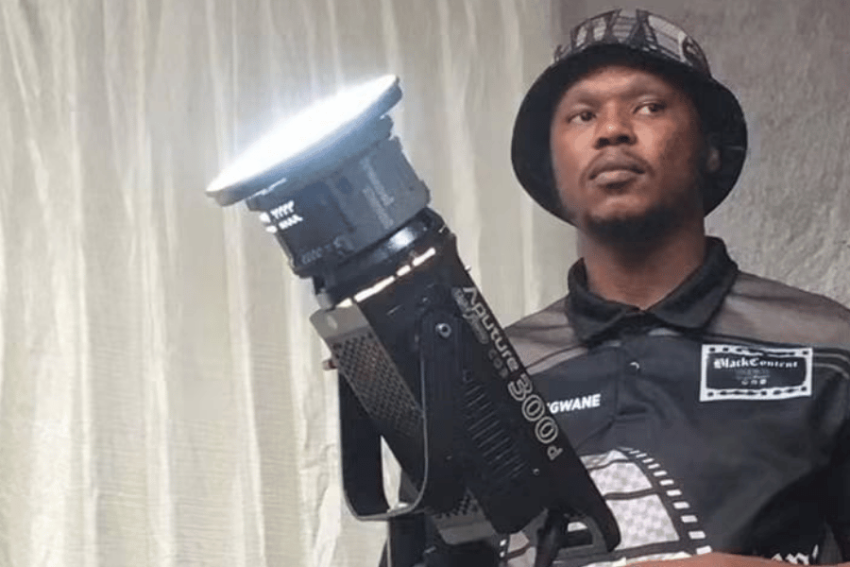
A Gauteng Legislature sitting descended into shouting and near-blows on Friday, when a filmmaker had to be physically restrained by fellow filmmakers as he advanced on a Gauteng Film Commission official who had accused the sector of making claims that were not factual.
The flare-up came at the end of a four-hour roundtable that had already turned hostile before it began, after the MEC responsible for the sector failed to arrive and the commission told filmmakers it could not disclose who had received public money.
Lungisani Mthethwa was pulled back by colleagues, who held him and urged him to calm down, as the room rose to its feet and the chairperson struggled to restore order.
“Can I be protected, Chair?” asked GFC official Mak Magoba, who had opened the commission’s response by warning against “allegations that are not factual”.
Magoba later withdrew the remark. “I do take those comments back. I wanted to emphasise the need for factual communication,” he said.
The Gauteng Sport, Arts, Culture and Recreation Portfolio Committee had called the session at the Birchwood Hotel and OR Tambo Conference Centre, a venue chairperson Disego Tlebere formally declared a precinct of the provincial legislature at the start of proceedings, to hear directly from people trained by the GFC.
Education and Sport, Arts, Culture and Recreation MEC Lebogang Maile was scheduled to present but he never came.
Tlebere told the room Maile had tendered an apology because the roundtable clashed with the Education portfolio committee, which had summoned him the same morning to deal with the Department of Education’s first quarter report.
Because Maile holds both portfolios, and because the legislature groups education and sport, arts and culture in the same cluster and sits them on the same day, the two meetings collided.
“The apology that we received from the MEC is that our meetings have clashed. Not that he has deliberately stayed away from this meeting. It’s just a misunderstanding on convening these meetings,” said Tlebere.
The explanation did not hold the room.
“We’re not being taken seriously as filmmakers. We don’t want rhetoric. I’m not scared of Lebogang, and he must stop making excuses. The house is burning. You are not doing us a favour,” said filmmaker Albert Ndlovu.
Another filmmaker issued an ultimatum: “There’s no excuse we are going to take. Call the MEC to come here in person, otherwise this meeting is not happening.”
Tlebere refused to halt proceedings, offering instead to have the head of department ask Maile to come after his other meeting. Committee member Nomthandazo Meso of the MK Party sided with the stakeholders.
“The previous MEC was undermining this committee. This current MEC must not continue with undermining this committee,” Meso said.
“The HOD must call the MEC. He’s not going to be in that meeting for the whole day. Soon as he’s done with that meeting, he must come here and account to this stakeholder,” she said.
Maile did not arrive at any point.
The GFC pressed ahead with its own evaluation of its 2025/26 skills programmes. GFC official Kamogelo Serage told the committee the commission had supported 13 programmes last year, five accredited programmes reaching 74 learners, and eight non-accredited master classes reaching 691 people, for a total of 765 beneficiaries.
On employment, the numbers were considerably smaller. Serage reported that five of eight learners on the Film and Television Training for Basadi programme had secured a ten-month placement, a 62.5% rate for that programme, and five people out of the 74 learners who went through accredited training.
A further eight interns were placed with a visual effects studio on a six-month internship aimed at permanent absorption.
“The primary goal of the accredited programmes is to lead to formal employment, while the non-accredited trainings usually focus on upskilling as well as networking,” Serage said.
For the remaining four accredited programmes, she said: “it’s not necessarily direct pathways to employment.”
In her conclusion, she said: “The GFC’s programmes are indeed making a meaningful contribution to employment, entrepreneurship, as well as career development in Gauteng.”
The evaluation’s recommendations, Serage confirmed, came from the service providers the commission had paid to run the training.
GFC official Nthabeleng Phora presented a 2026/27 Industry Support and Development budget of R14,237,000.
According to Phora, accredited training accounts for R950,000 of that and non-accredited training R525,000. Together that is about a tenth of the programme budget. Initiatives showcasing regional film get R2.145 million, more than both forms of training combined.
“We really do not have funds, colleagues, as we wish. We need to service the whole of Gauteng with fourteen million,” said Phora.
Filmmakers rejected the framing, pointing out that the figure covers one programme area rather than the commission’s full allocation.
“GFC is working with a budget of R50 million, but today they are telling us about R14 million. Where is the entire budget? GFC is not an events company but a film organisation,” fumed Mthethwa.
He further challenged the commission on its founding purpose. “We must remember that entities like the GFC were established to redress the imbalance that was created by apartheid. But until this day, we’re still poor,” he said.
Magoba eventually answered the budget question. “The call is forty-one percent. The rest goes to administration and also professional services,” he said.
Asked to disclose which companies had been funded and for how much, Magoba cited the Protection of Personal Information Act. The commission had given the legislature its lists of applicants, beneficiaries and participants, including contact numbers, he said, but could not release that to third parties.
Mpho Ntlatleng, founder of OL Afrika Media, which ran the commission’s Visual Effects Laboratory for 32 learners, told the meeting she had twice been instructed he could not train fewer than 30 people, while the commission’s own slide showed four other accredited providers training between eight and 13 learners each.
“Why do we have different conditions? That is four times what I had to train with the same budget. I’d like to find out how much they got funded,” he asked.
Magoba confirmed the funding history Ntlatleng described. “We had intended to increase the budget to one eighty. However, due to the budget that was allocated, we then had to regress and say we are only able to fund up to a hundred and fifty thousand per accredited programme,” said Magoba.
He said the commission had stopped specifying learner numbers, citing budget constraints “and also a high level of dropouts”, an acknowledgement that sits awkwardly against the evaluation’s completion figures.
Head of department Mpho Nawa acknowledged the breakdown, telling the meeting the department’s own budget was stagnant and that it had approached Treasury for an increase in the adjustment budget.
“How do we spread the cake across the entire province, so that it’s not only one group that gets the money? So that we deal with the perception of what they call favouritism, we fund the ones that we like. I don’t think we should be perceived that way,” he said.
On the commission’s high rate of compliance-based rejections, he said: “If people can’t comply, you don’t reject them on the basis of compliance and say, come back another day. You also see how you help them comply. That becomes developmental.”
Closing the session, Meso committed the committee to four things. The next meeting will be with the department rather than stakeholders to report on whether the HOD has met filmmakers. The committee will demand the beneficiary information Magoba declined to release publicly. It will consider a recommendation concerning an individual named repeatedly during the session and it will report back to filmmakers on how the issues were resolved.
“Departments must stop treating people like they are nobodies. Don’t be angry at the people when they are knocking at your doors,” said Meso.