
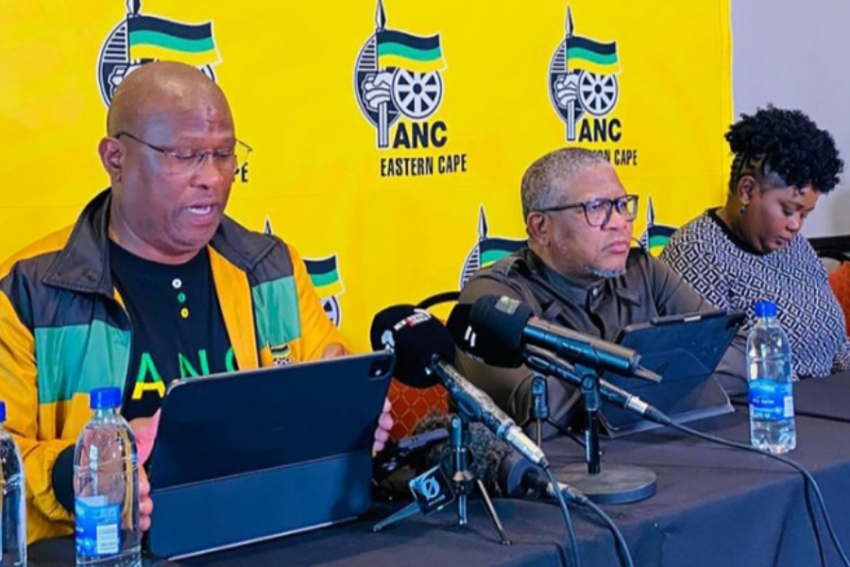
ANC secretary-general Fikile Mbalula says the governing party is dealing with a ‘very powerful force’ in the Eastern Cape as it battles a series of legal challenges over the province’s internal political processes.
Mbalula made the admission on Tuesday as the ANC convened a special extended National Executive Committee (NEC) meeting to consider and approve its candidate lists for the 2026 Local Government Elections.
His comments come amid continued uncertainty over the ANC’s organisational processes in the Eastern Cape, where litigation has affected the party’s ability to finalise some of its internal structures.
Mbalula said the party was dealing with a “determined force” in the province, with the conflict increasingly playing itself out through the courts.
“We are very clear now, we are dealing with a determined force in the Eastern Cape that is beyond us,” Mbalula said.
“And it is manifesting itself through the litigation process.”
He said the ANC would respond to the legal challenges as and when they arose, but was reluctant to provide further details because of the ongoing court proceedings.
“Anything that you say may be used against us in a court of law,” Mbalula said.
The ANC recently reinstated its Eastern Cape provincial executive committee (PEC), a development that has raised questions about the duration and purpose of the structure given the party’s ongoing internal disputes in the province.
Mbalula said the party would ideally not still be debating the existence of the PEC.
“In terms of our wishes and our plans, we shouldn’t be arguing about whether the PEC exists or not,” he said.
“We should be having a provincial conference and done and dusted, but we have to confront a rigorous, aggressive litigation in the province and we’ll leave it there.”
The ANC secretary-general said the party had been involved in litigation relating to both its provincial conference and the establishment of its provincial task team (PTT).
The ANC suffered its second blow after the Makhanda High Court recently dismissed the party’s application for leave to appeal, cementing the nullification of the party’s PTT and leaving the provincial structure leaderless.
Judge Vuyokazi Noncembu dismissed the ANC’s appeal with costs, finding that the party attempted to introduce new arguments not raised in the original case.
The initial June 2026 ruling declared the appointment of the 40-member PTT installed by Mbalula after the previous PEC term lapsed unconstitutional, unlawful, and in violation of the party’s own constitution.
Essentially, all decisions made by the PTT were rendered invalid, and its members (including convener and Eastern Cape Premier Oscar Mabuyane) were interdicted from acting as the province’s leadership or representing it in ANC activities.
The ongoing legal battles stem from failed elective conferences and delayed branch processes, representing a major political blow to the national and provincial leadership.
“We are in court on the matter of the conference,” Mbalula said.
“We have been in court about the establishment of the PTT.”
He said these legal challenges had directly affected the organisational processes the ANC had followed in determining the existence and functioning of its structures in the province.
Mbalula also complained that correspondence relating to the disputes was being circulated on social media before reaching the ANC formally.
“As I’m seated here, there are letters that they write to me and then they circulate in the social media,” he said.
“I no longer get these letters through the box mail of the ANC. I get them through the WhatsApp groups.”
He said some of the correspondence contained threats of interdicts and other legal action.
“They circulate them and then they are threatening interdict and many other things that they do,” Mbalula said.
Despite the challenges, he insisted the ANC was prepared to defend its organisational processes through the courts.
“We are ready to answer all the issues that they are raising in terms of the processes of the ANC in the Eastern Cape,” he said.
Mbalula said the party could not blame the courts for the situation and would instead have to confront the legal challenges within the framework of the rule of law.
“In this instance we can’t blame the courts,” he said.
“We’ve got to deal with it as it comes and therefore our belief in the courts and the rule of law is what is critical in terms of the ANC representing itself and itself well and responding to the challenge that is being presented to us through litigation.”
His comments come as the ANC prepares for the 2026 Local Government Elections, with the party attempting to finalise candidate lists while navigating organisational disputes in several provinces.
The Eastern Cape remains particularly significant for the ANC given its longstanding political support in the province and the importance of the province to the party’s electoral fortunes.
Mbalula, however, suggested that the current dispute went beyond an ordinary internal ANC disagreement.