
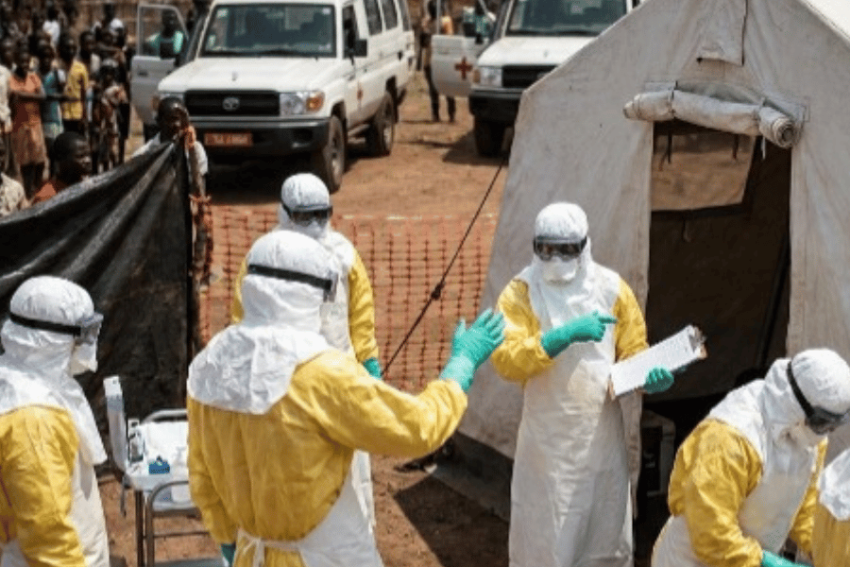
The Democratic Republic of Congo’s latest Ebola outbreak has entered a more dangerous phase, with transmission continuing to expand while health authorities confront a virus for which there is currently no approved vaccine or specific treatment.
The latest figures show the scale of the crisis.
According to data reported by the DRC on 27 August, the outbreak had reached 5,794 confirmed cases and 2,786 deaths by 26 August, an increase of 81 confirmed cases and 42 deaths on the previous reporting period.
The outbreak has now spread across 60 health zones, after two more Biena and Manguredjipa, both in North Kivu were added to the list this week.
Congo’s Ministry of Health data shows the case fatality rate in those two newly affected zones is significantly higher than the overall outbreak rate of roughly 48%, partly because of delays in the response reaching them.
The World Health Organization has described the outbreak as the fastest-growing Ebola event on record, and has warned it is on track to surpass the 2014–2016 West Africa epidemic the deadliest in history, which killed more than 11,000 people.
But the case count alone does not explain why health authorities are struggling to bring the outbreak under control.
This outbreak is caused by Bundibugyo virus, a species of Ebola that presents a fundamentally different public-health challenge from the Zaire strain responsible for previous major Ebola epidemics.
The DRC has now begun vaccinating frontline healthcare workers, but the vaccine being deployed, Ervebo, is not specifically approved for the virus driving the current outbreak.
South Africa’s National Institute for Communicable Diseases states plainly that, unlike outbreaks caused by Zaire ebolavirus, there are currently no approved vaccines or specific therapeutics for Bundibugyo virus disease.
The US Centers for Disease Control and Prevention similarly notes that Ervebo is indicated for a different Ebola species and is not expected, based on available evidence, to protect against Bundibugyo virus.
This does not mean the vaccination campaign is pointless. Rather, it illustrates the extraordinary difficulty facing health authorities, they are attempting to use an existing Ebola countermeasure in an emergency involving a different virus species, while clinical trials of vaccines specifically targeting Bundibugyo continue.
The World Health Organization and Africa CDC backed the DRC government’s decision to deploy Ervebo after the country requested access to doses from the global Ebola vaccine stockpile.
The deployment therefore represents a race against time protecting health workers while scientists and authorities work to establish how effective the vaccine may be against this particular outbreak.
The European Centre for Disease Prevention and Control has reported hundreds of patients hospitalised in isolation, with the large majority of identified contacts under follow-up in affected provinces.
The trajectory over the past fortnight illustrates how quickly the situation has changed.
On 12 August, the WHO’s cumulative total stood at 4,665 confirmed cases and 2,184 deaths.
By 26 August, the DRC was reporting 5,794 confirmed cases and 2,786 deaths, an increase of more than 1,100 confirmed cases and around 600 deaths in roughly two weeks.
That trajectory is what worries public-health officials.
The outbreak is unfolding across a vast and difficult environment where insecurity, displacement, mobility and weaknesses in healthcare access all complicate the identification and isolation of cases.
The WHO has warned that the response is struggling to keep pace with transmission.
The Ebola outbreak is not occurring in a vacuum. It is concentrated in eastern DRC, an area that has endured years of armed conflict, displacement and instability, an unusual challenge for disease-control teams.
Tracing people who have been in contact with infected patients becomes harder when communities are displaced or moving frequently because of insecurity.
Healthcare facilities can also become difficult to access, while strikes or shortages among health workers further weaken the response, a factor already cited as one reason the newly affected North Kivu zones are recording higher fatality rates.
The result is a vicious cycle, the harder it becomes to reach communities, the harder it becomes to detect cases early, and the later cases are detected, the greater the opportunity for transmission.
When people distrust health authorities, even the most sophisticated outbreak response can struggle.
The WHO has stressed the importance of community engagement and trust-building in the response, while health officials on the ground have described community resistance and mistrust as major obstacles.
This is one of the reasons Ebola outbreaks cannot be defeated simply by sending more medical supplies, the response has to convince people to seek care, accept contact tracing, cooperate with infection-control measures and allow safe and dignified burials.
For South Africa and the wider region, the outbreak is worth watching, but without creating unnecessary alarm.
There is currently no evidence that South Africa is experiencing an Ebola outbreak.
The NICD has been monitoring the situation, and earlier assessments indicated that the risk of widespread transmission in South Africa was low.
The more immediate regional concern is the movement of people across borders surrounding the affected parts of the DRC.