
‘South Africans are not divided on what is wrong in the country, but that they are divided on what to do about it.’
Forrest Gump’s box of chocolates adage – “You never know what you’re gonna get” – has become a part of popular culture’s metaphor for decades. However, when it serves up sour grapes, half-baked promises and political jousting, South Africans have had their fill for three decades.
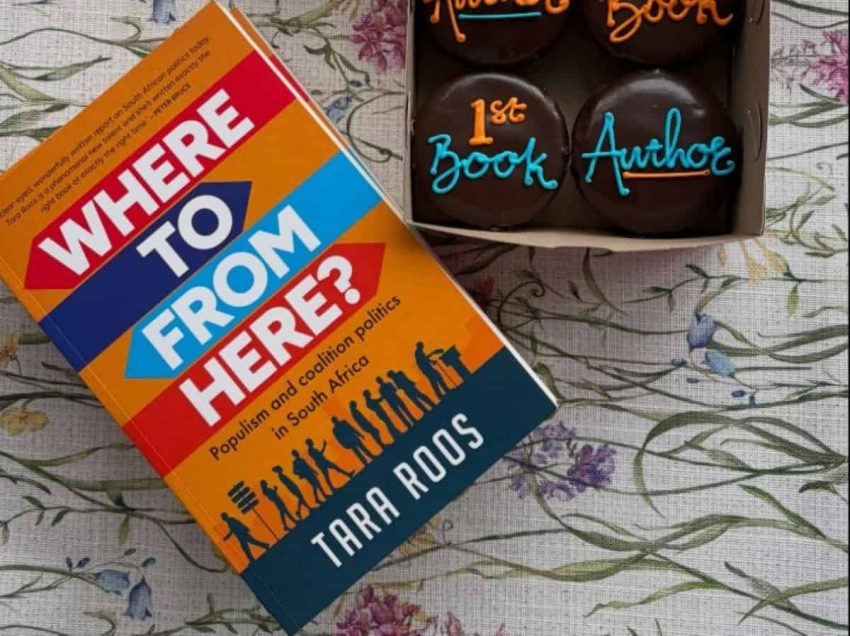
Political analysts agree that coalitions are on the cards for the country’s foreseeable future, and author and journalist Tara Roos’ debut book, Where To From Here, deals with this new reality. It unpacks the box of chocolates and shares which ones are past their sell-by date and which party’s filling tastes better for now.
It’s been five years since coalitions entered the fray, and the sustained presence of potholes and poor service delivery in cities like Joburg tells the rest of the rot. Roos examines it all with biting observations.
Politics, identity and policy
Politics, she says, is no longer only about policy but also about identity and consolidation. She cited the coloured vote in the Western Cape and Afrikaner voters edging toward the Freedom Front Plus as examples of blocs being actively organised and targeted.
She also observes that it’s becoming less about political ideology and more about opportunity in a fragmented environment playing out within a system not designed for it. Coalition politics landed without a form of governance beyond being reliant on negotiation rather than structure.
“The constitution is not set up for coalition governments,” she says.
There’s a framework that allows coalitions to exist, but offers little guidance on how they should function. The result is a political environment where deals are struck after votes are cast, leaving voters to reconcile their choices with outcomes shaped behind closed doors. It is this uncertainty that has turned coalition politics into a contest that feels less like governance and more like an ongoing negotiation and chamber fracas.
Roos, drilling deeper, added that the problem is not that South Africans are divided on what is wrong in the country, but that they are divided on what to do about it.
“Everyone is worried about crime, everyone is worried about the state of the economy, everyone is very worried about issues like gender-based violence, the cost of living,” she says. Agreement, she adds, breaks down when it comes to seeking solutions.
“We don’t know how to solve these issues together and that’s where the divergence is,” she says.
Parties offer answers
There’s also another political segue playing out. Roos says parties that speak directly to the electorate’s frustration are gaining traction because they offer answers, even if those answers are contested.
“You see that particularly because parties like the Patriotic Alliance picked up almost essentially all the Good party’s coloured-bloc votes, because Gayton McKenzie tackles issues head-on. It’s made Patricia de Lille’s party obsolete,” she says.
Roos added that similar patterns are visible elsewhere.
“The Freedom Front is also moving in that direction and they’re really capitalising on Afrikaner frustration,” she said.
“There is a significant measure of populism in politics these days.”
Roos bundles other smaller parties like ActionSA into the same silo. They may be kingmakers, but will continue on the fringe.
DA’s messaging
Then there is the DA and the upcoming municipal elections.
“They have not been able to crack Joburg and they have not been able to crack Gauteng,” she says, adding that extending its reach remains one of the party’s biggest structural challenges. The problem, she says, is not only performance but communication.
“The DA does have a really big issue in terms of messaging,” she says, adding that positions such as scrapping B-BBEE without a clear alternative leave voters unconvinced. The Helen Zille factor, now front and centre and very visible in Johannesburg, is, in her view, as much a signal of party desperation as it is a strategy.
“She is likely to bring out the most votes in Joburg,” Roos says, but adds that it may not be enough in a coalition environment where alliances determine outcomes.
“The reality is that the DA is not much liked by other political parties and a measure of animosity will not gain Zille enough support to make up for the 50 plus one requirement,” she said.
Where To From Here is ‘real’
Where To From Here builds on this ongoing political tension. Roos started writing it a few years ago without the certainty that it would be published.
“I started writing this book with the intention to offer something different from the standard political playbook. I thought I had a fresh perspective to share and I had something to say,” she says.
“If nothing else, I am extremely real in this book,” she says.
It draws on her experience across research, a stint in parliament and political journalism. She says it aims to capture the political moment without softening its edges.
“I think the book provides very useful insights into where we are going as a country.”