
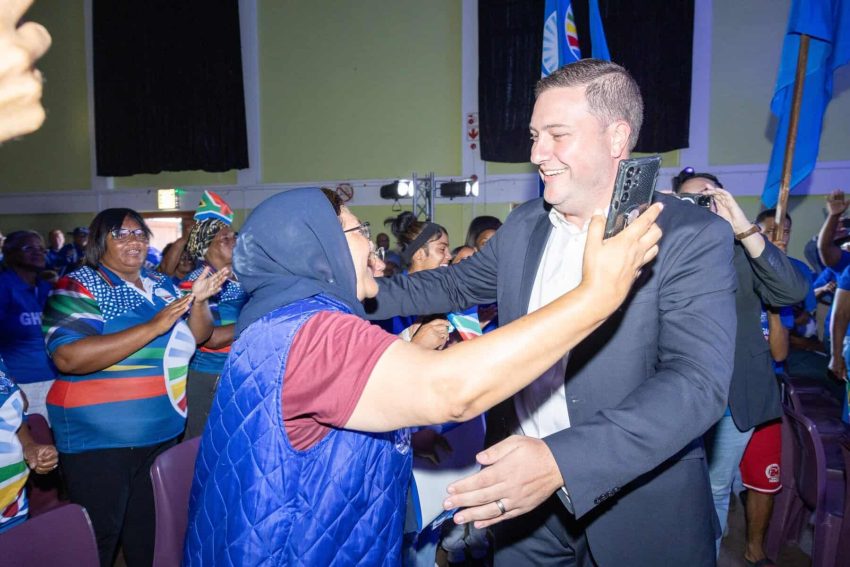
Geordin Hill-Lewis says the DA must win over disillusioned ANC voters to become the country’s largest party.
The DA will have a new leader when party delegates cast their ballots at its federal congress in Joburg on Monday.
Cape Town mayor Geordin Hill-Lewis is the frontrunner and, should he be elected, his plan is simple: growth – and he wants a mandate to pursue that.
Hill-Lewis seeks mandate for expansion
“I am explicitly seeking a growth mandate If we want the DA to be the largest party in the governing coalition in the next election, we have to grow. That’s just simple electoral maths,” he said.
The leadership contest comes at a significant moment for the party, following a recovery under outgoing leader John Steenhuisen.
This includes its recovery at the ballot in 2021, its growth trajectory sustained through to 2024 and its entry into the government of national unity (GNU).
As leader, he would work towards expanding the party’s support base so that it can continue to play a leading role in SA’s political future, Hill-Lewis said.
Targeting disillusioned ANC voters
This growth would not come from within the party’s existing voter base, but from voters who have moved away from the ANC.
“That means growing among mainly former ANC voters who are completely disillusioned with that party and who are not going to vote for it again.”
His longer-term objective is to position the DA as the largest party in the country by 2029. The Cape Town mayor said he was confident in the party’s ability to translate that ramp-up into governance outcomes, starting at the next election – particularly in urban centres that have faced persistent service delivery and administrative challenges.
“We have some great candidates in the big cities. I’m very confident every one of them will be superb mayors of those cities and will begin to turn around those cities.”
Competition from smaller parties acknowledged
But Hill-Lewis also acknowledged the competitive pressures the party continues to face, particularly from smaller opposition parties seeking to carve out support from the DA’s voter base.
These parties often target DA voters as a starting point for their own growth, rather than directly contesting ANC support, but the DA’s focus remains on a broader strategic objective, he said.
Central to that strategy is addressing what he said was a persistent gap between public perception and electoral behaviour.
“Survey after survey, poll after poll, confirms the huge majority of people see the DA as the best party of government. So we have a trust deficit because they’re not yet choosing to vote for us.”
Closing that gap would require more than messaging, Hill-Lewis said. It would depend on sustained presence in communities and a more deliberate alignment with the issues that matter to voters the party is seeking to attract.
“We’ve got to close that trust deficit by being present, by thinking carefully and being strategic about the issues that we want to be vocal on, making sure that those are issues that those South Africans care about and that they know we care about those issues.”
Despite pre-federal congress competitiveness, the DA was in a comparatively stable and prepared position as it looks ahead to upcoming electoral contests, he said.
The party had made progress in fundraising to support its campaign efforts and had assembled a strong slate of candidates in key metropolitan areas.
“The health and readiness of the DA is good. We’ve done well in raising funds to resource the election campaign.”
Steenhuisen credited with stabilising the party
He credited outgoing leader John Steenhuisen with steadying the party during a period of internal and electoral uncertainty.
“The party was in a very difficult spot when he took over. We had just had a bad election. Our leader had left the party. He stabilised the ship. He returned us to growth,” Hill-Lewis said.
Steenhuisen’s role in negotiating the DA into government as part of the GNU was a defining development in the party’s history.
“He negotiated us into the corridors of national government power for the first time in our history and prevented what he accurately described as the doomsday coalition from taking power in South Africa,” Hill-Lewis said.
Support Local Journalism
Add The Citizen as a Preferred Source on Google and follow us on Google News to see more of our trusted reporting in Google News and Top Stories.