
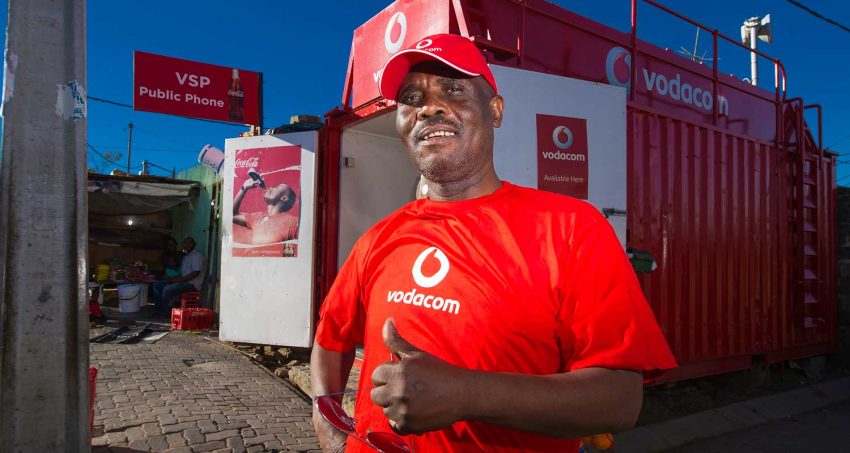
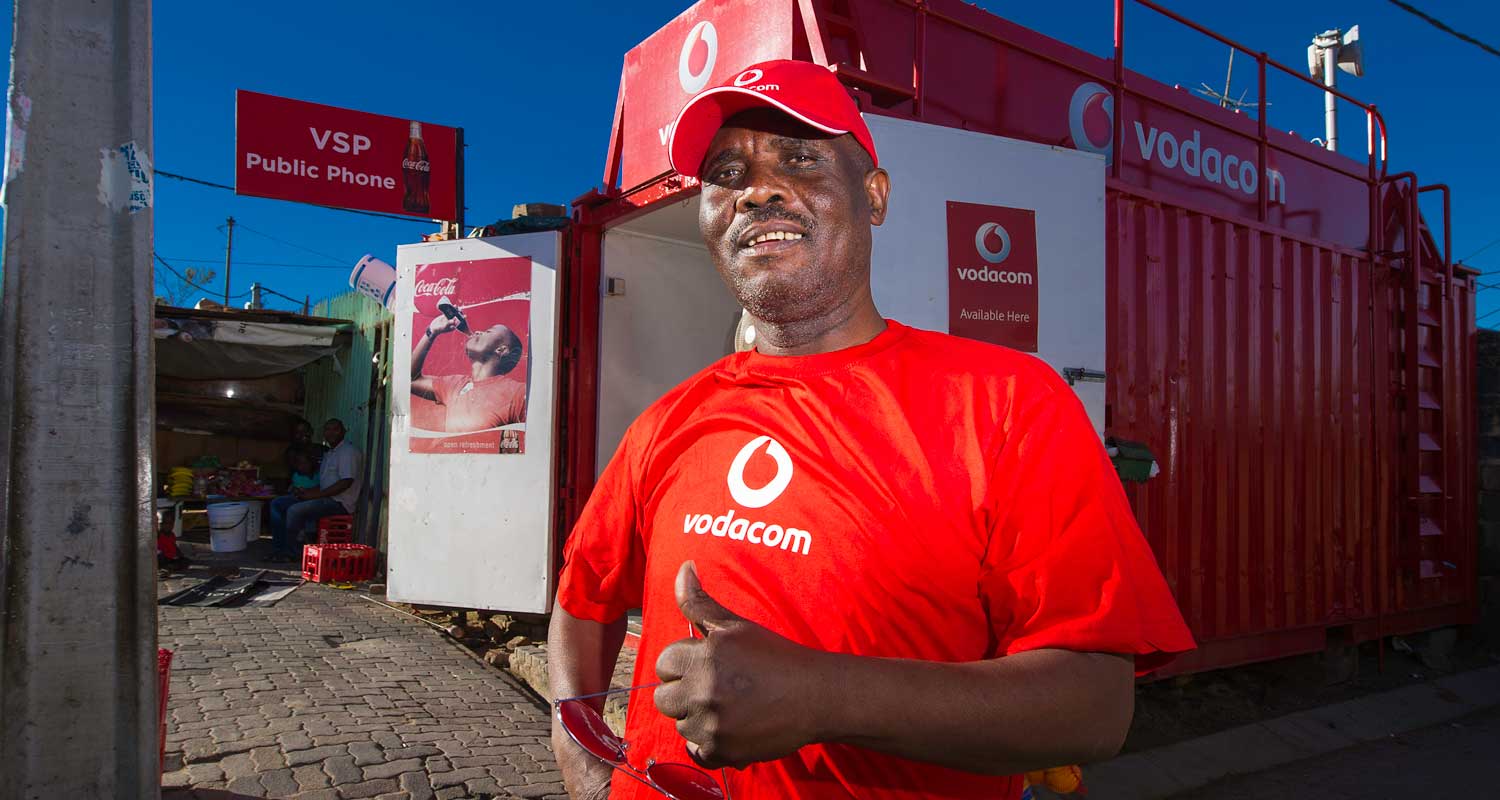
For years, Vodacom Group was viewed primarily as a telecommunications operator with an interesting side business in mobile money. That framing no longer holds: the numbers in its latest quarterly trading update show that fintech is not just a growth engine, it is becoming central to the group’s identity.
Over the past 12 months, Vodacom’s mobile money platforms processed US$500.7-billion (R8-trillion) in transaction value, a scale that rivals established global payments networks. Including Safaricom, Vodacom now serves more than 100 million financial services customers across its footprint.
Those figures — and equally impressive ones from rival MTN Group — did not emerge from a sudden strategic pivot. Vodacom59’s fintech business grew large because it evolved from structural realities in African markets.
The origins of Vodacom’s fintech scale lie in the gap between mobile penetration and banking access across much of Africa. In markets where traditional banking was expensive, distant or inaccessible, mobile operators already had something banks did not: national distribution, prepaid billing relationships and ubiquitous retail presence.
The breakthrough came not from Vodacom itself but from Safaricom, whose M-Pesa service in Kenya proved that mobile wallets could become everyday financial infrastructure. What began as a simple peer-to-peer transfer tool evolved into a system used for salaries, school fees, rent, utilities and in-store payments.
Vodacom’s role was to recognise that this was not a Kenyan anomaly but a replicable model – provided it was executed at scale, with regulatory buy-in and deep local integration.
Safaricom
Safaricom remains the single most important asset in Vodacom’s fintech story. Its performance continues to anchor the group’s financial services growth, and Vodacom’s decision to increase its stake to 55%, subject to regulatory approvals, underscores how central the business has become.
This is not simply about consolidating earnings. Control over Safaricom gives Vodacom operational leverage over product design, platform architecture and regional expansion – particularly into high-growth markets such as Ethiopia. The Safaricom platform has become a blueprint: once a market reaches sufficient scale, fintech usage begins to compound rather than grow linearly.
Read: Paystack COO: solving interoperability is key to Africa’s fintech future
Across its markets, mobile money platforms have expanded well beyond person-to-person transfers into merchant payments, lending, savings products, insurance, airtime and data integration, and sector-specific offerings such as fuel loans and communal savings schemes. Each new service increases wallet stickiness and transaction frequency.
In Egypt, for example, Vodafone Cash helped drive a 59.4% surge in financial services revenue during the quarter, supported by a nearly 29% increase in active customers. Egypt alone now contributes 27.5% of Vodacom’s group service revenue, underlining how fintech and connectivity have become mutually reinforcing.
The contrast between South Africa and the rest of Vodacom’s footprint is instructive. South Africa is a highly banked market with mature payments infrastructure, leaving limited room for explosive fintech growth. As a result, Vodacom’s domestic mobile business is increasingly defensive, supported by contract segment growth and “beyond mobile” services rather than volume expansion.
Elsewhere in Africa, fintech addresses structural gaps. In many markets, mobile wallets are not competing with banks – they are substituting for them. That reality explains why Vodacom’s international service revenue grew 12.6%, with normalised growth accelerating to 15.4%, while financial services revenue surged far faster.
In effect, Vodacom’s fintech success is both a growth story and a commentary on South Africa’s economic maturity.
Vodacom’s fintech scale is also hard to replicate. The group benefits from several reinforcing advantages: national network infrastructure, deep regulatory engagement, trusted brands, extensive agent networks and millions of embedded Sim-wallet relationships. Once merchants, consumers and governments rely on the same platform, switching costs rise sharply.
This is why fintech has become such a durable engine for the group. New entrants can launch wallets, but replicating national-scale payments rails tied into connectivity, identity and distribution is far more difficult.
Vodacom is still seen as a telecoms group, but the numbers increasingly tell a different story. Financial services are growing faster than connectivity, processing volumes measured in hundreds of billions of dollars and expanding across multiple markets simultaneously.
MoMo
As Safaricom is consolidated and fintech products continue to deepen, Vodacom’s future growth is likely to depend less on spectrum, towers and tariffs, and more on transactions, platforms and financial inclusion.
Of course, Vodacom is not alone in demonstrating the scale mobile money can achieve in Africa. MTN Group has built one of the continent’s largest mobile financial services platforms through its MoMo ecosystem, operating across more than a dozen markets.
MTN’s mobile money business has grown rapidly over the past decade by leveraging its large subscriber base, deep agent networks and early investments in interoperability, allowing customers to transact across borders and between wallets and banks.
Read: Vodacom leans on Africa growth as SA remains under pressure
In markets where traditional banking penetration remains limited, mobile operators have been able to evolve into systemically important financial intermediaries. By expanding beyond basic transfers into merchant payments, lending, savings and insurance, MTN has shown – much like Vodacom – that fintech in Africa is no longer an adjunct to connectivity, but a standalone growth engine with meaningful economic impact. – © 2026 NewsCentral Media
Get breaking news from TechCentral on WhatsApp. Sign up here.