


Uber has pledged R5-billion in investment in South Africa over the next three years, but the ride-hailing giant has acknowledged that the commitment is a mix of previously planned spending and genuinely new investment.
The pledge, announced at the South African Investment Conference on Tuesday, follows a pattern of corporate commitments at the annual event that critics say often repackage existing capital expenditure plans as fresh investment.
Deepesh Thomas, Uber’s GM for sub-Saharan Africa, told TechCentral in an interview that the pledge covers electric vehicle fleet expansion, charging infrastructure, merchant hardware and initiatives to create new earnings opportunities on the platform.
He said new verticals – including the push into township economies through Uber Eats and the roll-out of Uber Go Electric – require incremental investment, but acknowledged the total figure includes spending already in the pipeline.
The timing of the pledge is notable. Uber is actively lobbying government for regulatory relief on e-hailing licensing – and Thomas made no secret of the fact that the investment announcement is designed in part to strengthen its hand.
“We’re asking for further support and engagement with the regulators and the national transport ministry to work towards collaborative regulations,” Thomas said.
He stopped short of calling the investment contingent on a favourable regulatory outcome, but it’s clear the company hopes to get greater support from government as it ramps up its investment in the country.
Awkward position
Thomas said Uber’s core message to government is that over-regulation or regulation “that’s not relevant to innovation and technology” risks undermining the company’s economic contribution. “Let’s work together to get actual smart regulations that make sense, as opposed to regulating without understanding the clear practicalities on the ground.”
The pledge comes as Uber finds itself in an awkward position: it remains unlicensed under South Africa’s amended National Land Transport Act, despite a compliance deadline that passed on 11 March.
Read: Uber eyeing electric bike rides in South Africa
Thomas said Uber applied for its e-hailing platform licence in December, but that the process remains incomplete. Competitors Bolt and Wanatu have already received their licences.
“We believe our licence will be issued imminently, and there have been no challenges from the regulator on this specifically,” Thomas said.
The regulatory framework underpinning the licensing process is the National Land Transport Amendment Act, which came into force on 12 September 2025 after being gazetted in June 2024.
The amended act requires all e-hailing platforms to be registered and imposes new obligations including mandatory vehicle branding, the installation of panic buttons for both drivers and passengers, and geo-restrictions that confine drivers to designated jurisdictions. App developers who permit unlicensed users to operate on their platforms face fines of up to R100 000 or two years in jail.
The new rules were introduced partly in response to a wave of attacks – some fatal – on e-hailing drivers by metered taxi operators who accused them of not being subject to the same regulatory requirements.
All e-hailing drivers who obtained operating licences before the act came into force must apply to convert them within 180 days, and the relevant regulatory entity must communicate a decision within 60 days of receiving a conversion application. It is this administrative machinery that Thomas said has historically struggled to cope with the volume of applications.
But the bigger concern, he said, lies in what happens after the platform licence is granted. Individual drivers must then obtain their own operating licences – and Thomas worries the process may not cope with demand. Thomas said tens of thousands of drivers have applied in the past, but only thousands have been issued licences.
In certain cities, caps on operating licences are suppressing investment because third parties are reluctant to finance vehicles that may face impoundment. Thomas said Uber has established a technical task force with the National Public Transport Regulator and the department of transport to work through the practical challenges.
“A lot of questions are coming through from the industry: what does this mean? If I get stopped by a policeman, will my car get taken away? Am I able to work?” Thomas said.
Uber Go Electric
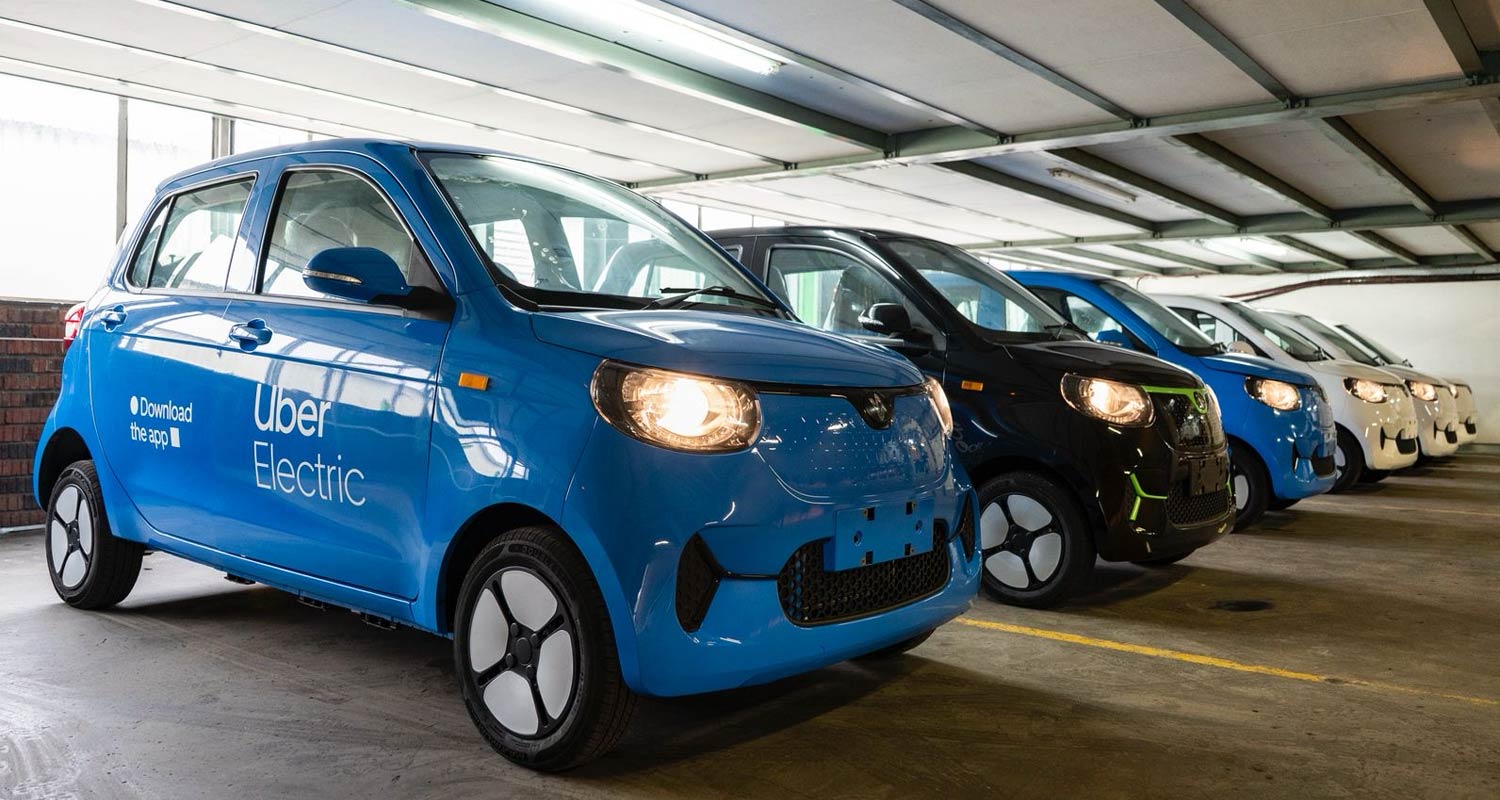
A portion of the R5-billion pledge is earmarked for the expansion of Uber Go Electric, the company’s low-cost electric vehicle service.
Uber has more than 120 EVs on the road in Johannesburg, concentrated in the Sandton-Rosebank corridor, and Thomas said demand has significantly outstripped supply in the four months since launch. A new batch of vehicles landed last week and the company is expanding into additional corridors monthly as charging infrastructure becomes available.
Uber’s two-wheel courier delivery fleet is already fully electric, and the company has a global target of zero emissions by 2040.
Read: The sweeping changes coming to e-hailing in South Africa
“We’re seeing really positive demand-side impact, and we’re pushing quite hard to scale this,” Thomas said.
Thomas said Uber remains “very bullish” about South Africa and sub-Saharan Africa. – © 2026 NewsCentral Media
Get breaking news from TechCentral on WhatsApp. Sign up here.