
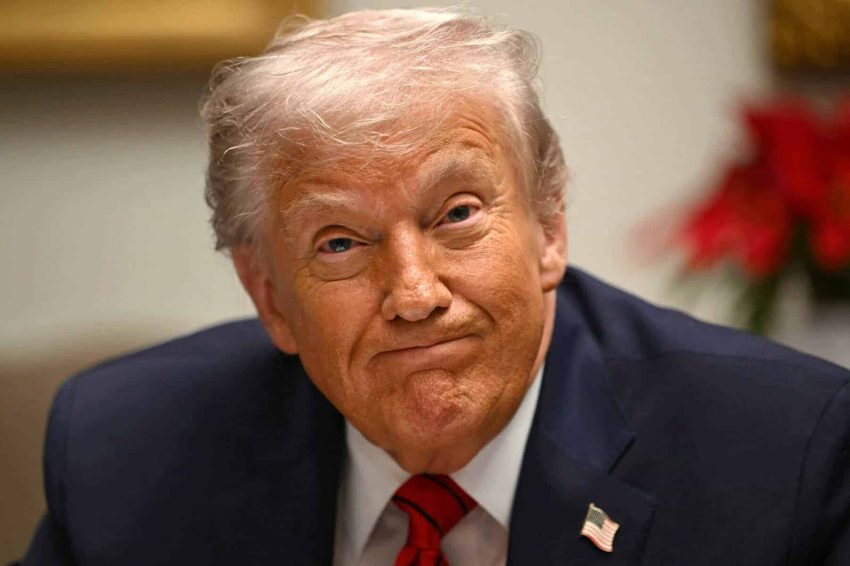
South Africa and the U.S heave heard a turbulent relationship since Donald Trump became president again.
US President Donald Trump is not going to accept the zero-duty trade agreement between South Africa and China, and President Cyril Ramaphosa must expect another tongue-lashing from the White House, says an expert who believes, however, that Trump is behind the world running into China’s open arms.
ALSO READ: King Dalindyebo denies ATM leader’s alleged influence in his trip to Israel
Expert weighs in on deal
North West University’s international relations expert, Dr Jan Venter, said Trump wouldn’t like the deal in which China offers South Africa 100% tariff-free access to the Chinese market. Instead, Trump might want to punish Pretoria with more tariffs or even sanctions.
“I am convinced of the irrationality of the US foreign policy under Donald Trump and the fact that America is on a speedy decline under Trump. But again, he (Trump) is the root cause of our move into China’s arms; he is the root of Africa’s move into China’s arms. He made some noises towards the UK because they went to China, and he threatened Canada and insulted their Prime Minister (Mark Carney) because they went to China. So we can accept that he will blast us as South Africa,” Venter said.
At the weekend Trade, Industry and Competition Minister Parks Tau signed the China-Africa Economic Partnership Agreement (CAEPA), a no-duty package with Chinese Commerce Minister Wang Wentao in Beijing, opening the way for South African exports to enter the Chinese market unhindered. Tau said the framework was designed to strengthen bilateral trade without undermining South Africa’s industrial capacity.
The deal is a realisation of a pledge by China’s President Xi Jinping to grant tariff-free access to 53 of Africa’s 54 nations, with South Africa among the first to benefit.
The deal has left Tau optimistic about South Africa’s foreign direct investment and economic growth prospects, also due to the Chinese automotive industry’s beginning to accelerate its investments in the country. “We will negotiate safeguards to protect our industries while identifying complementarities in our economies,” he explained.
Venter said the longer Trump remained in power, the weaker he would become. But at some stage, the opposition towards what he is doing in America will start growing. Dissatisfaction with Trump was already was showing within his Republican party, the opposition Democrats and the general American population. “Trump behaves like a schoolboy in the school ground, he hurts everybody, His foreign policy does not make sense,” Venter said.
Another view
Political analyst Goodenough Mashego also predicts high growth prospects for South Africa due to expected increases in post-deal trade volumes with China. Mashego said the deal would benefit the country’s economy immensely and the deal was a smart move by South Africa.
Xi first announced the landmark move to eliminate tariffs on imports from all African countries that maintained diplomatic ties with China in June last year. Eswatini is the only country on the continent not to benefit from the 100% tariff-free deal because it is the only one without a diplomatic relationship with Beijing; instead, it maintains ties with Taiwan which Beijing strongly claims as being part of China.
Xi said all 53 African countries will now benefit from comprehensive tariff exemptions across all product categories. This policy shift marks a significant expansion beyond earlier initiatives, confined to duty-free access only to Africa’s least-developed nations.
During his visit, Tau also met Chinese companies exploring investment opportunities in South Africa. The deal builds on a relationship that has seen China overtake the European Union as South Africa’s largest trading partner for more than 15 years. Ties were elevated to an “all-round strategic cooperative partnership” during President Cyril Ramaphosa’s state visit to Beijing in September 2024.
The agreement coincides with South Africa’s inclusion in the renewed African Growth and Opportunity Act (AGOA) by the Trump Administration. Despite speculation that Pretoria might be excluded, the US granted access, underscoring what observers describe as President Donald Trump’s unpredictable foreign policy style.
According to the Department of Trade, Industry and Competition (DTIC), the CAEPA will be followed by an Early Harvest Agreement by March 2026, cementing duty-free access for South African exports and boosting Chinese investment. Cooperation will extend to trade, energy, investment, and multilateral issues, with both sides pledging to align with WTO principles and ensure a stable environment for economic growth.
South Africa already exports citrus, rooibos tea, and other agricultural products to China. Tau said new opportunities were emerging in mining, agriculture, renewable energy, and technology. “As relations deepen, South African businesses will find greater access to the Chinese market,” he noted.
China has invited South Africa to showcase its products at the 9th China International Import Expo (CIIE) in Shanghai in November 2026, and to participate in a steel investment forum aimed at promoting opportunities in South Africa’s steel industry.
South Africa remains a leading destination for Chinese investment in Africa, while South African firms are increasingly active in China. Chinese automotive companies have already established operations locally, creating jobs and strengthening industrial capacity. “We look forward to attracting more Chinese investment while introducing South African products to the Chinese market,” Tau said.
He added that the framework agreement and the outcomes of the Joint Economic Trade Commission (JETC) meeting would provide a strong foundation for expanding trade and investment. “Together, these initiatives signal the urgency we attach to growing our bilateral relations and creating opportunities for our private sectors to do more business together,” Tau said.
NOW READ: McKenzie defends his support for Trump’s clamp down on illegal migrants in the US