


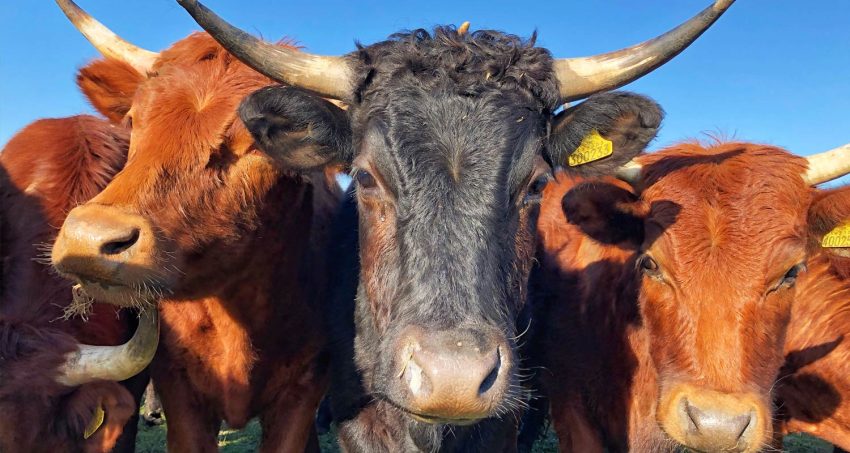

A Johannesburg company is applying technology to herd management as South Africa battles foot-and-mouth disease.
As government and farmers battle to contain the ongoing scourge of foot-and-mouth disease, internet of things-based solutions are coming to the fore to help manage herds and contain outbreaks.
Johannesburg-based IOTI.mobi has developed a virtual geofencing solution to help farmers separate diseased and high-risk herds from uninfected animals, with the entire solution — across software development, product design and manufacturing — done in South Africa.
Virtual fence
“The virtual fencing solution is a device that goes around the animal’s neck and uses small electric shocks, audio and vibration to keep the animal within a virtual fence created by the farmer,” Norman Parkin, CEO of IOTI.mobi, told TechCentral in an interview on Monday.
“The benefit of a virtual fence is you can move those fences so they become a different area of feeding. In all cases, we can determine the position of the animal relative to a gateway or, in the case where we use GPS, its exact location. In the case of an outbreak, you have that information available to know which animals were in close proximity to the sick ones so you can take immediate action to isolate specific animals.”
Read: Air pollution in South Africa: IoT devices use AI to monitor hotspots
According to a September 2025 report by the department of agriculture, South Africa successfully maintained a foot-and-mouth-free zone prior to January 2019. Since then, the country has reported 11 outbreaks of the disease. Four remain unresolved, while seven have been successfully neutralised in collaboration with the World Organisation for Animal Health.
Government has identified vaccination of the entire South African herd as the key component in its fight against the outbreak. On Saturday, the department of agriculture welcomed the delivery of the first consignment of two million high-potency vaccines from Argentina. Other consignments are expected in the coming weeks, including from Botswana and Turkey. But vaccines are only part of the solution.

IOTI’s geofencing product uses collars in combination with gateways to feed animal movement data back to farmers via a web-based interface. Farmers use the interface to set up their geofences along with event-based alerts that can be sent via Telegram, WhatsApp or SMS.
Since connectivity is less reliable in the far-flung and rural regions in which many farmers operate, gateways are equipped with GSM capability so they can connect to IOTI’s cloud. Connections between the gateways and the IoT devices on each animal use long-range Bluetooth to avoid gaps in GSM coverage.
Parkin said the average range IOTI has achieved through Bluetooth connectivity is around 2km, while up to 5km is possible in perfect conditions.
The combination of audio, vibration and mild electric shocks helps keep animals within the geofenced perimeter. The same signals are used to slowly move the herd — as well as the fence — meaning farmers do not have to round up animals to change feeding locations. IOTI used data from international implementations of similar solutions that show 97% of the herd is managed effectively in this way.
Farmers own the data provided by their devices and are free to integrate it into other management systems via an API. Data can also be shared with others in the community so that outbreaks are more effectively contained. As uptake of the solution grows, Parkin hopes to use the data IOTI collects to provide farmers and their communities with the information needed to make long-term decisions about their livestock.
Ruggedised
“We are building data-driven solutions continuously as we better understand what farmers’ needs are. The system not only looks at animal tracking but also tracks vehicle, gate openings and closings, water-level readings and vibrations.”
Parkin said creating a rugged design that can withstand the elements was challenging. Even more challenging was finding the appropriate battery chemistry to allow for a long-lasting battery with sufficient power output. The batteries on the geofencing devices use lithium-ion phosphate, have capacity between 400mAh and 800mAh, and are charged using the sun.
Read: Wi-Fi in minibus taxis to be scaled nationwide
Parkin said the geofencing solution is cheaper than traditional fencing in the long run, while also being more flexible. Even so, traditional fencing is still required to enclose the outer perimeter of a farming area, especially for security reasons.
“Fences are good for keeping criminals out because they act as a deterrent. But when it comes to moving animals around within the enclosed area, a virtual fence is the best way to go,” said Parkin. — (c) 2026 NewsCentral Media
Get breaking news from TechCentral on WhatsApp. Sign up here.