
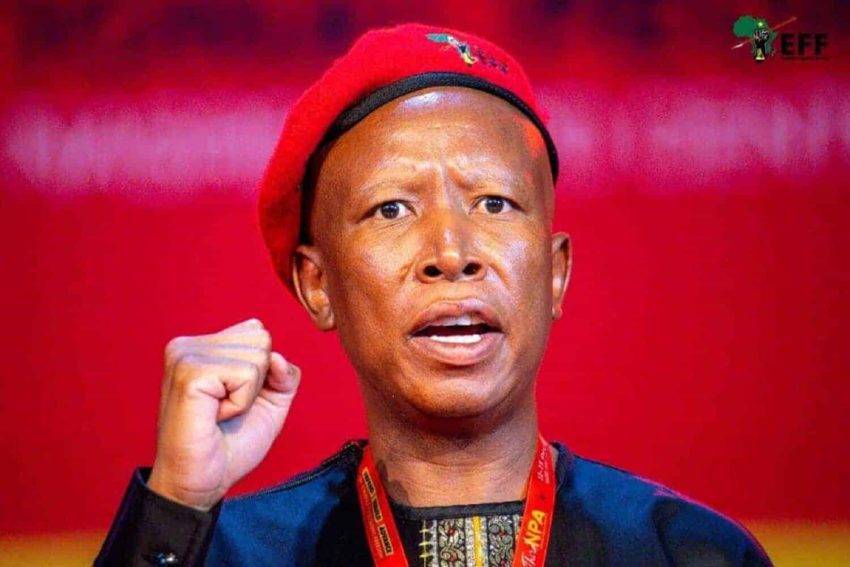
Malema says his party was never taught to hate.
EFF president Julius Malema says those that are complaining about foreign nationals owning spaza shops in the townships should be more concerned about fighting for the control of big industries such as mines.
He was speaking in Johannesburg on Sunday at the funeral service of the uMkhonto weSizwe Party (MKP) parliamentary deputy chief whip, Muzi Ntshingila.
“Why is there a strike to fight for spaza shops, but there is no strike to block the roads and claim the mines, and say these people who are mining here are the same as those that own spaza shops, they are not from here.
“Let the mines, the strategic means of production, be returned into the hands of the rightful owners,” he said.
Sanctions
Malema suggested that international foreign powers have ignored what he described as xenophobic tensions in South Africa because it is not in their interests to intervene.
“Why are there no sanctions? Go to Cape Town and take them out of their posh houses and say to them show us your passport go to Sandton and say to them show us your passport lets see what Israel is going to do to you, let’s see what America is going to do to you.
“There is no international response. We are concentrating on each other; they are making us lose the bigger picture, the bigger picture,” he said.
According to Malema, those international forces are protecting white monopoly capital in South Africa. He called for the unity of all ideologically black groupings.
The white working class and the black working class
On the other hand, Malema said South Africa must urgently deal with matters of redress which stem from the country’s colonial and apartheid history.
He said while he believes in the struggle of the working class, there is a difference between the white working class and the black working class.
“African working class and the white working class are not of the same status. We ought to emphasise the African working class because their situation is worse. We ought to emphasise women because their situation is worse, not because we hate men, but because women suffer triple oppression.
“It doesn’t mean we hate coloureds, but coloureds are us, but their conditions were not the same as ours, it doesn’t mean we hate Indians, but their conditions were not the same as ours. And when we start (process of redress) we have to start with the worse ones coming this way it’s not a hatred its redress… it is a struggle we are engaged in, the struggle to own the means of production,” he said.
A politician full of love
Malema has become known as a defender of what he has described as African unity amid tensions between some lobby groups and migrants who are in South Africa illegally.
“We were never taught the politics of hate, and we will never start hating now. We love all South Africans, Africans in particular, both in South Africa, Africa and in the diaspora,” he said.
Some African states have been repatriating their citizens out of South Africa as the anti-immigrant protests spread to different parts of the country. Groups such as March and March have given the government till 30 June to deport all illegal immigrants.
Those who are against these protests have seen them as being a danger to the unity of the continent and have blamed colonial borders for the divisions of African countries.