
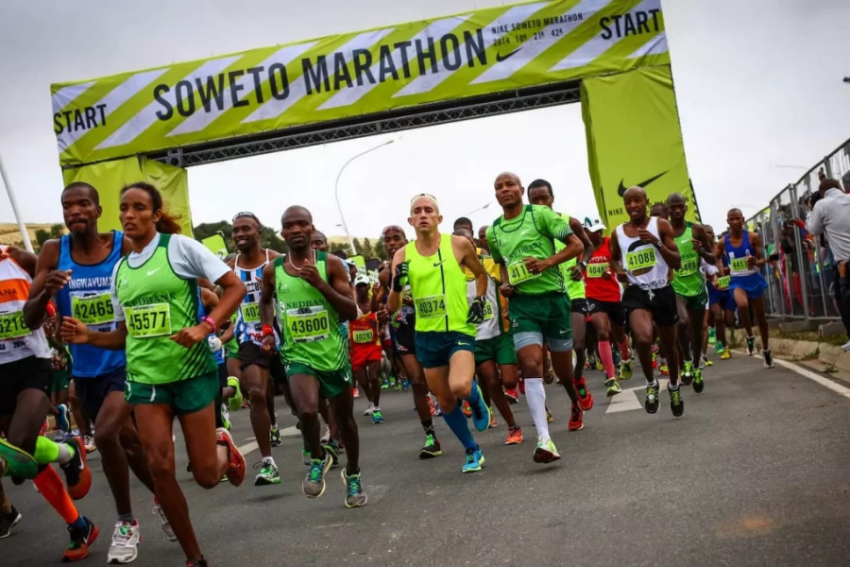
A fresh twist has emerged in the bitter battle over the future and history of the Soweto Marathon, after Gauteng MEC for Sport, Arts, Culture and Recreation Lebogang Maile’s office disputed co-founder Thulani Sibisi’s claim that he was simply excluded from a crucial stakeholder meeting.
Sibisi had told Africa Daily that he was not invited to the meeting held on 13 August 2026, accusing the MEC of treating him unfairly as he sought to intervene in efforts to revive the embattled People’s Race.
But Maile’s office has now provided a different version.
According to the MEC’s spokesperson, Onwabile Lubhelwana, Sibisi was invited to the meeting and received the invitation on 11 August
The office also said the Soweto Marathon Trust had subsequently apologised for Sibisi’s absence, indicating that he was unwell.
Sibisi previously told Africa Daily that he was aware of Maile’s engagements with people identifying themselves as founders of the Soweto Marathon but insisted that he had not been invited to the stakeholder meeting.
“I’m not sure why the MEC left me out, I simply was not invited. I am treated unfairly and I don’t know why,” Sibisi said.
Maile’s office has now rejected the implication that the MEC deliberately excluded Sibisi.
According to Lubhelwana, the meeting formed part of a broader process initiated by Maile to understand the challenges surrounding the marathon and create conditions for its revival.
The office said the MEC had initially engaged Central Gauteng Athletics (CGA) before meeting beneficiary clubs.
Thereafter, both the Soweto Marathon Trust and individuals identifying themselves as Soweto Marathon founders independently approached Maile requesting meetings.
“Those requests were accommodated,” Lubhelwana said.
The MEC’s office was unequivocal on the question of the 13 August meeting.
“The meeting of 13 August 2026 arose from a resolution taken during the engagement with beneficiary clubs that the process should be broadened to include all relevant stakeholders,” Lubhelwana said.
“An invitation was consequently circulated with an explicit request that it be forwarded to all relevant stakeholders, including Mr Sibisi, who received his invitation on 11 August 2026,” said Lubhelwana.
The office further said the Soweto Marathon Trust had tendered an apology regarding Sibisi’s absence when its representatives met Maile, indicating that Sibisi was unwell.
Maile’s office has also sought to distance the MEC from the increasingly contentious battle over who should be recognised as the founders of the Soweto Marathon.
Lubhelwana said the meeting with individuals identifying themselves as founders was not convened to determine or confer founder status on anyone.
“The MEC did not convene the meeting with the individuals identifying themselves as founders for the purpose of determining or conferring founder status upon anyone,” Lubhelwana said.
The office acknowledged that the engagements had revealed differing perspectives among stakeholders regarding the history and founding of the marathon.
But the Gauteng Provincial Government, it said, did not intend to make itself the arbiter of competing historical claims. Instead, Maile wants the history of the marathon to be properly documented.
“Questions concerning the formal historical record and recognition of individual founders should be directed to the Soweto Marathon Trust,” said Lubhelwana.
The dispute is unfolding against the backdrop of years of turmoil surrounding one of South Africa’s most iconic road races.
The Soweto Marathon was conceived, among other things, to address the lack of road-running opportunities in Soweto and surrounding townships.
It subsequently grew into a major sporting and symbolic event, attracting thousands of runners while becoming closely associated with Soweto’s history and South Africa’s transition to democracy.
But the People’s Race has also been plagued by governance disputes.
From 2023, internal battles increasingly spilled into public view, with some disputes eventually reaching the courts.
The turmoil continued into 2024, amid controversy surrounding the management and governance of the Soweto Marathon Trust.
More recently, concerns have also been raised about money allegedly owed to athletes, including outstanding prize money.
It is against this troubled background that Maile has now entered the fray, promising to facilitate engagements aimed at reviving the race.
Maile’s office insists that the MEC’s intervention is not about taking sides in the marathon’s internal battles.
“The MEC’s overriding interest remains the revival of the Soweto Marathon because of its sporting significance and the economic benefits it generates for Gauteng and, particularly, the people and businesses of Soweto,” Lubhelwana said.
The office also rejected the suggestion that Maile’s engagement with individuals identifying themselves as founders amounted to official recognition of their claims.
“The MEC’s engagement with any particular group should therefore not be interpreted as an endorsement of one historical account over another,” Lubhelwana said.
But that position does little to extinguish the wider battle over the marathon’s history.
Sibisi has insisted that anyone seeking to establish who founded the Soweto Marathon Trust should consult the Trust Deed.
The MEC’s office, meanwhile, says the provincial government will not arbitrate competing founder claims and has directed questions about formal recognition to the Trust.
The result is a remarkable situation in which the government is attempting to help rescue an iconic race while simultaneously navigating a dispute over who has the authority to speak about its past and its future.