
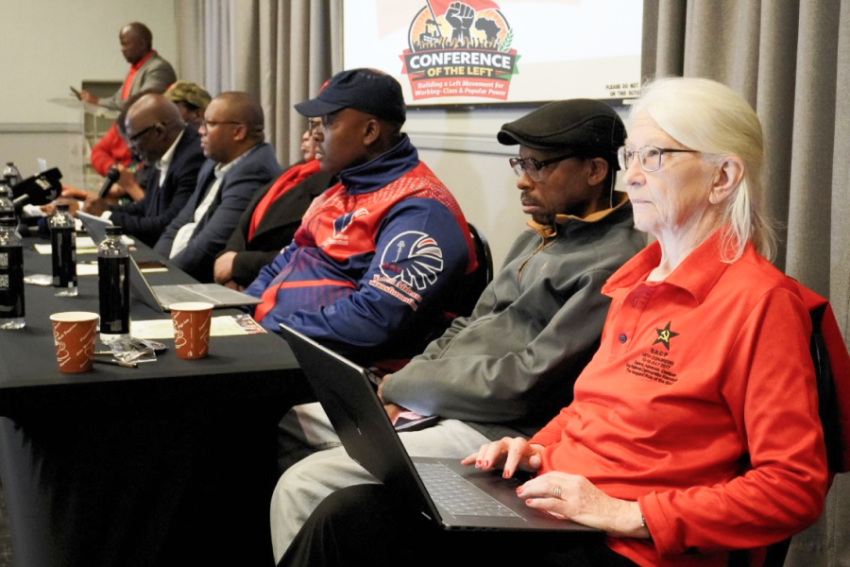
South Africa’s fractured left has taken its boldest step in years toward organised unity, convening a three-day conference in Ekurhuleni this weekend that produced a sweeping declaration of war against what delegates called the “deep structural crisis” of capitalism, neoliberalism and unfinished post-apartheid transformation .
The conference resolved to established a new Council of the Left to translate rhetoric into action.
The Conference of the Left, held from 29 to 31 May at the Birchwood Hotel, drew together an unusually broad coalition: political parties, trade unions and federations, community and social movements, co-operative formations, youth, women’s and student organisations, faith and traditional leadership structures, progressive intellectuals, and international solidarity organisations. The breadth of the gathering was itself a statement, a deliberate projection of the kind of mass force that organisers believe is needed to challenge monopoly capital and the dominant political order.
The conference adopted a declaration under the theme ‘Building a Left Movement for Working-Class and Popular Power’ and announced the formation of the Council of the Left, a standing coordination body that stopped short of positioning itself as a new political party. The signal was unambiguous: this is an organising project, not an electoral one. “The Council is not a new party,” the declaration states. “It will not contest elections in its own name.”
But the ambitions encoded in its programme of action are sweeping, and, in the current political climate, deeply confrontational.
“We gathered to organise against it.”
The delegates did not mince words about their diagnosis of South Africa’s condition. The declaration identifies capitalism, neo-colonialism, imperialism, monopoly power, patriarchy and racism as the structural roots of unemployment, hunger, inequality and social violence .
It charges that the 1994 democratic settlement, for all its historic significance, left the fundamental questions of power unresolved.
“The 1994 settlement did not resolve the national, class, gender and land questions,” the declaration states.
The commanding heights of the economy, it insists, remain in private, monopoly hands. Land has not been returned. And neoliberal austerity has deepened inequality rather than dismantled it.
The tone throughout was one of urgency and resolve. “We did not gather to lament this crisis,” the declaration asserts. “We gathered to organise against it.” The working class, it adds, is “not one constituency among many”. It is the decisive social force.”
Among the most striking concrete demands is a call to nationalise the South African Reserve Bank (SARB) and “fundamentally review its mandate, ownership, governance and accountability” so that monetary policy serves employment and industrialisation rather than private financial interests.
The demand, long associated with the more radical wing of the ANC alliance, is here issued by a cross-organisational left platform, signalling that it may be gaining renewed traction beyond traditional quarters.
On land, the declaration places expropriation without compensation at the centre of its transformational agenda. It calls for “restitution coupled with redistribution, security of tenure and expropriation of land without compensation” and for anti-eviction legislation and the transfer of land rights to those who “work and live on land”.
The declaration also demands a permanent Universal Basic Income Grant, the abolition of student debt, insourcing legislation to end the outsourcing of permanent public functions, and the defence of a fully funded National Health Insurance (NHI) against what it calls “private capture”.
One of the politically sharpest moments in the declaration is its explicit rejection of a binary that the conference believes is being used to soften public resistance to privatisation. Delegates refused to accept that the only alternative to state corruption is the handover of strategic network industries, electricity, rail, ports, water, and spectrum to private profiteers. Confront corruption and elite impunity, the declaration insists, while simultaneously opposing neoliberal privatisation.
On co-operatives and community-owned enterprises, the declaration is direct: “Co-operatives must not be treated as marginal projects or poverty relief schemes.”
The Council of the Left will operate through eight working clusters, each with responsible formations, measurable 12-month outcomes and dedicated resources. The clusters span economic transformation, the cost of living, land, public health, social violence and community safety, climate justice, internationalism, and constitutional review.
That final cluster is particularly significant. The conference called for a review of the 1996 Constitution “from the standpoint of unfinished national democratic and socialist tasks”, including property relations, public ownership provisions and social rights.
On climate, the declaration frames the just transition as a class question, one that must be worker-led, publicly planned and affordable, with an energy mix that includes renewables, coal and nuclear under public ownership.
Internationally, the conference expressed solidarity with Palestine, Cuba, Venezuela, Iran, Western Sahara and the Sahel and called for deepened support for South Africa’s International Court of Justice case against Israel, including “public mobilisation, boycotts, divestment and sanctions”.
The declaration is candid about the tensions within the left itself. “Unity is not silence,” it states. “Unity means acting together where we agree, debating honestly where we differ”, and refusing to allow those differences to be exploited by capital or imperialism.