


On Monday, South Africa’s communications regulator gave prospective satellite operators an unusually candid piece of advice: if you want to run a constellation service such as Starlink in this country, do not expect a new network licence from us – go and buy one from a company that already holds it.
In a notice gazetted on 29 June, Icasa set out precisely which authorisations a low-Earth orbit (LEO) service requires – an individual electronic communications service (I-ECS) licence, an individual electronic communications network service (I-ECNS) licence and the relevant spectrum – and then explained why it cannot, for now, issue the network licence at all.
Under the Electronic Communications Act (ECA), it may consider I-ECNS applications only once the minister has issued a policy direction and it has published an invitation to apply. No such invitation is open. The department, in fact, directed Icasa in August 2025 to first hold an inquiry into whether new network licences are needed at all. That inquiry is still running.
So the regulator points instead to a side door: acquire an existing licensee under section 13 of the ECA. In plain terms, the fastest lawful route into the South African market for the most capable communications networks ever built is to purchase a second-hand licence from an incumbent. The notice does not mention Starlink by name; it applies equally to Eutelsat OneWeb and Amazon Leo.
It is worth pausing on what that tells us. When a regulator’s most practical advice to the future is to enter through the second-hand market, the distance between the technology and the framework meant to govern it has become a chasm.
Displaced
South Africa has been here before – twice. For most of the 1990s, broadband meant Telkom: fixed lines, and later ADSL, set the pace, and a single state-owned incumbent had little reason to move quickly. Then the mobile operators began carrying data – modestly at first over 2G, then with real intent through 3G, 4G and now 5G – and within a decade they had not complemented fixed-line broadband so much as displaced it. Fixed-wireless and fixed-LTE finished the job in the suburbs.
I spent the better part of three decades on the operator side of precisely those transitions. At Vodacom I was closely involved in the launch of 3G, 4G and 5G in South Africa, and I have learnt – more often than not – to see the next wave coming before the market consensus does.
Read: Icasa caught in the political crossfire over Starlink
The pattern is remarkably consistent, and its central lesson is an uncomfortable one for whoever happens to be dominant at the time: incumbents mistake their present position for a permanent one, and treat the next technology as a threat to be managed rather than a shift to be absorbed. Telkom did exactly that with mobile. The risk now is that the mobile operators do the same with what is coming from orbit.
There has been a great deal of noise about Starlink, and some healthy scepticism about the size of its addressable market at current prices. But the noise has obscured the more important point: the shift to non-terrestrial networks is structural rather than speculative, and it is being driven by three forces that do not respond to lobbying.

The first is standards. In Release 17, finalised in 2022, the 3GPP – the body that defines the standards on which 2G, 3G, 4G and 5G are built – brought satellites formally into the mobile standard, and has deepened that integration with every release since; the early work on 6G now treats LEO as a native part of the network rather than an adjunct. In engineering terms, satellites have become base stations in the sky, speaking the same language as the towers.
The second is capital. SpaceX has reportedly amassed in the order of US$17-billion in spectrum and is preparing to offer its own mobile service – a direct move on the operators, not merely on fixed-line providers. The third is deployment: Starlink is live in some 27 African countries and counts more than 12 million subscribers worldwide, while Eutelsat OneWeb already operates commercially in South Africa through partners such as Paratus and Q-KON, and Amazon Leo is preparing to enter, with Vodacom lined up to distribute it.
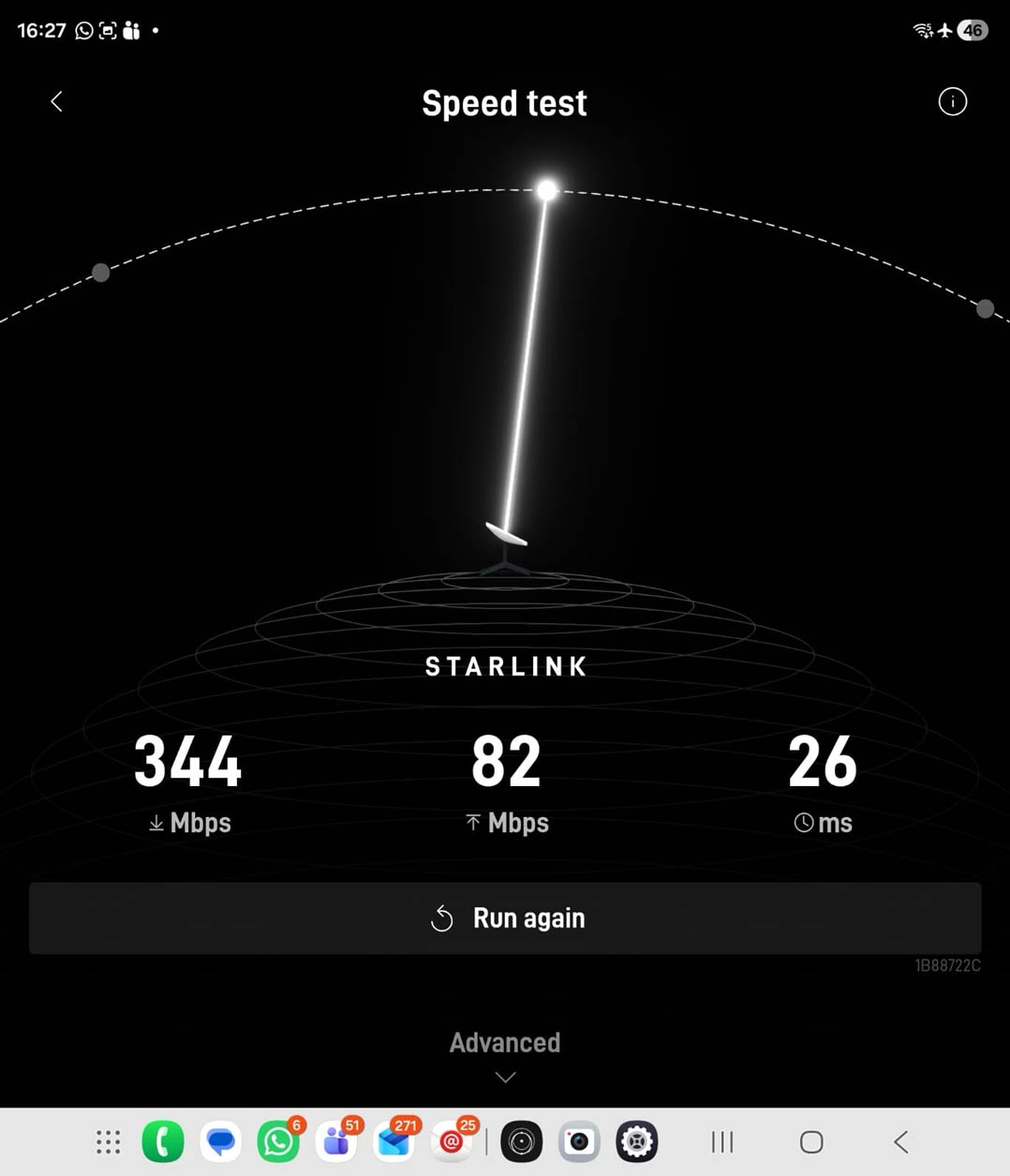
This is not a future I am forecasting. I have measured a little over 300Mbit/s from a single terminal in the Kalahari, hundreds of kilometres from the nearest tower. The networks exist; the standards are written; the demand is proven. What remains unsettled is not the technology, but South Africa’s response to it.
For the mobile operators, this is an awkward inheritance. They were the disruptors who unseated Telkom; on this front, they are the incumbents. Direct-to-device services threaten precisely the rural and roaming margins they have been able to defend until now, and a satellite operator with its own spectrum and a global launch capability is not a competitor that can be out-waited.
The regulatory clock
The strategic error would be to treat LEO solely as a threat to be lobbied against. The more astute response is already visible: Vodacom’s arrangement to distribute Amazon Leo is an operator choosing to ride the wave rather than stand in front of it. Satellite need not cannibalise a mobile network; integrated properly, it extends one into territory that was never going to be economic to cover with towers. The operators that internalise this will be the ones still setting the pace in five years. Those that mistake delay for defence will have the lesson administered to them, as Telkom’s was.
None of this is an argument against regulation. Spectrum must be coordinated, lawful-interception obligations are legitimate – Icasa’s notice rightly flags the difficulty of intercepting traffic where a constellation’s gateway sits offshore, as it typically does for LEO – and the case for meaningful economic participation is a sound one. The problem is not that South Africa regulates; it is that the framework has fallen badly out of step with the thing it regulates.
Read: Namibia tells Starlink to take a hike – again
The headline obstacle remains the requirement, under the ECA, that licensees be 30% owned by historically disadvantaged South Africans – a rule SpaceX has declined to meet. The minister’s December 2025 policy direction sought to open an alternative through equity-equivalent investment programmes, the mechanism that has allowed multinationals to invest here for two decades. But in May, Icasa told the minister it could not give that direction full effect without amending the act itself – handing the question to the slow-moving Electronic Communications Amendment Bill. Two-and-a-half years into the debate, the practical position is the one the regulator set out last week: no new licences, buy an old one, and wait. Meanwhile the grey market persists and our neighbours switch on.
Technology waits for no one. That is not a slogan; it is the through-line of every transition this industry has lived through. The honest question is no longer whether LEO will reshape South African connectivity – that has been settled, in orbit and in the standards bodies – but how long the country intends to be late to its own market.
The licensing decision sits with Icasa, and it is now entangled in one of the more bruising fights inside the government of national unity. But the strategic decision sits with the industry, and especially with the operators. Both need to catch up to what has already happened. The rest of the world is not waiting. Neither are the satellites.
- The author, Jannie van Zyl, is an electronics engineer with more than three decades of experience in ICT and a long record of reading the industry/s shifts early. At Vodacom he was instrumental in the launch of 3G, 4G and 5G in South Africa and, in the last three years, has worked to bring low-Earth orbit satellite connectivity to the country
- Subscribe to TechCentral’s daily newsletter
- Get breaking news alerts on WhatsApp