


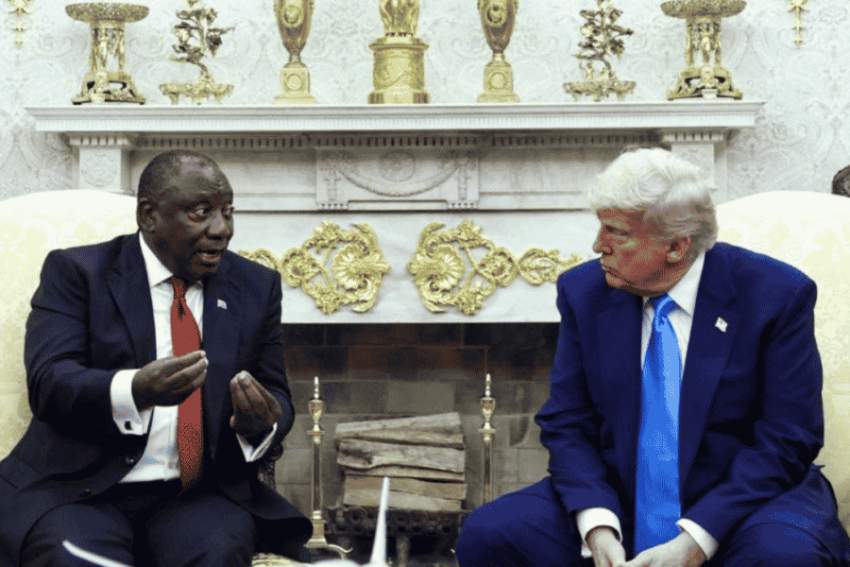
President Cyril Ramaphosa has failed to impress Washington with a personal letter to US President Donald Trump aimed at resetting deteriorating relations between Pretoria and Washington, with US Ambassador to South Africa Leo Brent Bozell III reportedly revealing the missive fell flat.
According to Business Day, Bozell said Ramaphosa’s letter did not satisfy Trump’s demands that Pretoria alter policies aimed at redressing apartheid-era inequalities.
The ambassador is also alleged to have intimated that former President Thabo Mbeki is better placed to break the diplomatic impasse.
Mbeki has remained mum on the matter.
Relations between the two countries have deteriorated sharply since Trump returned to the White House last year.
Trump has offered Afrikaners refugee status in the United States and falsely accused the South African government of subjecting white farmers to genocide – a claim Pretoria has repeatedly rejected as misinformation.
Ramaphosa has maintained that his government’s policies, including land reform, Black Economic Empowerment and the recently signed Expropriation Act, are aimed at improving the economic lot of South Africa’s Black majority who were systematically marginalised under apartheid, and that they have been misconstrued by Washington.
The letter was part of a broader diplomatic offensive by Pretoria to stabilise ties after a series of punitive steps by Washington.
Last year, Washington expelled South African Ambassador Ebrahim Rasool after he said Trump supporters were part of a “supremacist movement.”
The US also revoked the visa of former International Relations Minister Naledi Pandor, who was instrumental in South Africa’s genocide case against Israel at the International Court of Justice, a case the Trump administration has criticised.
Bozell, a conservative media figure appointed as Washington’s envoy to Pretoria six months ago, has emerged as the most vocal voice on the rift.
Speaking on a national radio station on Tuesday, Bozell said he was “deeply disappointed” by the state of relations, but repeatedly refused to answer directly when asked whether he believed Afrikaners were facing genocide in South Africa.
“I’m not going to go where you want to go… all I have focused on is the five asks and nowhere in those asks is the word genocide. And there’s my answer,” Bozell said when pressed for a yes or no.
Bozell said he had initially believed relations were improving after Washington put forward what he described as five “reasonable” requests to the South African government.
“I was the one telling Washington, watch for the breakthrough, watch for the breakthrough. It’s coming, it’s coming. And then it was the opposite,” he said.
He also took a swipe at International Relations and Cooperation Minister Ronald Lamola, who is currently in Washington seeking to engage policymakers and rebuild ties.
Lamola criticised Trump’s Afrikaner resettlement programme at the African Diaspora Forum this week, accusing the US of applying a race-based approach.
“It’s disappointing to hear him say what he says, and then he wondered why he hit a brick wall when it came to Washington. Well, that’s why,” Bozell said.
“There are those in the government who have been quite reasonable, and not just reasonable, but helpful in the discussions that we’ve had. But there are others, like Foreign Minister Lamola, who have not.”
Bozell said while he had been impressed with the South African people since his arrival, he had been less impressed with the government.
The ambassador’s reported suggestion that Mbeki should be roped in to mediate has raised eyebrows in diplomatic circles.
Mbeki, who remains an influential voice on the continent and is respected in Washington for his market-friendly policies and African Renaissance agenda, has not commented publicly on the suggestion.
The South African government has rejected claims that Afrikaners are being persecuted.
Official crime statistics and independent fact-checkers show no evidence of targeted genocide against white farmers, with farm attacks affecting both Black and white South Africans.
Pretoria is seeking to protect AGOA trade preferences, retain foreign investment, and avoid further visa and diplomatic sanctions.
Dirco has not yet responded to Bozell’s latest remarks, but officials have previously insisted that South Africa will not abandon its constitutional mandate to pursue redress for apartheid-era inequalities in exchange for diplomatic favour.