
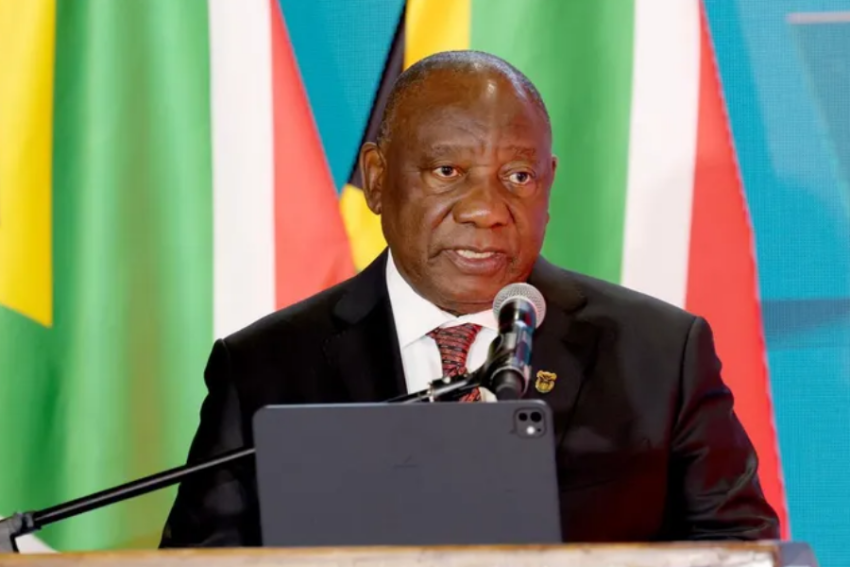
President Cyril Ramaphosa has called on Southern African countries to use the region’s vast mineral, agricultural and human resources to build an integrated industrial economy, warning that SADC cannot continue exporting raw materials and importing the finished products at prices set by others.
Delivering a public lecture at the University of KwaZulu-Natal’s Westville campus on Friday ahead of the 46th SADC Summit, Ramaphosa said the region needed to turn SADC Vision 2050 from a long-term ambition into a practical programme of action.
He said the region’s economic dependence on external markets remained one of the biggest obstacles to achieving shared prosperity.
“Our ambition should not be to catch up with other countries.
“Our ambition should be to build a regional economy that is unique to our circumstances and to our time.”
Ramaphosa said Southern Africa had the resources needed to drive its own industrial development but was failing to fully benefit from them because too many resources continued to leave the region in raw form.
“This region holds a substantial share of the world’s critical mineral resources. Many of the materials upon which the energy transition of the entire planet depends lie beneath our soil.
“But these minerals continue to cross our borders in raw form. We export the ore and we import the battery.”
He said the region risked supplying the rest of the world with resources needed for industrialisation while remaining dependent on others for the finished products.
“We supply an industrial revolution taking place somewhere else and we then purchase its products at a price set by others.
“We need to use our own resources to drive our own industrial revolution.”
Ramaphosa said this would require SADC member states to increase trade among themselves, develop regional value chains and invest in infrastructure connecting their economies.
Trade between SADC countries currently accounts for less than a quarter of the region’s total trade, despite the bloc having the energy, land, minerals, technology, financial institutions and markets required to produce many of the goods and services its people need.
“We have the land and the means to produce all the food we need.
“Together, we have the mineral resources we need. We have the technology and know-how to turn these resources into the manufactured goods that our people use.”
Ramaphosa said the region’s reliance on external markets had become particularly risky amid global economic turbulence, disrupted shipping routes, rising oil prices and growing uncertainty around international trade.
He said a regional market would give SADC countries greater control over their economic future.
“A regional market is different. A regional market is an advantage that we ourselves own. Others cannot take it away from us.”
He said the region needed to eliminate barriers that continue to make it difficult and expensive for businesses to trade across borders.
This included harmonising standards, reducing duplication at borders and ensuring that suppliers were not forced to wait months for licences.
Ramaphosa also called for greater investment in roads, railways, ports, energy infrastructure and cross-border water projects.
He said the SADC Regional Development Fund should be operationalised to help finance these investments and reduce the cost of capital.
The president also identified critical minerals, agriculture, pharmaceuticals, automotive manufacturing, agro-processing, paper and pulp, furniture, semiconductors and digital technologies as sectors capable of driving regional industrialisation.
On healthcare, Ramaphosa said SADC could no longer rely heavily on imported medicines and health products.
“We can no longer accept that we import almost everything that heals us,” he said.
He said the region needed to pursue greater health sovereignty, including through the SADC pooled procurement mechanism, which could create sufficient demand to encourage pharmaceutical manufacturing within the region.
“A region that supplies the world with the minerals of the future should not have to wait upon the world for its medicines.”
Ramaphosa also placed significant emphasis on infrastructure corridors, saying routes such as the Maputo, North-South, Trans-Kalahari, Beira and Lobito corridors needed to become more than transport links.
“These corridors must carry power, data and people.”
He said regional energy cooperation should also be accelerated through electricity interconnectors, increased power trading and investment in renewable energy, battery storage and green hydrogen.
Digital infrastructure, he said, presented another opportunity for SADC countries to ensure that the economic value generated from their own data remained within the region.
“Already, we are exporting data and importing intelligence.”
Ramaphosa said Southern Africa needed to develop its own computing capacity, connectivity and skills to ensure that data generated by its people, businesses and institutions could be processed and used locally.
The president also warned that industrialisation would not succeed without addressing unemployment, particularly among young people.
More than half of the SADC population is under the age of 30, which Ramaphosa described as the region’s “greatest strategic asset”.
But he warned that this demographic advantage could only translate into economic growth if young people were given meaningful opportunities.
“Youth unemployment is one of the gravest threats to the stability, cohesion and progress of every country in our Community.”
He said investment in education, technical and vocational training, digital literacy and entrepreneurship would be essential to preparing young people for the region’s future economy.
Ramaphosa also called for greater support for women-owned businesses, saying women continued to face barriers to finance, markets, productive assets and procurement opportunities.
Beyond economic integration, he said SADC’s Vision 2050 could not be achieved without peace and stability.
He described the conflict in the eastern Democratic Republic of Congo as the “gravest test” of the region’s collective resolve and paid tribute to SADC troops who had lost their lives in efforts to support peace and stability.
He also welcomed progress in Mozambique’s Inclusive National Dialogue and referred to efforts to support political processes in Madagascar.
On migration, Ramaphosa acknowledged the growing tensions surrounding irregular migration in South Africa but rejected vigilantism and discrimination against people from other countries.
“We cannot preach integration at summits and practise exclusion in our streets.”
He called for greater cooperation between SADC countries to address the economic and political conditions driving migration, including poverty, conflict, governance failures and a lack of economic opportunity.
Ramaphosa also warned that climate change posed a major threat to the region’s development, pointing to recurring droughts, cyclones and floods.
He called for stronger regional disaster-response mechanisms and greater investment in climate resilience.
Returning to the vision of Pixley ka Isaka Seme, whose 1906 speech on the “Regeneration of Africa” he invoked, Ramaphosa said the continent’s renewal now needed to move from aspiration to implementation.
“It is no longer a proposition. It is a programme of work. It has actions, assigned responsibilities and deadlines.”
Ramaphosa said the SADC of 2050 should be a region where raw materials are processed locally, industries operate across borders, electricity generated in one country powers homes in another and young entrepreneurs can trade seamlessly throughout the region.
He said the responsibility for delivering that future would ultimately fall to the region’s youth.
“Vision 2050 is not our document. It is yours, and you are entitled to demand an account of what we did with it.”