


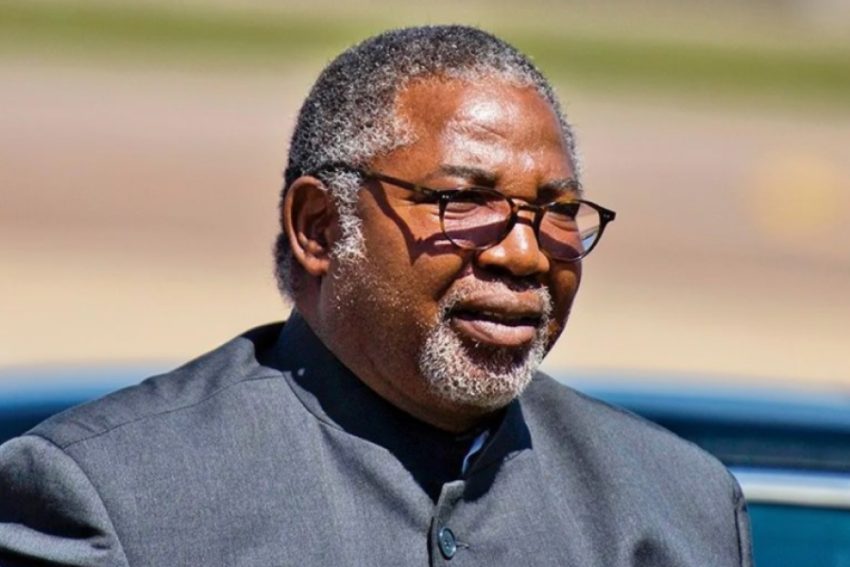
Former minister Charles Nqakula’s remarks about President Cyril Ramaphosa potentially facing arrest could be viewed as part of a broader internal campaign against the president, as influential figures within the ANC and wider liberation movement appear to be ‘sharpening the knives’ against him.
While Ramaphosa has remained silent on the comments, political analyst Professor Andre Duvenhage from the North West University – believes the remarks should not be dismissed lightly, warning that they add to mounting political pressure facing the president.
Duvenhage’s comments follow claims made by Nqakula during an interview on the African Renaissance podcast hosted by former EFF MP Mbuyiseni Ndlozi, where the former national security adviser suggested Ramaphosa could potentially face arrest over undisclosed allegations of misconduct.
Speaking to Africa Daily, Duvenhage said Nqakula’s intervention points to growing internal tensions around Ramaphosa and reflects what he described as an “onslaught” against the president from within the broader liberation movement.
“I have no doubt that there are people and organisations within the bigger political environment, including influential individuals, that would like to get rid of Cyril Ramaphosa,” Duvenhage said.
“I’m not going to say there is a total onslaught against Ramaphosa, but there is definitely an onslaught against him, and it is coming more from inside the revolutionary movement than from outside.”
Duvenhage said Nqakula remains an influential figure within the ANC fraternity and his decision to make such allegations publicly, despite providing no supporting evidence, suggested deeper political tensions.
“Him making these type of accusations without providing evidence is indicating to me that there is a problem with Ramaphosa and that they are sharpening the knives. It will definitely add to the additional problems Ramaphosa is facing,” he said.
Nqakula, a veteran of the anti-apartheid struggle who served as minister of safety and security, minister of defence and later as Ramaphosa’s national security adviser, told the podcast there was a possibility that the president could one day be arrested.
“There is a situation where something may happen and see him being arrested,” Nqakula said.
However, when pressed to provide details, he acknowledged that he did not want to make claims about matters he did not fully understand.
“I don’t want to be on record saying something that I don’t quite know and understand,” he said.
Nqakula nevertheless suggested that Ramaphosa’s challenges extended beyond the Phala Phala farm scandal.
Africa Daily understands that there are currently no known criminal investigations against Ramaphosa beyond matters already publicly ventilated.
The president continues to face renewed parliamentary scrutiny following the Constitutional Court’s decision to revive impeachment proceedings linked to the 2020 burglary at his Phala Phala game farm in Limpopo.
Duvenhage said comments of this nature had the potential to undermine confidence in Ramaphosa’s leadership and deepen uncertainty within the ANC.
“Yes, definitely. It will have the potential and it will probably play back into the ANC and help create uncertainty within the organisation, and already there’s a lot of uncertainty going on,” he said.
He further warned that sustained attacks on Ramaphosa could have wider implications for political stability and investor confidence.
According to Duvenhage, Ramaphosa remains a central figure in the Government of National Unity (GNU), making any perceived weakening of his position potentially significant.
“Ramaphosa is a very critical factor when it comes to the Government of National Unity. It’s his creation. If his position becomes vulnerable, it can affect political stability,” he said.
“My own research indicates that the South African political environment is becoming more and more unstable and when you have instability it automatically affects investor confidence.”
While Duvenhage said political grievances did not justify making allegations without evidence, he suggested the remarks resembled political tactics rather than a substantive case.
“If you have strong evidence, bring it forward. Play the ball, not the man,” he said.
“I’m seeing some dirty tricks in this regard.”
The analyst also suggested that should no evidence emerge to support the allegations, Ramaphosa could potentially have legal grounds to pursue a defamation claim.
“If no evidence is produced, yes, I think there will be grounds for legal action, including a defamation claim,” he said.
However, Duvenhage also believes Ramaphosa is unlikely to respond publicly unless the issue gains significant traction.
“At this point in time, it hasn’t reached the point where I believe he will react immediately, but this can change in days or weeks,” he said.
Despite describing the ANC as a deeply divided organisation, Duvenhage said Ramaphosa’s survival continues to depend largely on maintaining support within the ANC’s National Executive Committee and parliamentary caucus.
“If cracks start developing within these two environments, it can touch on his survival,” he said.
“Ramaphosa is a survivor, but at some point there is the last straw that breaks the back of the camel. I’m not saying we are there yet, but if the onslaught continues, we may eventually reach a tipping point.”
The ANC had not responded to our written questions at the time of publication.