
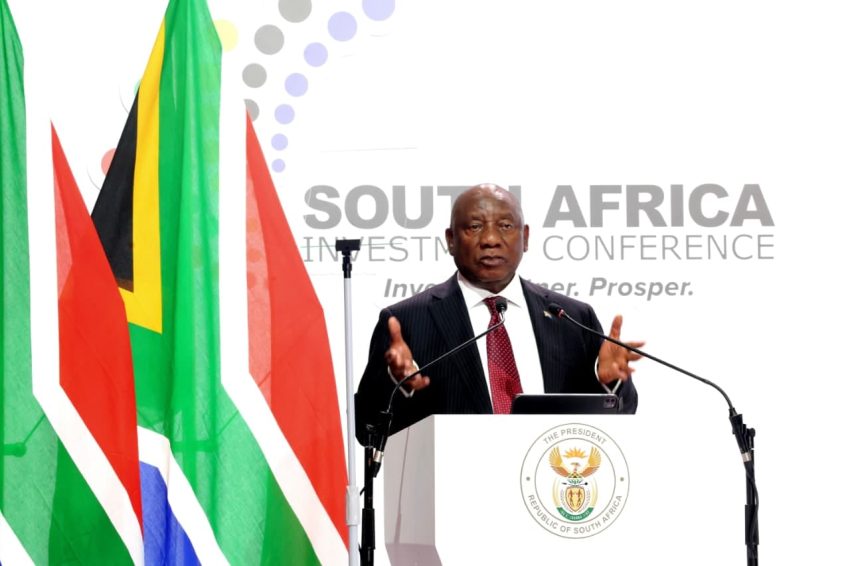
President Cyril Ramaphosa addressed the nation on Sunday night as the final results of the 2026 local government elections were announced, and thanked those who made the election free and fair.
“We thank all those who made this election free and fair,” Ramaphosa said.
He said millions of South Africans went to the polls four days ago to exercise one of the most fundamental rights of democracy.
Among them, he said, were those who have stood in voting queues in every election since 1994, and young South Africans casting their ballots for the very first time.
“They came from our cities and towns, from villages and farms, from every province and across our land,” Ramaphosa said. “But they were all united by a common conviction that their voice matters. That their vote counts.”
The President said this year marks 30 years since the Constitution was signed into law, and referred to the principle in the Freedom Charter that the people shall govern.
“It is not inherited. It is not owned by any political party. It is not the permanent possession of those who hold public office,” he said. “It is entrusted by the people to those whom they elect, and it must always be exercised in their interests.”
Ramaphosa said the participation of more than 540 political parties and nearly 137,000 candidates bore witness to the multi-party nature of South Africa’s democracy.
“Greater choice and more competition are the signs of a healthy democracy,” he said. “At a time when democracy is under strain in many parts of the world, South Africans have shown once more that ours is a strong and enduring democracy.”
He said the right to vote is what gives democracy its legitimacy.
“The right to vote is what gives our democracy its legitimacy,” he said. “We celebrate the enduring strength of our democracy and the sovereign right of the people of South Africa to choose their representatives.”
Ramaphosa said many households are struggling with the high cost of living.
“Many households are struggling with the high cost of living,” he said. “Too many people, particularly young people, remain without work. In too many communities, the quality of municipal services falls far short of what our people have a right to expect.”
“South Africans want to live in communities where they feel safe, where public infrastructure is maintained, where businesses can flourish and where young people can look to the future with hope.”
He said those expectations were the basic requirements of a life of dignity.
The final results were as follows: The ANC received 30.76% of the vote and secured 3,246 council seats. The Democratic Alliance received 24.64% and 1,695 seats. The uMkhonto weSizwe Party received 9.76% and 785 seats. The Economic Freedom Fighters received 6.22% and 588 seats. ActionSA received 5.67% and 313 seats.
Political parties and independent candidates outside the top five collectively received 22.97% and 1,695 seats.
The ANC achieved outright control in 53 municipalities and is the leading party in 128. The DA achieved outright control in 12 and is the leading party in 32. The IFP achieved outright control in five and is the leading party in 19. The MK Party achieved outright control in three and is the leading party in 19. RISE Zanansi communities achieved outright control in one.
Of 213 municipalities, 74 have a party with an outright majority. In Johannesburg, no party secured an outright majority in the 270-seat council. In Tshwane, the DA leads ahead of the ANC in a 214-seat council. In Ekurhuleni, the ANC leads in a 224-seat council. In eThekwini, the ANC leads in a 222-seat council.
Ramaphosa addressed municipalities where no party secured an outright majority.
“In municipalities where no political party has secured an outright majority, the elected representatives will need to find common ground,” he said. “This is not a weakness of democracy. It is an expression of the choices that the people have made.”
“Negotiations over the formation of municipal governments must not become contests over positions, privileges or the distribution of power. They must be guided by what will best serve the people.”
“The stability of our municipalities cannot be sacrificed to narrow political interests. The delivery of essential services cannot be held hostage by political disagreements.”
“The people did not cast their votes so that their representatives could spend the next five years fighting among themselves. They voted because they expect their lives to improve.”
Quoting Amilcar Cabral, Ramaphosa said: “[The people] are fighting to win material benefits, to live better and in peace, to see their lives go forward, and to guarantee the future of their children.”
“Our people do not judge government only by the promises that are made or the policies that are adopted,” he said. “They judge government by what changes in their daily lives.”
“They want water to come out of the tap and electricity that works. They want their refuse collected, their parks maintained and their streets safe.”
To incoming councillors, he said: “You have been entrusted with an immense responsibility. You will serve in the sphere of government that is closest to the daily lives of our people.”
“Your responsibility is not simply to occupy a seat in a council chamber. It is to serve the communities that have placed their trust in you.”
“It is to put the interests of residents above personal ambition and political advantage.”
Ramaphosa said councils must be constituted without delay, parties must negotiate in good faith to elect office-bearers, and budgets must be passed on time.
“Our people’s interest must not be drowned by the quest of political parties or representatives to settle political scores or petty squabbles,” he said.
He said the revised White Paper on Local Government envisages a bold reset of how municipalities function and are managed, to strengthen finances, direct resources towards infrastructure maintenance and ensure services are delivered efficiently and reliably.
He thanked the Chairperson, Commissioners, Chief Electoral Officer and staff of the Independent Electoral Commission for their dedication and professionalism.
“The independence, integrity and credibility that the IEC has always been known for are essential to the confidence that South Africans place in the electoral process,” he said.
He also thanked NATJOINTS, composed of the South African Police Service, the South African National Defence Force, the Department of Home Affairs and other institutions, political parties, candidates, election agents, observers and volunteers, the media, and election officials.
“We thank the many thousands of election officials who worked long hours, often under difficult circumstances, to ensure that South Africans could exercise their democratic rights,” he said.
“We thank those who travelled long distances to reach voting stations. We thank those who waited patiently in queues. We thank the elderly who have remained steadfast in their commitment to democracy. We thank the young people who participated in shaping the future of their country.”
“The ballots have been counted. The choices have been made. The responsibility now passes to those who have been elected,” Ramaphosa said.
“The people have spoken. Their verdict must be respected. Their concerns must be heard. And their expectations must now be met.”