
South Africa once served as the gateway for capital into Africa but has lost ground to jurisdictions such as Mauritius.
South Africa could potentially repatriate as much as R10 trillion currently invested abroad by local citizens if proposed reforms to create a “synthetic financial centre” succeed.
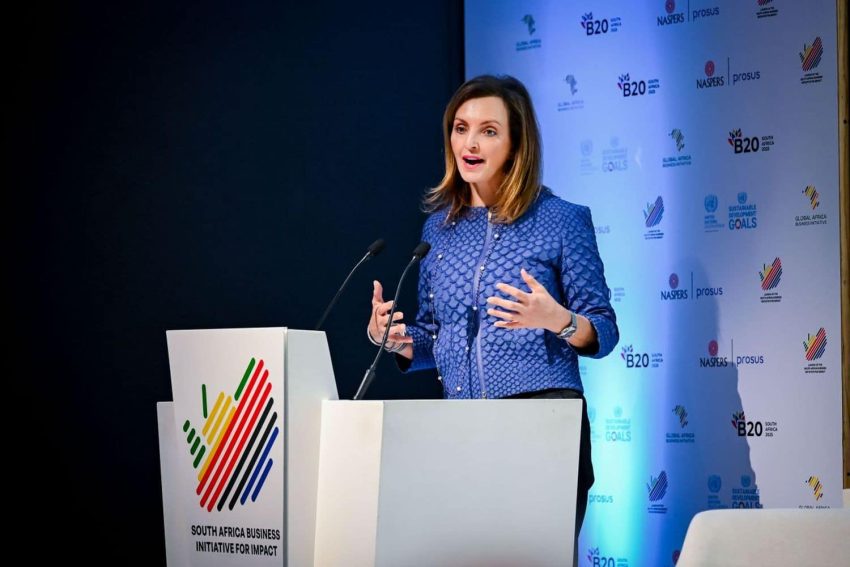
This, says JSE CEO Leila Fourie, could transform South Africa’s capital markets and restore lost competitiveness as a regional financial hub.
“The funds currently managed offshore are estimated at around R10 trillion, which is almost half of the JSE’s R24 trillion market,” Fourie said in an interview with Moneyweb after the bourse’s full-year results posting on Monday.
Expansion of HoldCo framework
The concept of a synthetic financial centre featured prominently in the 2026 Budget Review, where National Treasury outlined plans to expand the so-called “HoldCo framework” to asset managers.
The objective is to enable the management of foreign assets and foreign-currency instruments from within South Africa, and promote the country as a competitive financial and investment hub for the African continent.
Unlike traditional financial centres, the proposed model would not involve a physical location but rather a legal and regulatory framework.
According to Fourie, the reforms aim to restore competitiveness, noting that South Africa’s ranking in the Global Financial Centre Index has slipped.
“We’ve now slipped from 92nd position globally in the Global Financial Centre Index to 94th, and Mauritius, Casablanca, and Kigali have risen to 52nd, 56th, and 65th [respectively].”
ALSO READ: How the JSE All Share changed over three decades
Not a physical hub
Fourie emphasises that the proposed centre would exist purely as enabling legislation rather than a physical hub.
“A synthetic financial centre is rather a policy of legal construct that is enabling legislation. And the very first enabler is going to allow our local asset managers to trade and to manage non-ZAR-funds.”
Currently, South African companies that wish to manage foreign-currency funds must establish operations offshore.
“Right now, if you want to manage non-ZAR fund, you have to have an offshore office. You can’t do it locally.”
By allowing such funds to be managed domestically, the reforms aim to relocate associated jobs, tax, systems and expertise back onshore.
“And so the whole idea behind our competitiveness initiative is not only to position ourselves competitively, but also to create an environment where job creation happens onshore, [so] that those fund managers and the systems attract those funds back into the country.”
She cautions that the changes will not eliminate exchange controls.
“It doesn’t necessarily mean that exchange control is going to become a thing of the past. It just means that you will be able to manage these global funds onshore.”
Multicurrency listings and derivatives reform
Beyond fund management, the JSE and industry stakeholders are advocating additional reforms.
“Now, the next very big step that we would like to see as the private sector – and we’ve been working under the leadership of National Treasury – is the enablement of listings in non-ZAR currency.”
According to Fourie, allowing companies to list securities denominated in dollars or other hard currencies on the JSE could bring substantial macroeconomic benefits.
“We believe that will have far-reaching macroeconomic growth potential.”
ALSO READ: And the best share in 2025 was …
Acceptance of non-rand collateral
Another priority is enabling the derivatives market to accept non-rand collateral.
“Right now, if an international investor wants to invest in our local environment, they have to post rand collateral, and that rand collateral carries activity risk,” she says.
Permitting hard-currency collateral could reduce both risk and transaction costs.
Fourie also points to sovereign borrowing as an example of lost opportunity.
“Right now, if the National Treasury wants to raise government bonds in dollars, they go to Luxembourg. There is no reason why those bonds could not be issued on the JSE and that investors within the construct of their exchange control limits would be able to still invest.
“Even more so, international investors could then invest in those dollar bonds on the JSE.”
She argues that South Africa’s market infrastructure is capable of supporting such activity.
“We are a world-class exchange. Our settlement assurance, our margining and risk management processes are world class.”
Legislative and technical hurdles
Implementing the framework would require substantial legislative work, particularly around anti-money-laundering controls and exchange-control compliance.
“Basically, what would be required is a legislative framework that our National Treasury would develop outlining the construct of the synthetic financial system.”
A shift to multicurrency listings would also necessitate extensive operational changes across the market.
“All of our participants would have to switch to a multicurrency system. We would have to have rules around valuation, timing, frequency, et cetera.
“There is a lot of plumbing and a lot of work that would be required to enable any multicurrency market. But it’s urgent,” she says.
“Our market sentiment is shifting. South Africa has an opportunity to position itself on the global stage. We were one of the best-performing markets last year in the equity market.”
ALSO READ: JSE breaches 107 000 for first time as gold stocks shine
Industry view
Separately, Omri Thomas, director at Abax Investments, told Moneyweb the proposed framework would fundamentally alter how South African asset managers handle offshore investments.
According to Thomas, managing global funds currently requires establishing vehicles in jurisdictions such as Ireland, which shifts employment and administrative activity offshore.
Allowing foreign-currency portfolios to be managed domestically could reduce costs and complexity.
Although he doubts that it would lead to large immediate inflows of foreign capital, it could make locally launched dollar-denominated funds more competitive and improve access for domestic investors to global assets at lower cost.
“South Africa historically served as a gateway for capital into Africa, but has lost ground to places like Mauritius, which offers favourable tax conditions and has attracted listings away from Johannesburg. The reforms could help recapture some of that activity.”
Senior market participants involved
Fourie told Moneyweb a broad coalition of senior market participants is already working on the initiative, and that the process will continue after she departs from the JSE at the end of March.
“There are a number of very senior people involved in the committee tasked with this. I chair that committee now, but I’ll hand that baton to Valdene [Reddy].”
Reddy, currently director of capital markets, has been appointed as the JSE’s new CEO from 1 April.
Asked whether she would remain involved, Fourie indicated she would step back after handing over leadership but remain supportive.
“I will sit on some boards and to the extent that I’m required. I’m always very happy to support, but I’ll probably be cheering from the sidelines.”
This article was republished from Moneyweb. Read the original here.