


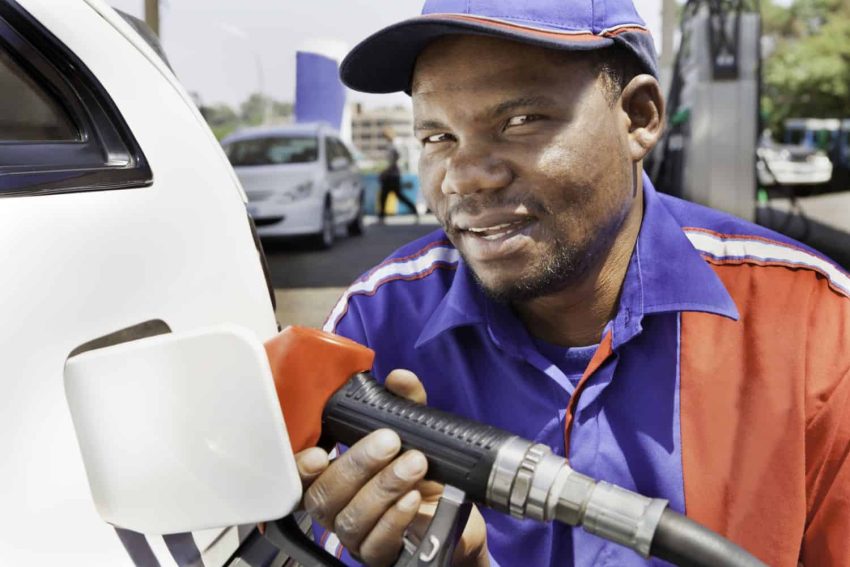
Tipping petrol attendants has become customary in the country, and adds to their wages at the end of the month
A survey has revealed that South Africans have a poor tipping culture when it comes to petrol attendants.
Unlike restaurants that already include a ‘service tip’ in a bill, fuelling stations do not have this luxury. But petrol attendants deserve to get tipped, right?
There is no denying that most people in the country are financially stretched, but petrol attendants play an important role in motorists’ daily lives.
Apart from pumping fuel, they perform maintenance tasks, including cleaning windshields, checking oil and water levels, and ensuring optimal tyre pressure.
SA has 140 000 petrol attendants
Data from Trade and Industrial Policy Strategies (TIPS) has revealed that the fuel retail sector plays an important role in employment, especially in Gauteng. The sector had 140 000 employees in 2019, which has likely increased since then, with petrol stations in the country growing.
However, due to the shift to electric vehicles, these jobs are at risk.
“The transition to electric vehicles will significantly affect petrol station workers, whose employment is largely dependent on the sale of liquid fuels,” reads the report. “Without adequate preparation, more than 140 000 people stand to lose their jobs between now and the final shift to full use of electric vehicles.”
Gauteng has the highest share of petrol station workers, which accounts for roughly a third of petrol station jobs, followed by KwaZulu-Natal and the Western Cape. “In all, these three provinces account for about two thirds of total petrol station employment in the country,” reads the report.
R2k per week for petrol attendants
Petrol attendants in the country receive R45.79 per hour, according to the Motor Industry Bargaining Council (MIBCO) wage tables. This is more than the national minimum wage of R30.23.
Given that most fuelling stations operate 24 hours a day, it is reasonable to assume that these employees work at least 12 hours, although there is no official document to support this.
At the end of the month, petrol attendants receive at least R8 242, while cashiers earn slightly less (R8 154).
Tipping petrol attendants has become customary in the country, and adds to their wages at the end of the month.
South Africans do not tip
But, a poll conducted by Business Tech, has revealed that most people do not tip petrol attendants. Glassdoor’s data show that petrol attendants earn roughly R750 in tips per month, with most submissions from Johannesburg.
“Of the respondents, 1 788 (43%) said they don’t tip, while 879 (21%) said they tip R5. Of the South Africans who do tip, most tip R10 (915 or 22%),” said the publication.
“323 (8%) of people noted that they tip R20, while 179 (4%) said they tip more than R20. Experts note that this lack of tipping is partly due to South Africans carrying less cash.”
However, the excuse that people do not tip because they do not carry cash is becoming less valid with the rise of digital payment methods.
Tipping methods
Tappy Wallet, a tipping solution launched in 2025, makes it easy for people to tip petrol attendants, without using cash.
It works through a small wearable device (such as a wristband or tag) that the attendant carries. A customer simply taps their phone on the device, enters an amount, and the money is transferred instantly to the attendant’s wallet.
Tappy Wallet joins companies like Tipped that help workers track how much they have earned in tips.
Petrol attendants can receive safe, cashless tips in real time, reduce the risk of carrying cash, and earn more from customers who might not have cash on hand.
Support Local Journalism
Add The Citizen as a Preferred Source on Google and follow us on Google News to see more of our trusted reporting in Google News and Top Stories.