
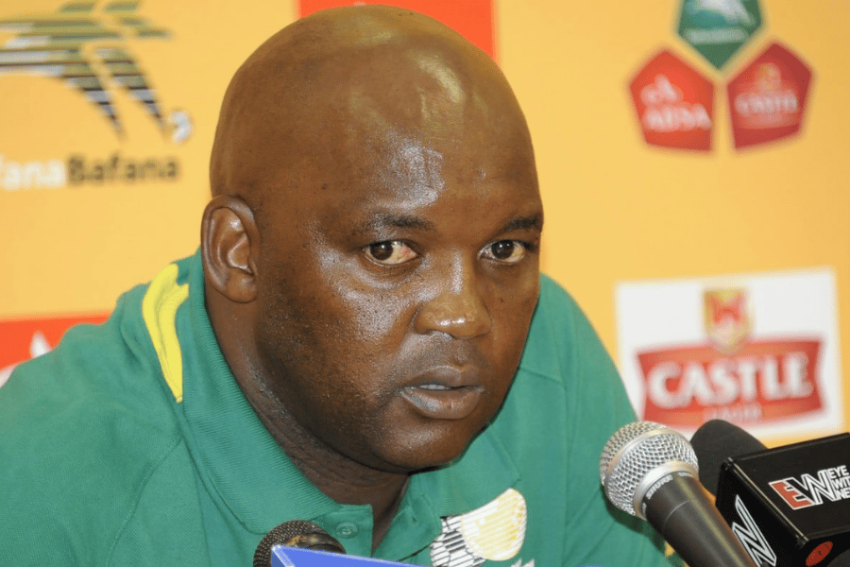
The reported salary package being negotiated for Pitso Mosimane to return as Bafana Bafana coach has reopened an uncomfortable question in South African football: does the South African Football Association (SAFA) value local coaches as highly as it values coaches from overseas?
Mosimane is being lined up for a second spell in charge of Bafana Bafana after SAFA president Danny Jordaan confirmed that the former Mamelodi Sundowns and Al Ahly coach is the association’s preferred candidate to replace Belgian Hugo Broos.
However, the negotiations have reportedly hit a stumbling block over money.
Reports suggest SAFA offered Mosimane a package worth about R5 million a year, which translates to approximately R416,000 a month. Mosimane’s camp has reportedly rejected the offer, with his representatives understood to be seeking a package closer to what Broos earned.
That figure has immediately raised eyebrows among South African football followers.
It is not necessarily because R400,000-plus a month is excessive for a coach of Mosimane’s stature. Rather, it raises a much bigger question: why have South African coaches so often been paid significantly less than foreign coaches, despite some of them having delivered historic achievements for Bafana Bafana?
Mosimane’s journey with Bafana
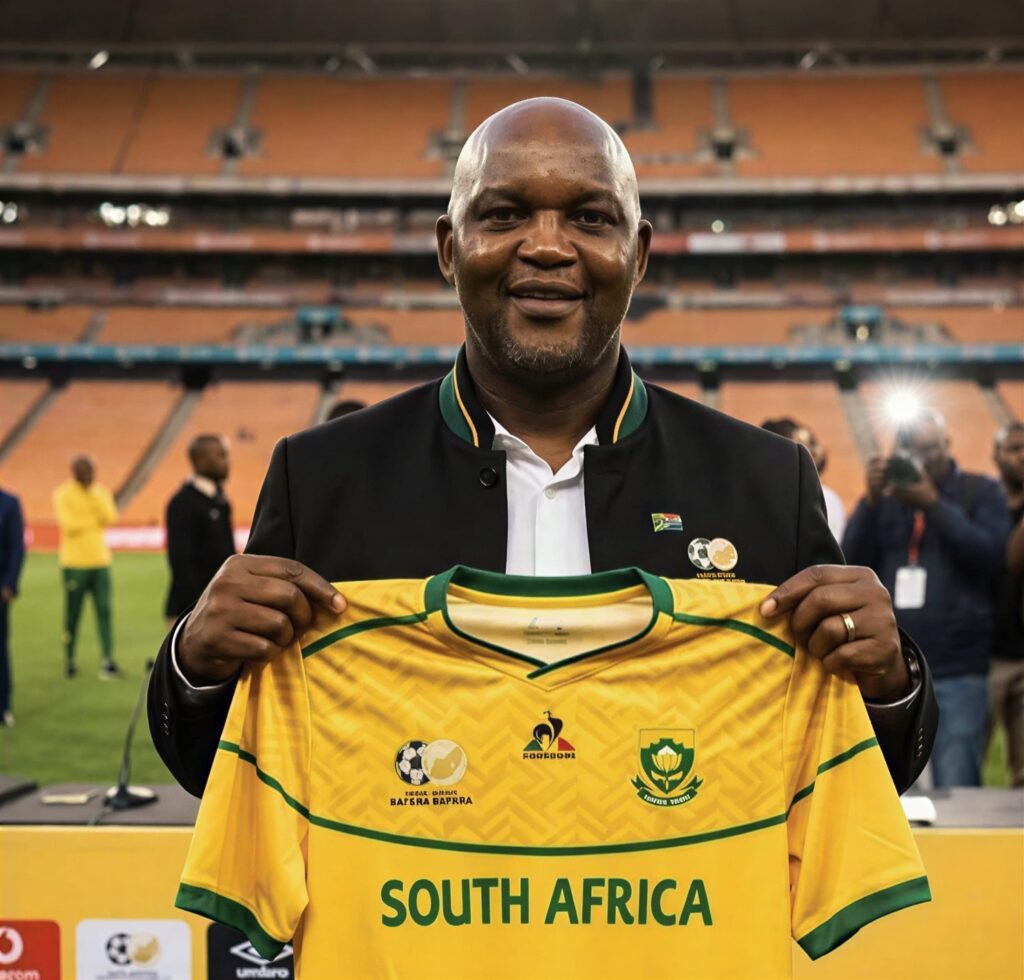
Mosimane’s relationship with Bafana Bafana did not begin when he was appointed head coach in 2010.
His involvement with the national team stretches back several years and included working under some of the foreign coaches appointed by SAFA.
He was part of the Bafana setup during the era of Ted Dumitru, before becoming increasingly involved in the national team’s technical structures.
Mosimane subsequently worked closely with Brazilian World Cup-winning coach Carlos Alberto Parreira. He spent several years learning under Parreira and was part of the technical team as South Africa prepared for the 2010 FIFA World Cup.
He also served under Joel Santana, Parreira’s successor, during the build-up to the 2009 FIFA Confederations Cup.
In 2007, Mosimane even served as Bafana’s caretaker coach for seven matches before Parreira returned to the head coaching position. South African History Online records that Mosimane moved from SuperSport United into the national team setup and served as caretaker coach during that period.
Those years effectively became his apprenticeship at international level.
When Parreira left after the 2010 World Cup, SAFA finally turned to one of its own.
On July 15, 2010, Mosimane was appointed Bafana Bafana head coach.
A difficult first spell
Mosimane’s first match as permanent Bafana coach ended in an encouraging 1-0 victory over Ghana in August 2010.
The victory was significant because Ghana had reached the quarter-finals of the 2010 World Cup.
Under Mosimane, Bafana produced several impressive results, including victories over Egypt, Burkina Faso, Niger and Kenya.
But his tenure ultimately ended in controversy.
South Africa failed to qualify for the 2012 Africa Cup of Nations after a misunderstanding over the qualification regulations. Bafana drew 0-0 with Sierra Leone in their final qualifier when they believed a draw would be sufficient, only to discover that they needed to win the match.
Mosimane was dismissed in June 2012.
His final Bafana record was 16 matches, six victories, seven draws and three defeats.
That episode remains one of the biggest disappointments of his coaching career, but it did not define what would follow.
The redemption of Pitso Mosimane
After leaving Bafana, Mosimane rebuilt his reputation at club level.
His greatest breakthrough came at Mamelodi Sundowns, where he led the club to the CAF Champions League title in 2016, becoming the first South African coach to win the competition with a South African club.
He later moved to Egyptian giants Al Ahly and won the CAF Champions League in 2020 and 2021, making him a three-time Champions League-winning coach.
Reuters reports that Mosimane subsequently coached in Saudi Arabia, the United Arab Emirates and Iran, further strengthening his international coaching credentials.
His club record means the Mosimane now being considered by SAFA is a very different coach from the one who was dismissed in 2012.
And that is why the salary debate is so important.
The foreign-coach premium
South African football has a long history of paying foreign coaches substantially more than local coaches.
One of the clearest examples was Parreira.
When the Brazilian was appointed Bafana coach, his reported salary was R1.8 million a month. His assistant was reported to be receiving R590,000 a month. The figure was so controversial that it was described in Parliament as excessive and “obscene” by former Bafana player Roger de Sa.
When Parreira left, another Brazilian, Joel Santana, took over.
Santana was reportedly paid about R1.5 million a month. Parreira had been earning about R1.8 million.
Other reports put Santana’s salary at approximately R1.4 million a month, while Parreira’s was reported at R1.8 million.
The contrast becomes even more striking when one goes back to the 1990s.
Remember Clive Barker
The late Clive Barker remains one of the most successful coaches ever to lead Bafana Bafana.
Barker guided South Africa to its first and only Africa Cup of Nations title in 1996.
Two years later, he also guided Bafana to qualification for the country’s first FIFA World Cup in 1998.
CAF and Parliament have both recognised Barker’s achievements as among the most important in the history of South African football.
Yet Barker’s remuneration provides one of the starkest examples of the financial gap.
A report published by IOL stated that Barker was earning only R12,500 a month when he led Bafana to the 1996 AFCON triumph. He later negotiated a salary of R100,000 a month for the final year of his coaching career.
That means the coach who delivered South Africa’s greatest men’s international football achievement was, at one point, earning a fraction of what foreign coaches would later receive.
Barker died on June 10, 2023, aged 78, following a battle with Lewy Body Dementia.
His legacy, however, remains enormous.
And then there is Shakes Mashaba
Another South African coach whose story deserves consideration is Ephraim “Shakes” Mashaba.
Mashaba has served South African football in different capacities and had two spells as Bafana Bafana coach.
His tenure also produced important moments, including helping Bafana qualify for the 2015 AFCON.
By the time he was dismissed in 2016, Mashaba was reportedly earning around R500,000 a month, making him the fourth-highest-paid of the previous five Bafana coaches at that time.
But his situation today provides a painful reminder that football fame does not necessarily guarantee financial security after retirement.
In June 2026, Mashaba’s family publicly appealed for assistance as the former Bafana coach battled serious health problems, including prostate cancer and tuberculosis. His daughter, Nonhlanhla Mashaba, appealed for help with mounting medical expenses and requested assistance with medical supplies, groceries, hygiene products, a walker and home-care support.
Mashaba’s condition has since attracted support from public figures, including ActionSA president Herman Mashaba, who visited him and his family in July.
His circumstances should force South African football to ask a difficult question:
What happens to the men and women who dedicate decades of their lives to developing the country’s football when their playing and coaching careers are over?
It is not about saying foreign coaches should not be paid
The argument should not be misunderstood.
South Africa should be able to employ the best coach available, whether that coach comes from Soweto, Limpopo, Brazil, Belgium or anywhere else.
A foreign coach with an outstanding record should be properly compensated.
The problem arises when nationality appears to influence the value placed on coaching expertise.
If a foreign coach can command more than R1 million a month simply because of his international reputation, while South African coaches with deep knowledge of the local game are expected to accept significantly less, then SAFA needs to explain the logic behind its remuneration policies.
The question becomes even more relevant in the Mosimane case because he is no longer simply a local coach.
He is a three-time CAF Champions League winner.
He has won major trophies with Sundowns and Al Ahly.
He has coached outside South Africa.
He has worked under some of the world’s most respected coaches.
And, importantly, he understands South African football from the inside.
Is R400,000 enough for Mosimane?
If the reported R5 million annual offer is accurate, Mosimane would be receiving about R416,000 a month.
That is a substantial salary by South African standards, but it is also dramatically below the reported packages previously paid to Parreira and Santana.
It is also reportedly below the package associated with Broos, whose tenure ended after South Africa’s 2026 World Cup campaign.
The irony is difficult to ignore.
SAFA appears willing to bring back a South African coach with a far more decorated club résumé than when he left Bafana in 2012, yet the reported offer is considerably lower than the money that was once paid to foreign coaches.
Whether Mosimane eventually accepts the job remains a matter for the final negotiations.
But his return has already achieved something important: it has reopened the debate about how South Africa values its own football brains.
Time for a new approach
Perhaps the real lesson from Barker, Mashaba and Mosimane is that South Africa needs to develop a sustainable coaching pathway rather than repeatedly looking overseas whenever Bafana Bafana faces a crisis.
Mosimane himself is proof that local coaches can learn, grow and eventually compete at the highest levels of African football.
He began as an assistant.
He worked under foreign coaches.
He gained international experience.
He made mistakes.
He was dismissed.
He rebuilt his career.
And eventually he became one of the most decorated coaches in African club football.
That journey should be an example for SAFA.
Instead of treating local coaches as cheaper alternatives, the association should create a transparent remuneration structure based on experience, qualifications, achievements, responsibilities and performance — rather than nationality.
If a South African coach is good enough to lead Bafana Bafana, he or she should be paid accordingly.
And if a foreign coach is appointed, that coach should also be paid according to the same objective criteria.
The Mosimane negotiations therefore go beyond one man’s salary.
They are about respect, recognition and the value South Africa places on its own football talent.
For a country that produced coaches such as Clive Barker, Shakes Mashaba and Pitso Mosimane, perhaps it is time to stop asking whether local coaches are good enough — and start asking whether the football authorities have ever valued them enough.