


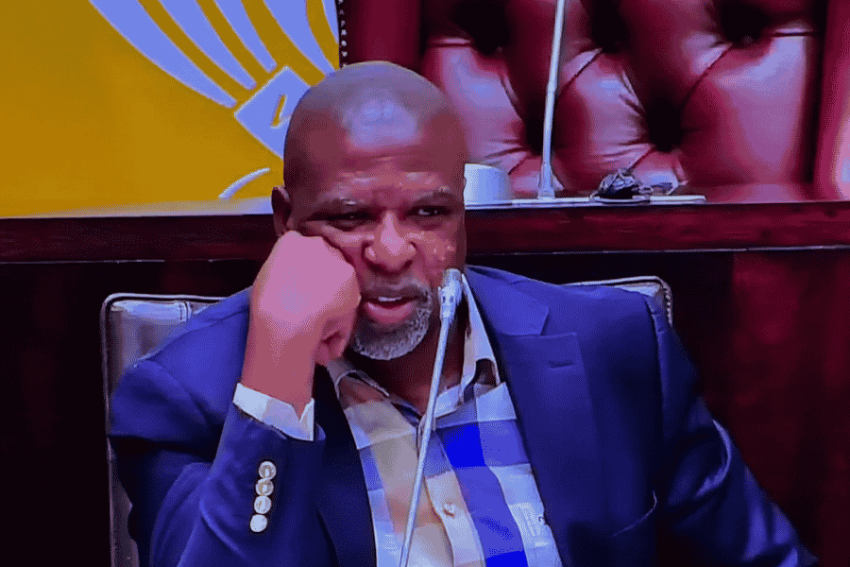
The probe into South Africa’s broken criminal justice system has taken a dramatic turn, with Parliament’s ad hoc committee now demanding that top prosecutors themselves be investigated for alleged capture by organised crime.
After weeks of focusing on police corruption, the committee probing claims made by KwaZulu-Natal police commissioner Nhlanhla Mkhwanazi is widening the net to the National Prosecuting Authority (NPA)
MPs on Thursday night rallied behind a proposal that the National Director of Public Prosecutions must account to Parliament on how it will deal with allegations that prosecutions have been compromised.
Committee chairperson Soviet Lekganyane said the ANC’s submission was that the NDPP be ordered to provide a confidential report to the Justice Portfolio Committee.
“The ANC submitted that the NDPP should provide a confidential report to the Portfolio Committee on Justice concerning allegations that prosecutions may have been compromised by organised criminal interests,” Lekganyane told the committee.
He said the ANC wants the report to spell out what process will be followed to probe the claims and what steps will be taken to protect cases that may have been tainted. Sensitive intelligence, the party proposed, should be routed through the Joint Standing Committee on Intelligence.
Until now, the ad hoc committee, established after Mkhwanazi alleged political interference, corruption and criminal infiltration of law enforcement, has focused heavily on SAPS and Crime Intelligence.
Parties are currently working through the final sections of a 790-page draft report, with deliberations stretching into late-night sessions. The deadline to conclude is 30 October.
As part of wider reforms, the committee is also eyeing an overhaul of the SAPS Act.
This week ActionSA pushed for all ministerial directives on police policy and operations to be tabled before Parliament for scrutiny. After debate, MPs agreed that only specific directives should be tabled, not every instruction from the Minister.
But consensus has collapsed on what should happen to the Investigating Directorate Against Corruption.
The DA has reignited its push for thw Independent Directorate Against Corruption (IDAC) to be shut down completely and replaced by a standalone anti-corruption body outside the NPA.
Speaking during deliberations on Wednesday, DA chief whip Glynnis Breytenbach was adamant that IDAC should be disbanded.
“We think IDAC should be closed down and that an independent anti-corruption commission should be appointed outside of the NPA. We don’t think IDAC should continue to exist,” Breytenbach said.
She said the DA instead wants a stronger, financially autonomous NPA that does not depend on the Department of Justice for its budget.
“They should have control over their own budget. They should no longer source their budget from the Department of Justice but should negotiate the terms of their own budget directly with Treasury,” she argued.
The MK Party, which has already tabled a bill to disband IDAC, agreed.
“IDAC, I must re-emphasise once again, must close. We can do without IDAC,” said MK MP David Skosana.
The EFF fiercely opposed the dissolution argument, warning that closing one body will not fix systemic capture.
EFF MP Leigh-Ann Mathys said the focus should be on laws and oversight, not scrapping institutions.
“We all had high hopes, and look what happened to it. I don’t know the issue with IDAC; it had so much to do with it not having enough independence. It was pretty much that it was captured, and it can happen to any entity that is existing,” Mathys said.
EFF leader Julius Malema said IDAC’s problems stemmed from a lack of oversight, not a flawed mandate.
“There’s nothing wrong with IDAC. IDAC was behaving in a manner it did because there was no structure playing an oversight over it, and therefore, it was a power unto itself,” Malema told MPs.
He pointed to the appointment in July 2026 of retired Judge Takalani Joseph Raulinga as IDAC’s oversight judge to handle complaints of abuse of power and maladministration, saying that mechanism should have existed from the start.
“The problem is not the institution. The problem is the individuals occupying it, along with the lack of early detection mechanisms to hold them immediately accountable,” Malema said.
ANC MP Mdumiseni Ntuli echoed that view, arguing that rotten elements should be removed rather than the institution itself.
“There was something fundamentally wrong with the incumbents, and the best way to deal with that situation will not be to close the entire institution, but to deal with the elements that are within,” Ntuli said.
IDAC has been under fire over its handling of Crime Intelligence-related matters, including the now permanently withdrawn case linked to the appointment of Dineo Mokwele.
The fallout from testimony before the Madlanga Commission led to the resignation of former IDAC head Andrea Johnson and the suspension of investigators Dylan Perumal, Brian Padayachee and Suneel Bellochun.
Advocate Ntuthuzelo Vanara is now acting head.