
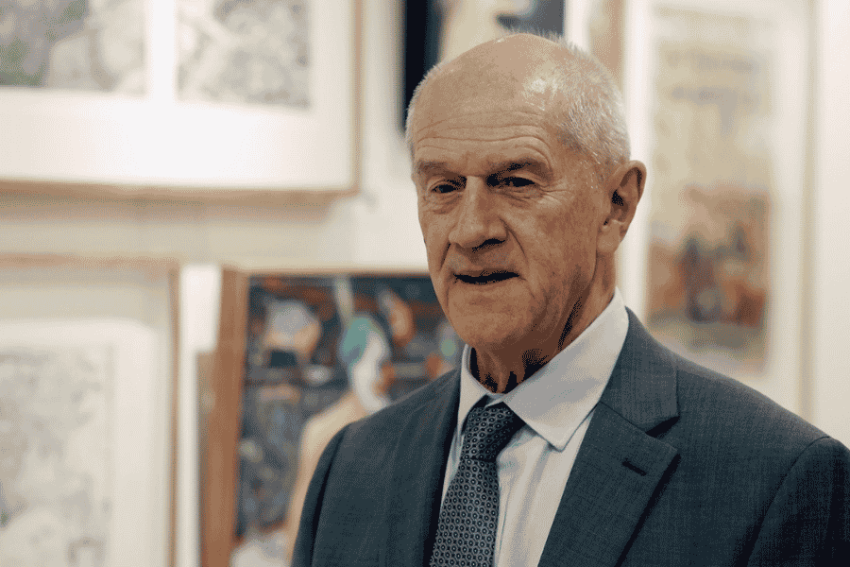
Veteran negotiator Roelf Meyer says South Africa should stop treating its bruising fight with Washington as a unique humiliation and stop obsessing over America’s threatened boycott of the G20 Leaders’ Summit in Johannesburg.
Meyer, the former NP cabinet minister who helped negotiate the end of apartheid, said his recent talks in Washington made it clear that South Africa is not the only target of an aggressive White House – and that playing the “political football” victim will not help Pretoria.
“South Africa was not the only country experiencing strained relations with the US,” Meyer said, revealing a lengthy conversation with his Canadian counterpart on the sidelines of meetings in Washington.
“I had a long conversation with my Canadian colleague in Washington, and you can imagine what that conversation delivered. It’s not South Africa alone. We might experience special treatment in a certain way, but we are not the only one that falls into that category of what you refer to as a political football,” he said.
His intervention comes as relations between Pretoria and Washington have sunk to their lowest point since 1994.
The Trump administration has cut aid, expelled South Africa’s ambassador, offered refugee status to white Afrikaners citing “persecution”, and threatened to skip the G20 Summit next month – a move that would be unprecedented for a G7 leader and has been framed as a deliberate snub to President Cyril Ramaphosa’s presidency of the forum.
Meyer, who understands high-stakes brinkmanship better than most, said the G20 snub should not be over-inflated. South Africa’s task, he argued, is to focus on deliberations and what it is trying to convey, not on who shows up for the photo.
Meyer said the world is facing a wave of American disruption and Pretoria will not win Washington over by making it personal.
That disruption has been fuelled in part by a small but vocal group of white Afrikaners who have travelled to the US to lobby Congress and right-wing media with claims of farm murders, land expropriation without compensation, and racial discrimination.
Meyer did not dismiss their right to speak, but he put them in historical context.
He recalled the 1992 referendum called by former president FW de Klerk, where white South Africans were asked whether they supported the continuation of reforms toward democracy.
Seventy percent voted Yes to change, 30% voted No.
“It’s sad, but that is what we have to keep in mind,” Meyer said of those who opposed transition.
He said that 30% and their descendants are still in the country.
“Those who had voted against change, as well as their next generation, remained in South Africa, although they represented a small minority of the country’s total population,” Meyer said.
“Today, in terms of the total proportion, it’s a small minority out of the whole, but they’re entitled to their views,” he added.
“We can keep on trying to persuade them differently, and I think that is what we should do.”
For Meyer, that history explains the current information war. The minority who never accepted the democratic project in 1992 are now finding an international audience willing to listen, and an American administration willing to use their narrative as leverage against Pretoria’s independent foreign policy on Gaza, Ukraine and BRICS.
But he warned that South Africa cannot win that argument by shouting louder in Washington. It wins it by keeping the G20 agenda on track – on debt, inequality, climate finance and African development – regardless of whether the US president attends or sends a junior official.
In his world, a successful summit is not measured by American validation. It is measured by whether the other 19 leaders agree on a declaration that outlives the current turbulence in the West.