
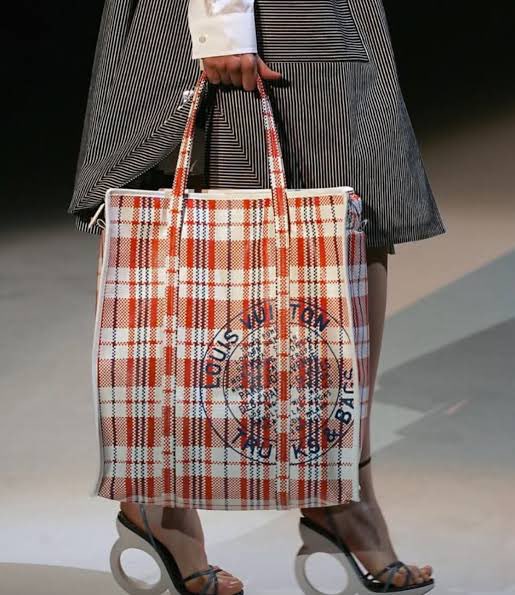
If you grew up anywhere from Accra to Alexandra, you know the bag. The red-white-blue checkered woven plastic bag, foldable yet sturdy, able to carry a lifetime of possessions. In South Africa, it’s called Mashangane, Khonzekhaya, uMas’goduke, Mmalebogo bag, or simply No Problem bag. Across West Africa, one name has stuck: Ghana Must Go.
Every African home has this bag. This bag has been in African homes for the past 20 years, invented in Africa. The entire design has been stolen by a luxury brand without giving credits pic.twitter.com/2iRFxqXnMr
— African Hub (@AfricanHub_) September 17, 2025
A Bag With History
The name carries weight. In 1983, hundreds of thousands of Ghanaians were expelled from Nigeria with just hours to pack. Families stuffed everything into these cheap market bags, giving rise to the iconic moniker.
Cultural historian Dr Nana Osei Quarshie describes it as more than luggage: “The bag is a symbol of survival and displacement,” he notes.
From Market to Luxury Shelf
Fast-forward to 2007, when Louis Vuitton, under Marc Jacobs, unveiled a plaid leather-braided tote, a high-end riff on the humble Ghana Must Go bag. Priced at $595 (R10 300), resellers now list it for $1,200–$2,500. Meanwhile, the original is still bought at taxi ranks in South Africa for under R100.
The bag itself has a journey worth tracing. Its red-white-blue nylon canvas originated in Japan, exported to Taiwan, then Hong Kong, where tailor Lee Wah reportedly made the first bags in the 1960s. Originally used as construction-site shelter, it morphed into a durable, cheap carryall, picking up new names and meanings across Africa from Mwaudako in Namibia to ukwa in Zambia, and Efiewura Sua Me in Ghana.
Social Media Reacts
When Louis Vuitton’s version resurfaced recently, African social media erupted. TikTok users compared the home-language names. Instagram comments mixed satire and critique:
It’s admiration and outrage in equal measure: craftsmanship is lauded, yet the familiar pattern of luxury brands profiting from everyday African life without credit is called out.
@thesindosfamily Replying to @Rudy and all here is your Mashangane Bags #mashangane #luella #nontando🧵👗👌🏻🪡✅💕designer #redbull #sama28 #kagiso ♬ original sound – THE SINDOs FAMILY
Fashion scholar Dr Erica de Greef points out, “These moments open debate about ownership, memory, and power. Is it homage, or appropriation?”
Not the First Time
Louis Vuitton has a history of referencing African motifs. In 2017, a menswear collection borrowed Basotho blanket motifs, maize cobs, and giraffes, turning them into a R33 000 silk shirt. Designer Marianne Fassler admitted the backlash reflected genuine hurt. Other examples include Maasai shuka fabrics and Ghanaian kente cloth, often reproduced without compensation to the original communities.
Africans Reclaim the Narrative
Yet this story isn’t only about appropriation. Many African designers are reclaiming these motifs:
-
Laduma Ngxokolo’s Maxhosa Africa reinterprets traditional patterns in modern fashion.
-
Nigerian brand A.A.K.S, founded by Akosua Afriyie-Kumi, uses plaid patterns in handcrafted raffia bags.
As Lagos designer Papa Oppong told Business of Fashion in 2023, “We’re not just responding to Western luxury. We’re asserting that our utilitarian objects are worthy of design innovation on our own terms.”
More Than Just a Bag
The Ghana Must Go bag holds memories, politics, and resilience. From a shelter cloth to a migrant’s lifeline, and now a luxury accessory, it illustrates how African daily life shapes global style. When a R100 bag becomes a $2,000 collector’s item without credit to its origins, people notice—and they speak out.
Whether you call it Mashangane, Khonzekhaya, uMas’goduke, or Ghana Must Go, this bag has travelled farther than most fashion trends, carrying stories of migration, survival, and African creativity across decades and continents.
Source: IOL
Featured Image: X {@TruthFMUg}