


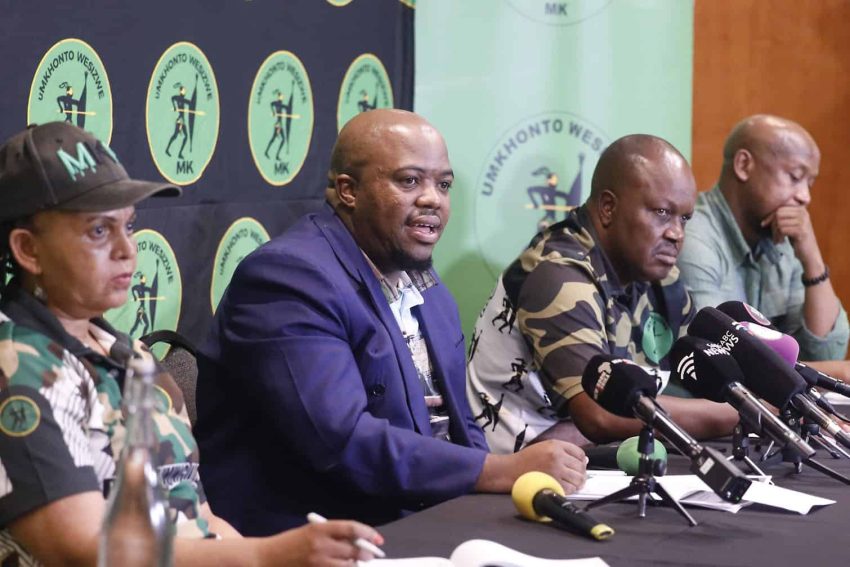
The latest reports about a plot against Nomvalo come at a time when the MK Party is preparing for local government election.
Three months after Sibonelo Nomvalo was appointed the secretary-general of the uMkhonto weSizwe Party (MK party), questions are being raised about whether he will last in his position.
This comes after the Sunday World this weekend reported that Nomvalo has accused the party’s caucus leader in the KwaZulu-Natal legislature, Inkosi Phathisizwe Chiliza, of leading a plot to get him booted from his position.
The paper reports that Nomvalo is accused of being controlled by a senior politician in a rival party. He is also accused of receiving expensive gifts and security from those believed to be his handlers outside the party.
Nomvalo has denied these allegations and has reportedly approached senior leaders in the MK Party to investigate the claims and institute disciplinary action against Chiliza.
The MK party has had several secretaries-general since the party was formed in 2023. The party has also not held an elective conference since its formation, leaving the appointment of top leaders solely in the hands of party founder Jacob Zuma and those around him.
Instability in MK party
Political analyst Andre Duvenhage told The Citizen on Monday that the latest reports about an alleged plot against Nomvalo do not come as a surprise.
“We have seen a number of secretaries-general come and go, most of them not staying longer than a few months. The problem with the MK party is that it is run by a cabal of personal interests, centred around Jacob Zuma and his closest people, more or less family people, and there are no proper procedures, protocol, organisational structures – they have more of a patrimonial structure than an organisational structure.
“The point is personal influences are stronger than the influences of organisational decisions,” he said.
While it is common for political parties to hold elective congresses, Duvenhage said he is sceptical that fully fair elections can take place in the current environment within the MK party.
“But if indeed they can create a situation where elective processes can take place it will be possible to bring organisational structure back – but that will work against the personal interests of what I would like to call the personal cabal that is driving the MK party,” he said.
Duvenhage said another problem with the MK party is the use of identity politics, in which the party has been associated with Zulu nationalism as part of its mobilisation strategy.
“Within the context of black politics in South Africa, the Zulu identity as a form of mobilisation is probably the strongest of them all.”
Zuma’s role in the divisions
He said Zuma is also to blame for the current tensions in the party because they benefit his divide-and-rule strategy.
“He used factional battles to establish his power base so that no single individual or grouping becomes too strong. He uses divide-and-rule as a mechanism, and that is common to patrimonial-type structures and also structures that are not functioning in a democratic way,” he said.