
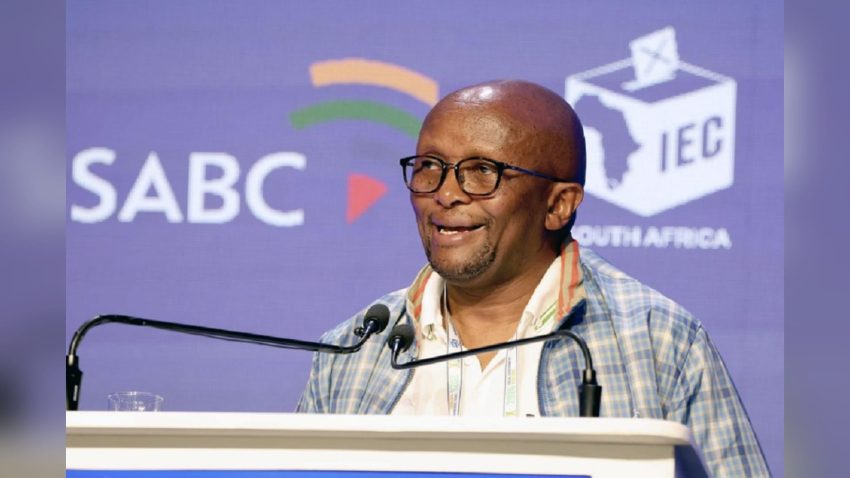
The Electoral Commission of South Africa (IEC) has given four different voter counts in four days. Its latest tally is nearly a million lower than its first.
Despite declaring the elections free and fair, the Commission has yet to explain why its own senior officials cannot agree on how many South Africans participated.
On Thursday, IEC Deputy Chief Electoral Officer Masego Sheburi said 15.9 million South Africans had voted, including those who participated in special voting and on election day.
“We can indicate that at this rate, 15.9 million South Africans participated both during special votes, as well as during the elections yesterday,” Sheburi told Journalists on Thursday at a media briefing.
At the time, the IEC estimated voter turnout at 54.5%, but also cautioned that the figures were preliminary.
However, on Sunday, 8 November, the figure had dropped to 15.2 million.
Speaking at the IEC National Results Operations Centre, Gallagher Convention Centre in Midrand, Gauteng, the Chief Electoral Officer Sy Mamabolo said: “In these elections, 15.2 million South Africans participated. Every voter who successfully exercised the right to vote did so within an operational environment supported by voting station infrastructure, electoral personnel, ballot papers, technological systems and logistical arrangements.”
Few minutes later, IEC chairperson Mosotho Moepya announced an even lower figure, of approximately 14.9 million.
Moepya said: “A total of 29.2 million voters were registered for the 2026 elections. Approximately 14.9 million South Africans cast their ballots in this municipal election. The national turnout for these elections is 52%, an increase of 6.1 percentage points from the 45.9% turnout recorded in the 2021 Local Government Elections.”
The successive revisions represent a discrepancy of up to one million voters, with neither official explaining what happened to the missing numbers.
The IEC has not explained why the figures changed, which of the three Sunday figures represents its final verified count, or how the different turnout percentages were calculated.
The discrepancies are particularly concerning because the Commission’s senior leadership presented the figures at the ceremony where it formally declared the elections free and fair.
Both Mamabolo and Moepya acknowledged that the IEC had fallen short in certain areas, although neither directly addressed the conflicting voter totals.
Mamabolo said: “We have succeeded in many aspects in this election, but we have come short in others.”
Moepya was similarly candid about the Commission’s shortcomings. “In celebrating these elections, we must not create the impression that all things went perfectly well. There is no such election. We are the first to know,” he said.
He added that the Commission had a responsibility to acknowledge its mistakes and ensure they were not repeated. “To this extent, no institution can take itself seriously if it does not acknowledge its shortcomings. Equally, no institution should allow its shortcomings to obscure the considerable work it has done well,” Moepya said.
He subsequently declared the 2026 local government elections free and fair.