
It could remain in place for longer if strong Eurozone summer demand puts further pressure on global jet fuel prices.
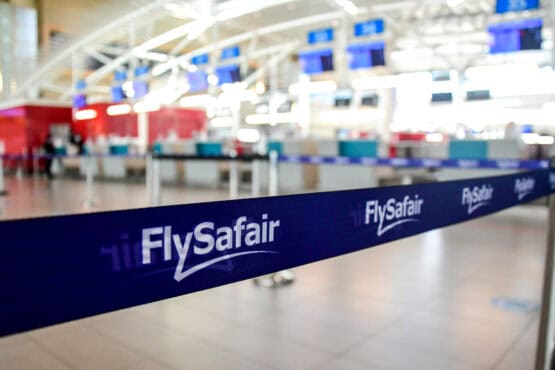
South Africa’s largest airline, FlySafair, has extended the surcharge on ticket prices in a bid to thicken its buffer against the steep increase in fuel costs triggered by conflict in the Middle East.
It will be in effect until August, if leaders of the warring countries can agree on a ceasefire sooner rather than later.
The low-cost airline implemented the surcharge mechanism in March, when jet fuel came under tremendous pressure after global oil prices surged to the highest since mid-2022 following the US and Israel’s war on Iran.
The conflict in the Middle East has resulted in an effective shut down of the Strait of Hormuz, the narrow waterway through which roughly 20% of the world’s oil supply flows.
As a result, tanker traffic collapsed, with estimates suggesting a 70-80% drop in shipping through this critical route. The impact on prices has been immediate and severe.
Global oil prices have mirrored a pendulum, with Brent crude surging past $115 per barrel before settling around $87-$100 amid extreme volatility.
More critically for aviation, Jet A1 fuel prices at South African coastal airports spiked by approximately 70% in just the first week of the hostilities.
Fuel typically makes up 50-55% of an airline’s input costs (roughly the same for FlySafair’s direct operating costs).
While FlySafair has extended the surcharge by another three months for now, the airline says it’s difficult to put a definitive timeline on how long it may remain necessary.
It adds that it will depend entirely on how global fuel markets and supply dynamics evolve.
“The biggest shift since the outset of the conflict has really been the timeline,” FlySafair chief marketing officer Kirby Gordon tells Moneyweb.
“Initially, there was a view that the volatility may be relatively short-lived and that a temporary surcharge applied to bookings a few months out would be sufficient.
“As the conflict and associated supply pressures have persisted, we’ve had to revise that position and apply the surcharge to flights operating in the foreseeable future, based on ongoing market analysis and industry guidance.”
Gordon says the surcharge is not static, with weekly reviews to assess the situation.
“There have already been some periods where we’ve been able to reduce it marginally as market conditions eased slightly,” he adds.
Euro summer: A dream for some, a nightmare for airlines everywhere else
One of the concerns globally at the moment is the traditional northern hemisphere summer demand cycle, where airlines in Europe and North America typically increase flying activity significantly, placing additional pressure on global jet fuel demand.
In an environment where supply is already constrained, that can place further upward pressure on prices.
“From a route planning perspective, this is naturally not an ideal environment in which to incubate new routes or take aggressive expansion decisions,” says Gordon.
“The focus at present is on maintaining core connectivity across the network as efficiently and sustainably as possible.
“We are continuously adjusting schedules and operational planning to maximise efficiency, but the volatility in both input costs and consumer demand makes that process more dynamic than usual.”
The airline says it has modelled a range of potential outcomes, from a relatively rapid stabilisation and recovery in fuel markets, through to a more prolonged period of elevated pricing and geopolitical uncertainty.
This article was republished from Moneyweb. Read the original here.
Support Local Journalism
Add The Citizen as a Preferred Source on Google and follow us on Google News to see more of our trusted reporting in Google News and Top Stories.