


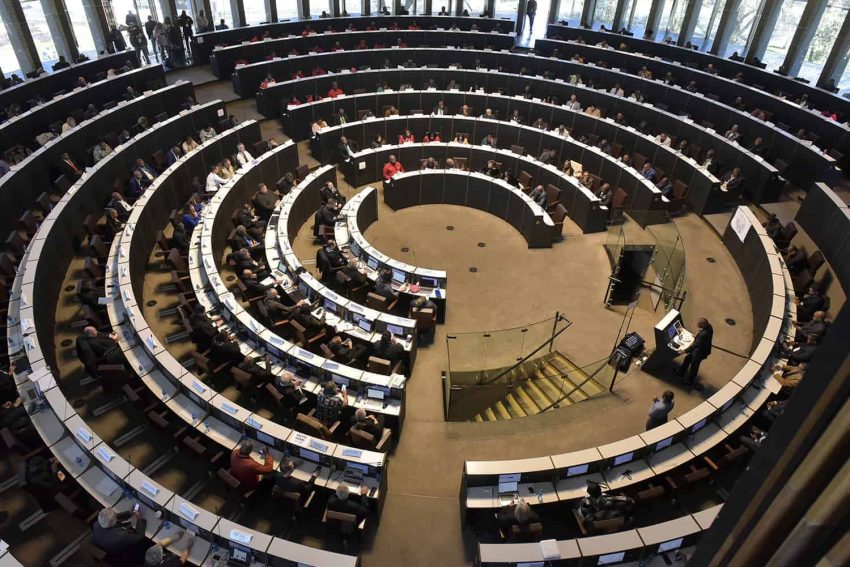
The DA said the city’s decision to scrap the debt of struggling households is a ‘reckless’
Days after the City of Johannesburg adopted a report to honour a R10.3 billion wage deal with the South African Municipal Workers Union (Samwu), the city has now passed a motion to write off the millions of rands owed by residents on the city’s indigent register.
The motion was adopted on Tuesday after it received sufficient support from councillors, including the ActionSA caucus, which is not part of the current government in Joburg. It was tabled by the EFF’s Mgcini Tshwaku, but he did not provide the exact amount that would be scrapped.
According to reports, residents, businesses and government departments owe the City of Johannesburg around R50 billion.
EFF motion adopted: What does this mean?
What this means for Johannesburg residents is that households registered on the city’s indigent database, who, due to their financial circumstances, are unable to afford basic services such as water, electricity, sanitation and refuse removal, will no longer be required to pay accumulated municipal debt.
Reacting to the adoption of this motion on Tuesday, EFF chairperson in Gauteng, Nkululeko Dunga, said it will ensure the city stops aggressive debt-recovery measures against indigent households, including the disconnection of essential services.
According to the city’s classification, indigent households are those without sufficient income to meet municipal rates and tariffs, including beneficiaries of the South African Social Security Agency (Sassa), unemployed individuals and child-headed households.
“The EFF maintains that any debt owed by these households is, in reality, unrecoverable, as these families must prioritise their limited resources towards survival,” he said.
The motion to remove the debt of indigent households was recently adopted in the City of Tshwane but rejected in the City of Ekurhuleni, where it did not receive enough support.
“EFF reiterates its principled position that municipal debt owed by the poor must be scrapped in full. This is not an act of charity, but a matter of justice. No household should be criminalised for being poor, particularly when the government of the day has completely failed to provide jobs and improve living conditions.”
Dunga said indigent households are trapped in a cycle of debt, not because they refuse to pay, but because they simply cannot afford to.
“This crisis reflects a deeper structural failure in the fiscal framework, where municipalities are underfunded and forced to extract revenue from those with no means.
“This unjust system punishes the poor for the failures of the state,” said Dunga.
ALSO READ: WATCH: Zille dives into Joburg pothole, but stunt won’t guarantee mayor position
DA’s concerns
The DA in Johannesburg abstained from voting for this motion. Its caucus leader, Belinda Kayser-Echeozonjoku, told The Citizen that it is irresponsible to simply write off debt without sufficient details and an effective plan for revenue collection.
“At a time when Johannesburg is battling collapsing service delivery, they ballooned the salary bill to over R21 billion, and the city is making reckless financial decisions.
“It is even more troubling that a request for an urgent debate on this ballooning salary bill was denied, while a vaguely defined and unquantified debt write-off is pushed through without scrutiny.
“This is not governance, it is financial irresponsibility, because the city already has multiple targeted support mechanisms designed to assist vulnerable residents in a fair, structured, and sustainable way,” said Kayer-Echeozonjoku.
‘Several options to help the poor’
According to Kayser-Echeozonjoku, there are existing measures in place to help the poor and those struggling financially.
This includes the Extended Social Package (ESP), which provides a sliding scale of support, ensuring that those with the greatest need receive the highest level of assistance from the city.
The support includes free basic water allocations, free basic electricity (typically around 50kWh or more, depending on category), and free refuse removal for qualifying households.
“The issue is not a lack of programmes, it is a lack of implementation, which the ANC and its partners failed to do, being part of government in Johannesburg.
“Instead of fixing administrative failures and ensuring that qualifying residents are properly supported, the city is choosing to politicise poverty and push unsustainable financial decisions that ultimately place even greater strain on already failing municipal finances.
“Johannesburg residents deserve dignity, fairness, and responsible governance, not short-term political gimmicks that risk long-term consequences.”
ActionSA’s ‘pro-poor stance’
Meanwhile, ActionSA caucus leader Marcel Coutriers said his party supported the motion because it aligns with its pro-poor stance.
“ActionSA in the City of Johannesburg supported the motion on the protection of indigent beneficiaries because we are, and will always be, a pro-poor political party committed to fairness, dignity and justice.
“This motion sought to correct a fundamental injustice: that vulnerable residents, who qualify as indigent, continue to be treated as debtors due to administrative failures within the city,” he said.
NOW READ: Service delivery fears grow after Joburg wage deal