
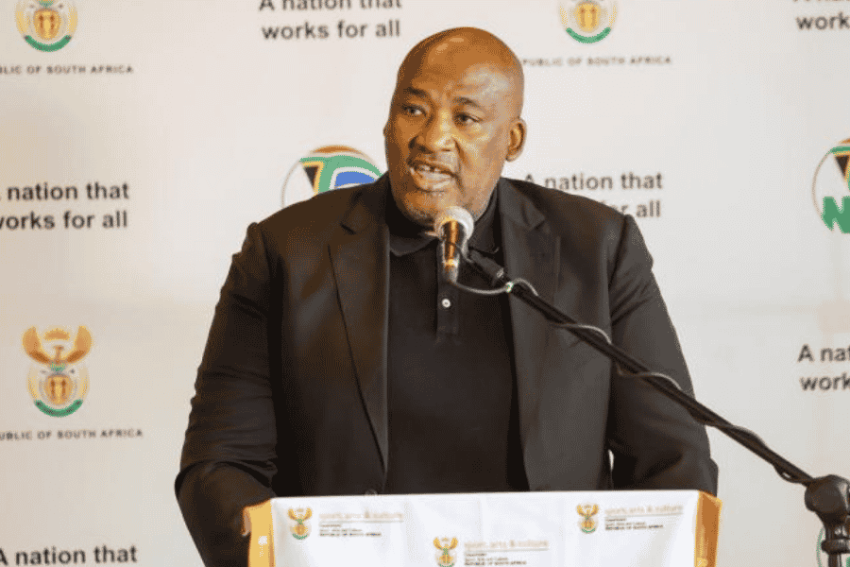
The Auditor-General has confirmed fraud by some beneficiaries who received money from Gayton McKenzie’s Department of Sport, Arts and Culture (DSAC).
They doctored the proofs of payment they handed in to account for the funds.
A follow-up review by the Auditor-General of South Africa (AGSA) found that beneficiaries submitted invalid bank account details.
Payment amounts and account-holder names on proofs of payment were changed. The amounts on those proofs did not match the bank statements behind them.
The AGSA warned that this “heightens the risk that transferred funds were not utilised for their intended purposes”.
It said the fraud could lead to financial losses and failures in service delivery.
The review followed up on suspected fraud on transfers that the AGSA flagged a year earlier.
The AGSA did not name the beneficiaries or say how much money was involved.
The findings are in the AGSA’s 2025-26 budget review briefing to Parliament’s Portfolio Committee on Sport, Arts and Culture. It was presented on 1 October.
The department also fell short on its flagship job-creation programme.
It planned to create 10,000 work opportunities through the creative sector stimulus under the Presidential Employment Stimulus Programme (PESP). It reported 8,762.
In its annual report, the department explained that jobs were “disqualified owing to lack of validity and duplication of documentation, i.e. identity documents”.
The AGSA credited PESP with creating jobs in the arts. But it raised concerns about weak monitoring, reporting backlogs and poor supporting evidence.
It also found that more PESP money was approved without a full assessment of how earlier rounds had performed. The AGSA said there was also no full assessment of whether those rounds gave value for money or were sustainable.
The problems go beyond the fraud.
The AGSA said many beneficiaries still fail to submit complete and timely financial and performance reports. This is despite the department introducing an 80/20 funding model to tighten accountability.
The department does not pick up these failures in time, and no corrective action follows.
It appointed outside service providers to help monitor and verify spending. The AGSA said serious gaps in beneficiary reporting remain.
It could not get enough assurance that the money was consistently used for what it was meant for.
The AGSA also found the department did not ensure that transfers to its entities were used for their intended purposes.
Transfers are where most of the department’s money goes. Of the R6.29 billion DSAC spent in 2025-26, R5.187 billion, or 82.5%, went out as transfers and subsidies.
Funding to sport federations was also flagged. The AGSA found recurring problems with spending reports and supporting documents. It blamed the lack of clear reporting rules.
The AGSA said the department’s interventions so far “have not adequately addressed the root causes”.
It wants the department to tighten beneficiary oversight, verification, record-keeping and consequence management.
This is not the first time the AGSA has raised the alarm about where DSAC’s transfers end up.
In 2022, it issued a material irregularity over R7.5 million paid to a beneficiary in 2018 and 2019 to start a broadcasting academy. There was no evidence that the money was used for the project.
The AGSA has since closed that matter. It said the department is pursuing civil recovery and took disciplinary action against the official responsible.
The department previously received a Gobodo forensic report into R51.8 million transferred to the Cultural and Creative Industries Federation of South Africa (CCIFSA) between 2014/15 and 2023/24.
McKenzie said he had instructed the director-general to begin processes against officials named in the report.
In a written reply to MK Party MP Gift Motaung in July, McKenzie said three officials faced disciplinary proceedings over irregular expenditure flagged by the AGSA for 2025-26.