


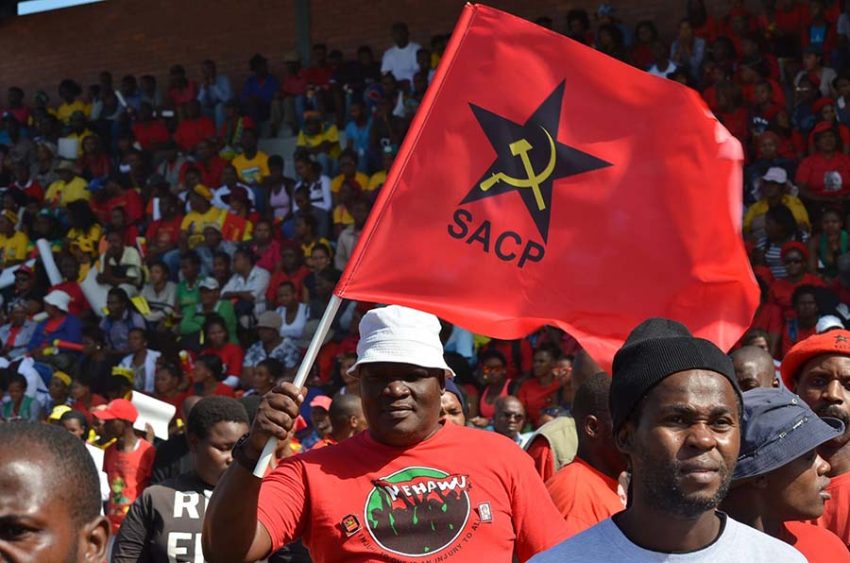
The South African Communist Party (SACP) has launched a scathing counterattack against the ANC, accusing the governing party of arrogance and paternalism after it dismissed an upcoming Conference of the Left as a “coalition of negation”.
In a strongly-worded statement, the SACP tore into ANC secretary general Fikile Mbalula and the party’s national executive committee for attempting to undermine the conference before it has even taken place.
The clash marks a significant escalation in tensions within the tripartite alliance, as the SACP pushes back against what it sees as the ANC’s drift towards neoliberal policies and its embrace of the Government of National Unity.
ANC’s pre-emptive strike
Mbalula and the ANC had characterised the planned Conference of the Left as a “coalition of negation — united by what it stands against, namely the ANC in government”. The governing party suggested the conference collapses class distinctions and even involves business formations, questioning its left-wing credentials.
The ANC’s statement appeared designed to delegitimise the gathering before it could convene, positioning the governing party as the sole authentic voice of progressive politics in South Africa.
‘Selective memory and opportunism’
But the SACP was having none of it. In its response, the party accused the ANC of “selective memory and opportunism”, pointing out that ANC leaders had previously engaged with the conference organisers without objection.
“The ANC statement is arrogant, presumptive and paternalistic,” the SACP fired back. “It pre-empts and misrepresents the conference’s purpose and outcomes.”
The communist party said the ANC’s dismissal of the conference showed contempt for the competence and agency of working-class participants and organisers.
Defending the left platform
The SACP defended the Conference of the Left as an “open platform for honest debate, strategic reflection and possible convergence” aimed at addressing South Africa’s mounting crises — mass unemployment, deindustrialisation, austerity, failing public services and deepening inequality.
Rather than diluting class politics, the SACP argued, the conference seeks to strengthen them by organising expanded layers of the working class, including informal traders, cooperatives and micro-enterprises, under working-class leadership.
The party rejected the ANC’s “purist, exclusionary definition” of the left as “politically limiting” and out of step with the realities facing ordinary South Africans.
Alliance under strain
Despite the sharp exchange, the SACP insisted it remains committed to the tripartite alliance with the ANC and Cosatu as “a site of principled engagement”.
However, the party made clear that alliance discipline should not mean silence in the face of unemployment, poverty, inequality, austerity, corruption and what it called a “rightward drift” in government policy.
The statement pointedly referenced the GNU — the power-sharing arrangement between the ANC and the Democratic Alliance — as part of this rightward shift, contributing to “austerity, neoliberal consolidation and failure to address the crisis facing workers and the poor”.
Battle for the left
The confrontation reveals a deeper struggle over who speaks for the left in South African politics, with the ANC seeking to maintain its historical dominance while the SACP and other formations assert their independence.
By attempting to position itself as the opponent of the Conference of the Left, the ANC risks further alienating its traditional allies at a time when it can least afford such divisions.
The SACP accused the ANC of “self-glorification, isolationism and combative politics” — a far cry from the united front approach that characterised the alliance during the struggle against apartheid.