
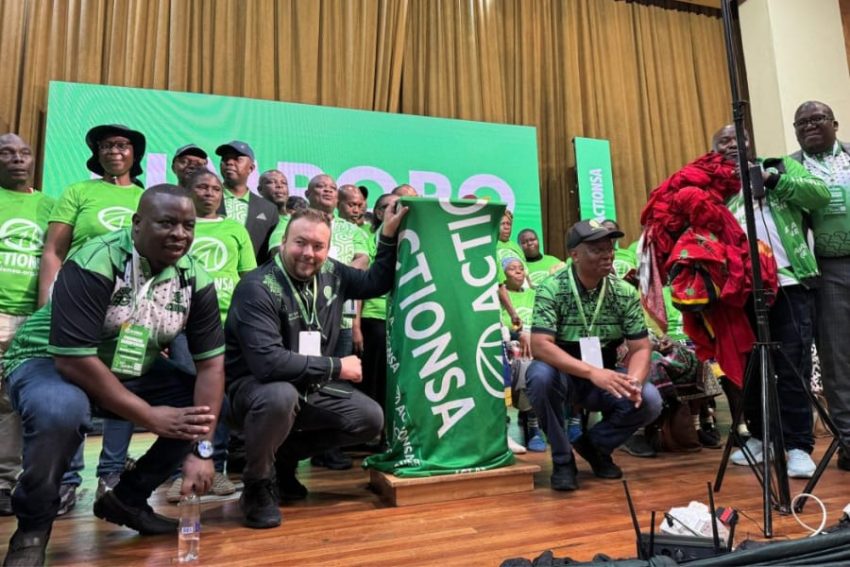
Action SA chairperson Michael Beaumont has launched a sharp attack on the DA over its role in the Government of National Unity, accusing the party of hypocrisy for branding cooperation with the ANC as betrayal while defending its own deal with the governing party as a rescue mission.
Beaumont said the DA entered the GNU, handed President Cyril Ramaphosa the presidency, and failed to secure a single reform in return.
“Well, you and me both, and I think let’s just call it what it is. It’s eye-wateringly hypocritical,” Beaumont said.
“I mean, the DA goes into the GNU. They give Cyril Ramaphosa the presidency. They do not require a single reform back in exchange before they do this.”
The comments go to the heart of the political battle over the GNU, which was formed after the May 2024 general election left the ANC without an outright majority for the first time since 1994.
The DA became the second-largest party in the GNU, while Action SA remained outside government and positioned itself as an opposition voice.
Beaumont argued that the DA accepted far less than it could have demanded in cabinet negotiations, and has since become an implementer of ANC policy rather than a force for change.
“They get offered half the seats they were entitled to in that cabinet, and they are implementing ANC policy right now,” he said.
He linked that criticism directly to the country’s economic crisis, arguing that the GNU has failed to deliver the reforms its supporters promised.
The DA entered the GNU promising stability, growth and reform, Beaumont said, but South Africa is now living through the highest unemployment in its history without a major economic reform package on the table.
“At a time in which the highest unemployment in South African history is taking place, and there’s not even an economic reform in the pipeline, much less having been delivered,” he said.
“But don’t worry, that’s rescuing South Africa. Rescue. Rescuing from what? I don’t know.”
The attack reflects a wider fight over language in South African politics: who gets to claim they are saving the country, and who gets accused of selling it out.
Beaumont said the DA and its supporters use one standard for themselves and another for everyone else.
When the DA works with the ANC, he said, it is presented as responsible, patriotic and necessary. When another party does the same, it is presented as dangerous and self-serving.
“But now you’ve got people who say, when another political party works with the ANC, that’s not rescue. That is doomsday. That’s auctioning. That’s their agenda there,” he said.
“And it’s just quite unbelievable. I mean, let’s call it what it is.”
Action SA has repeatedly argued that the GNU has not changed the fundamental direction of government policy on the economy, employment, energy, crime and service delivery.
The party says it has refused to join the GNU precisely because it did not want to be bound to an ANC-led programme without clear, enforceable reform commitments.
The DA, by contrast, has argued that its presence in government has prevented a worse outcome, restrained the ANC’s left flank, secured key ministries, and kept South Africa on a constitutional and market-friendly path. DA leaders have said that walking away would hand power to a coalition of the ANC with the EFF or uMkhonto weSizwe Party, which they argue would be disastrous for the economy and investor confidence.
Beaumont rejected that framing. He said the DA cannot claim to be rescuing South Africa while unemployment remains at record levels, growth remains weak, and no major reform has been delivered.
For Action SA, the GNU debate is also about credibility ahead of the next election cycle.
The party is trying to present itself as the real opposition to ANC rule, while painting the DA as a party that has been absorbed into the very government it once promised to replace.
The DA has not yet responded to Beaumont’s latest remarks. The party has previously dismissed Action SA’s criticism as opportunistic, arguing that Action SA has itself worked with the ANC in coalitions at municipal level and has no consistent principle on cooperation with the governing party.
“If you go into government, hand over the presidency, take half the cabinet seats you were entitled to, and then implement the other party’s policy while unemployment hits a record high, you cannot call that a rescue,” Beaumont’s argument runs.
The GNU remains intact, but the political war over what it means is intensifying.