
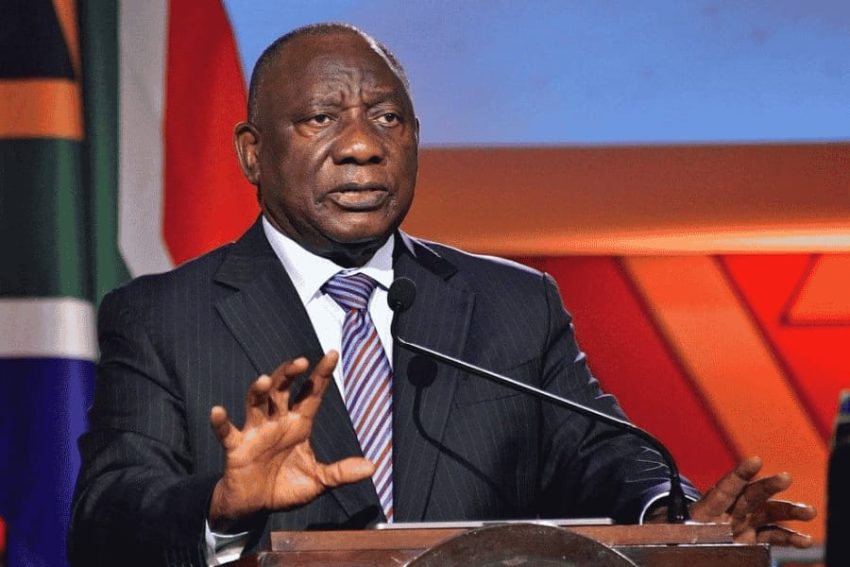
The Western Cape High Court has handed President Cyril Ramaphosa a total victory in the Phala Phala saga, declaring the damning Section 89 panel report unlawful and setting aside every step Parliament took on the back of it.
In a judgment that torched the work of the independent panel, Judge NP Mabindla-Boqwana found that the panel fundamentally misconstrued its functions, went beyond its lawful limit, asked itself the wrong questions, and made several material errors of law.
The Court found that the report could not stand.
As a result, the Court said, “the process it engaged in and the conclusions it came to were not rationally related to the object of Rule 129 G1b or the power and duty it was required to exercise in terms thereof. The Court found that the report could not stand.”
With those words, Judge NP Mabindla-Boqwana on Wednesday handed President Cyril Ramaphosa a complete victory in his bid to kill the damning Section 89 report that has haunted his presidency since November 2022.
“I read the order. One, the report of the independent panel comprising the first, second, and third respondents rendered in terms of Rule 129 G1b of the rules of the National Assembly is declared unlawful and is reviewed and set aside in its entirety,” the judge said.
“Two, any steps taken by the National Assembly pursuant to the report are reviewed, declared unlawful, and set aside. Three, each party is to pay their own cost of this application as well as that of the interdict application under case number 2026-138228 and the application for leave to appeal that followed. I hand out the judgment. Court adjourns.”
The judgment, delivered in the Western Cape High Court, ends – for now – a four-year legal and political saga over the theft of $580,000 in undeclared US dollars from Ramaphosa’s Phala Phala game farm in February 2020.
The panel, chaired by retired former Chief Justice Sandile Ngcobo with retired Justice Thokozile Masipa and Advocate Mahlape Sello SC, had found prima facie evidence that Ramaphosa may have committed a serious violation or serious misconduct on all four charges brought against him.
Those charges, lodged by ATM leader Vuyo Zungula in July 2022, alleged Ramaphosa had undertaken paid work outside his duties in breach of Section 96(2)(a) of the Constitution, failed to report the theft in breach of Section 34 of the Prevention and Combating of Corrupt Activities Act, and committed serious misconduct by directing Major General Wally Rhoode, head of the Presidential Protection Unit, to investigate the burglary instead of reporting it.
On 13 December 2022, the National Assembly voted against referring the report to an Impeachment Committee. After further litigation, the Constitutional Court in EFF3 ordered the report to be referred to the committee.
Ramaphosa then launched the present review, arguing the panel had acted irrationally and misconstrued its mandate under the principle of legality.
Judge Mabindla-Boqwana agreed, systematically dismantling the panel’s work.
She explained that Rule 129 G1B required the panel to recommend to the Speaker whether sufficient evidence exists to show that the president committed in bad faith a serious violation or serious misconduct.
“The court found that the proper meaning to ascribe to the term sufficient evidence is enough material that, on the face of it, is admissible and relevant, and which, if the impeachment committee finds to be true, would establish that the president had personally and in bad faith committed either, one, a serious violation of the constitution or the law, or two, a serious misconduct,” she said.
The panel, she found, did not do that. Instead, it equated sufficient evidence with prima facie information that the president had a case to answer, irrespective of merit or sufficiency.
“The panel did not state in its report that there was sufficient evidence showing that the president committed a serious violation or serious misconduct, only that the information before it prima facie disclosed a case to answer,” the judge said.
“In doing so, it equated sufficient evidence requirement in Rule 129 G1B with prima facie evidence.”
That was a material error of law, because the case-to-answer test belongs in adjudicative settings and imposes a burden to rebut, while the panel was only a sifting body.
The court also found the panel went beyond the charges.
“For instance, the ATM and EFF furnished additional information ostensibly to strengthen the evidential basis of the charges. But this led the panel to pronounce on issues unrelated to the charges and for which the president was not charged, such as the source of the foreign currency and General Rhoode’s exploits in Cape Town and Namibia,” the judge said.
It relied heavily on former State Security Agency boss Arthur Fraser’s June 2022 affidavit to police, even though Fraser had no personal knowledge of the 9 February 2020 incident, did not disclose his sources, and much of his affidavit amounted to hearsay.
On Charge 1, paid work, the court found the panel wrongly applied a directive for public service employees and ignored the Executive Members’ Ethics Act and Code, which allow Cabinet members to hold disclosed business interests that pose no conflict.
“It also found that the panel misunderstood the subject of the prohibition in Section 96-2A of the Constitution and therefore could not rationally have concluded that there was evidence showing, even on a prima facie basis, that the president contravened it,” the judge said.
On Charge 2, failure to report, the panel never considered bad faith, even though a serious violation requires far more than a mere breach.
“Such a violation of the law must be intentional or malicious and in bad faith,” the judge said. “Accordingly, the Court found, given the panel’s own findings and on the conspectus of the evidence as a whole, it could not be said that the president breached Section 34-1 either intentionally or maliciously and in bad faith.”
On Charges 3 and 4, dealing with Rhoode, the court found the panel erred by dealing with them together, focusing only on Charge 4 and disregarding Ramaphosa’s response on Charge 3.
None of the information before the panel disputed Ramaphosa’s response that security of his private residence was under the Presidential Protection Unit’s responsibility, nor did the panel find his response untrue.
On Charge 4, the court found no evidence that any deviation from standard procedure in Rhoode’s investigation was on the president’s instruction, and that the panel misread a Namibian presidency media release to conclude Ramaphosa had contacted the Namibian president for help.
Before reaching the merits, the court dismissed preliminary challenges from the MK Party and others, including that the Constitutional Court had already decided the issue, that Section 167(4)(e) gave the Constitutional Court exclusive jurisdiction, that the review was unduly delayed, and that it was an impermissible midstream review.
The court held the review became necessary only after the EFF3 decision, and that Ramaphosa brought it on 26 May 2026 after the 8 May 2026 order, a delay which was not unreasonable. It also held that allowing a flawed impeachment process to continue would deprive him of protection in the rules and cause irremediable harm to his office.
“This was not to say the president should not have to undergo an impeachment process,” the judge stressed. “Rather, given the far-reaching consequences of the process, it must proceed on a lawful foundation.”
On Wednesday, that foundation was declared unlawful in its entirety.
Ramaphosa had already obtained an interim interdict in July preventing Parliament’s impeachment committee, chaired by Makashule Gana, from continuing public hearings pending the review.
That interdict is now cemented by a final order setting aside every step taken pursuant to the report.