
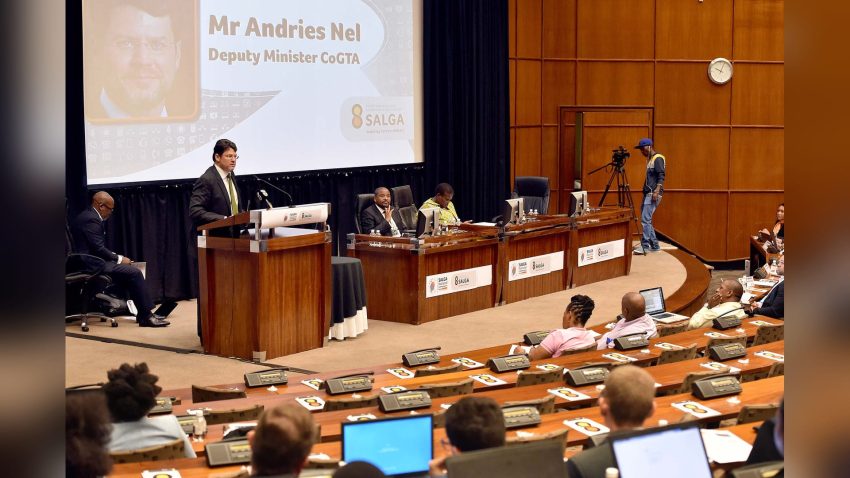
Newly elected councillors will begin undergoing a phased training programme in January 2027, South African Local Government Association (SALGA) spokesperson Motalatale Modiba has confirmed.
“The newly elected councillors will start undergoing the phased-in training programme from January 2027,” Modiba told Africa Daily.
The Integrated Councillor Induction Programme (ICIP) is intended to equip more than 10,500 incoming councillors with the knowledge and skills required to fulfil their governance, legislative and oversight responsibilities following the 2026 local government elections.
The programme, which will be implemented in partnership with institutions including the Local Government Sector Education and Training Authority (LGSETA), the National School of Government (NSG) and the Department of Cooperative Governance and Traditional Affairs (CoGTA), will follow a three-phase approach.
The elections saw 10,526 council seats contested, with the incoming councillors expected to assume responsibilities that include representing communities, participating in municipal decision-making and holding municipal administrations accountable.
In its response to Africa Daily, SALGA said the programme was designed to ensure councillors were progressively equipped to carry out these responsibilities.
“The ICIP is implemented through a phased approach to ensure that councillors are progressively equipped to perform their representative, legislative and oversight responsibilities effectively,” the association said.
The first phase will focus on councillor induction and preparation, introducing newly elected representatives to the constitutional, legislative and policy frameworks governing local government.
This will include their roles and responsibilities, codes of conduct, ethical obligations, accountability requirements, municipal governance structures and decision-making processes.
Training will also cover municipal finance, planning, performance management and service delivery responsibilities.
The second phase will provide functional and portfolio-based training for councillors serving in different municipal committees.
SALGA said the training would expose councillors to their responsibilities in areas including finance, infrastructure, governance, community services, planning and oversight.
The third phase will focus on continuous professional development throughout councillors’ terms of office.
This will include refresher sessions, thematic training, peer-learning platforms and knowledge-sharing initiatives.
“Through this learning pathway, councillors are supported to build competence in key areas including ethics and leadership, governance, legislation and policy, municipal finance, development strategy and planning, performance and accountability, public participation, oversight, accountability and the evolving policy context,” SALGA said.
Beyond the national induction programme, the association said it offers additional accredited training opportunities through the SALGA Centre for Leadership and Governance.
These include skills programmes at NQF Levels 3 and 5, as well as the Councillor Development Executive Programme at NQF Level 6.
Other programmes cover municipal governance, performance management, leadership in municipal governance and media and stakeholder engagement. A separate Local Government Women Leadership Development Training Programme is also available for female councillors.
Municipalities also run their own continuous development programmes to strengthen councillors’ ability to carry out their responsibilities.
“These municipal-level programmes are designed to respond to local institutional priorities, service delivery challenges, governance needs and community expectations,” SALGA said.
However, questions remain about the practical implementation and monitoring of the programme.
While SALGA confirmed the January 2027 commencement date and outlined the programme’s structure, its response did not specify how many days or hours each councillor would receive, or whether attendance would be compulsory.
The association also did not provide a breakdown of the programme’s budget, the anticipated cost per participant or the specific measurable indicators that would be used to assess whether councillors had acquired the necessary competencies.
Details on additional interventions for councillors who miss training or struggle to demonstrate an understanding of their responsibilities were also not provided.
The training programme comes amid questions about the preparedness of councillors, particularly given that South Africa’s electoral and constitutional framework does not require them to hold specific educational qualifications or meet prescribed minimum competency levels to stand for election.
SALGA acknowledged that councillors were not required to hold particular educational qualifications, but said the increasing complexity of municipal governance required them to develop competencies in governance, legislation, ethics, leadership, oversight, municipal finance, planning, accountability and service delivery.
The ICIP is overseen by a steering committee chaired by SALGA, with participation from CoGTA, National Treasury, the Auditor-General South Africa, the National School of Government, LGSETA and other government and local government institutions.
SALGA also emphasised that its role was to support and strengthen municipalities rather than directly manage their operations.
“SALGA does not run municipalities, appoint municipal managers, approve municipal budgets or deliver municipal services directly,” the association said.