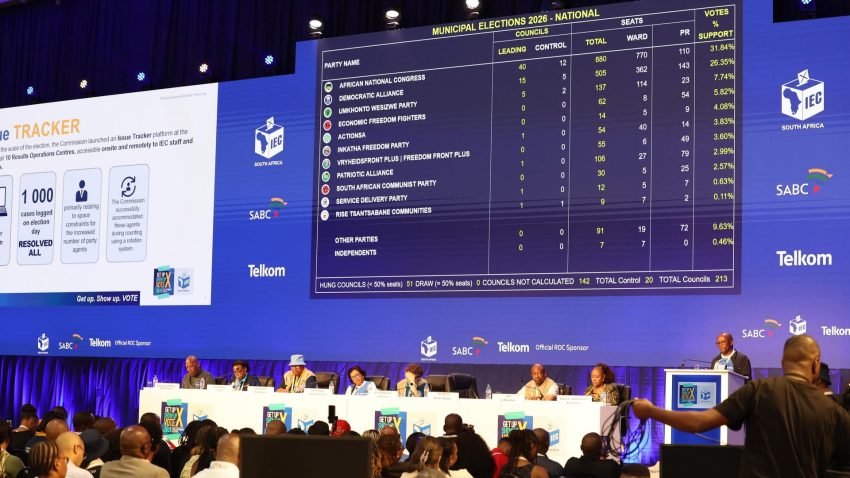
Counting continues, but coalition negotiations are already gathering pace, with early results pointing to shared governance in South Africa’s biggest cities.
No party is set to govern Johannesburg or Tshwane on its own. For the ANC, the message is clear: it will have to enter coalitions in most metros to hold on to power.
The scramble for partners has begun, as preliminary figures show Johannesburg and Tshwane will need to be shared.
The ANC is likely to be pushed into coalitions across most metros.
With 70% of ballots counted in the local government elections, the emerging picture is fragmented. The DA is leading in most metros, ANC support is falling, and smaller parties now hold the deciding votes.
Johannesburg
The DA leads with 41.02%, followed by the ANC on 16.99% and ActionSA on 15.58%.
On these numbers, Johannesburg is a hung council. The DA is the biggest party by far, but it is still short of a majority. It will need partners. So will the ANC if it wants to block Helen Zille from becoming mayor.
Tshwane
The DA leads with 33.07%, followed by ActionSA on 22.67% and the ANC on 21.47%.
Tshwane is even tighter. The DA, ActionSA and ANC are all within striking distance of each other, and no coalition will be simple. Whoever governs the capital will have to negotiate, compromise, and hold a fragile alliance together.
Mangaung
The DA leads with 37.41%, followed by the ANC on 30.41% and the EFF on 17.44%.
Even in Mangaung, once a safe ANC stronghold, the ruling party is now fighting for second place. The EFF is the kingmaker.
Ekurhuleni
The DA leads with 29.77%, followed by the ANC on 27.14% and ActionSA on 18.37%.
Ekurhuleni is a three-way split. No party is close to a majority. Every vote in council will count.
Nelson Mandela Bay
The DA leads with 44.57%, followed by the ANC on 25.78% and the EFF on 5.21%.
The DA is within touching distance of a majority here, but still not over the line.
eThekwini
MKP leads with 45.73%, followed by the DA on 18.12% and the ANC on 17.44%.
In Durban, it is MKP that is setting the pace, leaving both the DA and ANC scrambling for relevance.
Cape Town
The DA leads with 61.24%, followed by the ANC on 9.70% and the PA on 3.70%.
Cape Town is the exception. The DA is on course for an outright majority and does not need anyone else.
Everywhere else, it is coalition season.
ANC deputy secretary-general Nomvula Mokonyane said coalition talks are still open to any party.
“It is premature for us to start talking, because the ANC is open to talk to everyone and work with everyone, as long as we ensure stability, and as long as we ensure that the six pillars contained in our manifesto are also reflected in what that political party or those independents stand for,” Mokonyane said.
She said this included the SACP, which contested the elections on its own.
“The SACP will be one of those parties we are open to engage with, because it has contested elections. We didn’t go to elections as an alliance,” she said.
Coalitions in South Africa have too often meant instability, musical chairs in the mayor’s office, collapsed councils and broken service delivery. Johannesburg and Tshwane have lived through that chaos before.