
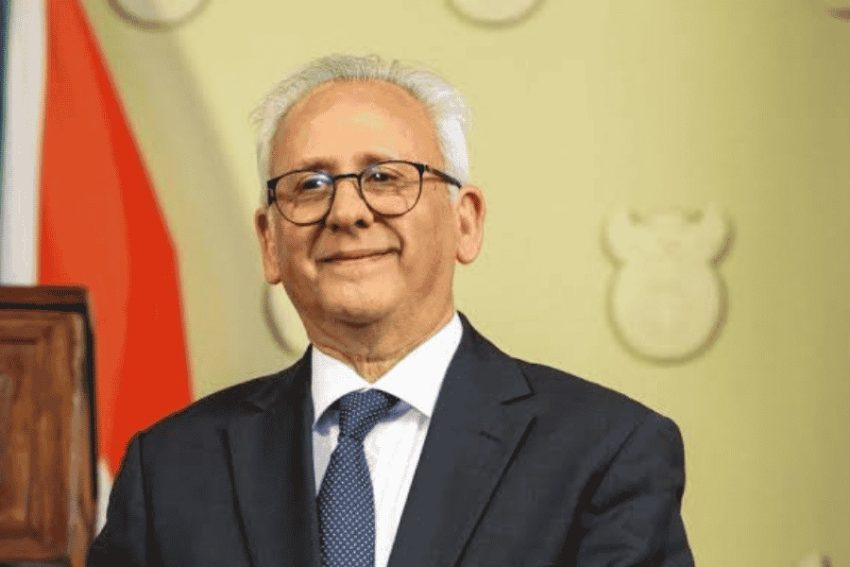
Acting Police Minister Firoz Cachalia has initiated a high-stakes process to appoint KwaZulu-Natal Police Commissioner Lieutenant-General Nhlanhla Mkhwanazi as the new National Head of the Hawks, in a move set to reshape South Africa’s war on organised crime and corruption.
Cachalia has submitted a Cabinet Memorandum seeking concurrence for Mkhwanazi’s appointment as head of the Directorate for Priority Crime Investigation (DPCI), with the memorandum expected to be tabled at the next Cabinet sitting.
Spokesperson Kmogelo Mogotsi confirmed the process on Thursday.
“The Acting Minister of Police, Mr Firoz Cachalia has, pursuant to the powers vested in him in terms of the South African Police Service Act 68 of 1995, initiated the process to appoint a National Head of the Directorate for Priority Crime Investigation (DPCI), commonly known as the Hawks,” she said.
Mogotsi said the appointment is being made in strict accordance with the law.
“In accordance with Section 17CA(1)–(3) of the Act, the appointment of the National Head of the DPCI is made by the Minister of Police, with the concurrence of Cabinet. The Act further provides for the reporting of the appointment to Parliament,” he said.
“The Acting Minister has submitted a Cabinet Memorandum seeking Cabinet’s concurrence for the appointment of Lieutenant General Nhlanhla Mkhwanazi as the National Head of the DPCI. The Memorandum will be presented at the earliest opportunity during a Cabinet sitting.”
“The DPCI plays a critical role in South Africa’s fight against organised crime, corruption, and other serious priority offences. This is a priority for the Police Reset Agenda. The appointment of a National Head is important in ensuring strong leadership, strategic direction and operational effectiveness in addressing these crimes,” Mogotsi said.
The move comes as Cachalia pushes his wide-ranging police reset agenda, which treats organised crime as one of the biggest threats to national security. He has previously warned that criminal syndicates have moved well beyond drugs and firearms into sectors such as construction, water services and public institutions.
“These gangs are accumulating power and wealth. They are diversifying their activities. They are attempting to infiltrate institutions, public institutions. We see them trying to infiltrate economic sectors, construction. Water, basic services have been compromised through this kind of infiltration,” Cachalia said recently, adding that South Africa needs a stronger elite organised crime-fighting capability similar to the FBI.
Mkhwanazi, who heads the SAPS in KwaZulu-Natal and has since July been in charge of the new national organised crime strategy, is seen as Cachalia’s preferred enforcer to drive that vision.
The KZN commissioner rose to national prominence last year after levelling explosive claims about political interference, corruption and infiltration of the criminal justice system, allegations that led to the establishment of the Madlanga commission. His outspoken approach has made him a public favourite while also making him a target in internal battles within the SAPS.
Just this week, Mkhwanazi and Cachalia together obtained an interim interdict in the Durban High Court against the March and March movement following violent anti-immigration protests, after police intelligence warned of a plan to torch the Home Affairs refugee reception centre in Berea.
The proposed appointment also comes amid turmoil within the Hawks itself.
The current KZN Hawks head, Lesetja Senona, has accused Mkhwanazi of ordering his removal from his office and seizure of his devices, a matter linked to the Madlanga inquiry.