
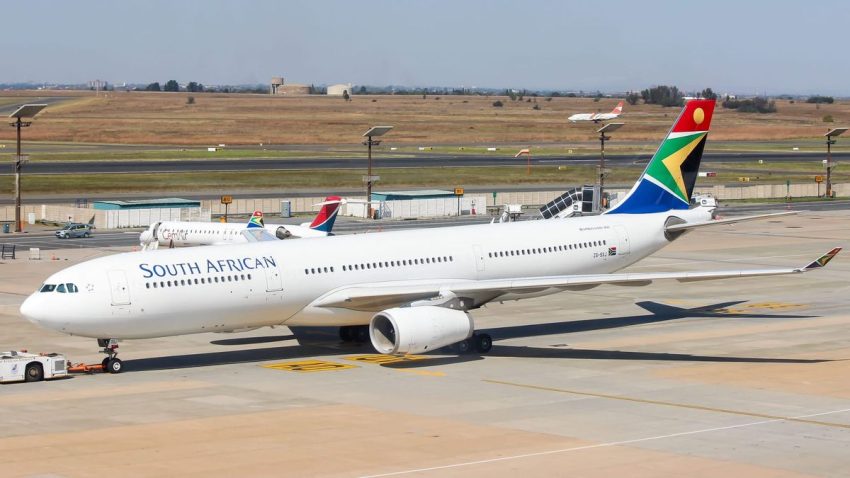
A South African Airways (SAA) captain has taken the airline to the High Court over the handling of an incident involving an Airbus A330-300, nearly two years after the aircraft experienced unexplained movements during a domestic flight.
Captain Yvette Walsh, who was serving as First-Officer on a Cape Town to OR Tambo International Airport service on 27 October 2024, wants an independent investigation to establish what happened and whether the conclusions drawn against her are justified.
What Happened Aboard the A330?
The aircraft began moving up and down during the flight, a motion commonly described as porpoising. Walsh and the flight’s captain, Craig Pearce, initially believed turbulence was responsible.
Walsh says she followed the manufacturer’s procedures, disengaging the autopilot and descending to a lower altitude while passengers were instructed to fasten their seat belts.
The aircraft stabilised within minutes, allowing the crew to re-engage the autopilot and continue the flight.
Although no passengers were injured, four cabin crew members sustained minor injuries. A catering trolley also came loose and damaged the aircraft’s rear right-hand door, making the occurrence a serious incident under international aviation standards. The aircraft was later flown to Lagos, Nigeria, on the same day. Walsh has questioned whether the inspections carried out before it returned to service were sufficient to rule out possible damage.
Disputed Findings and Missing Evidence
Months later, Airbus submitted a technical report to SAA and the South African Civil Aviation Authority (SACAA). Its findings raised questions about Walsh’s handling of the aircraft, which she disputes.
News24 reports that the Airbus report included an incorrect reference to the flight travelling to Malaysia, alongside a description of the aircraft climbing sharply before descending rapidly. Walsh argues that this account does not accurately reflect the incident.
Moreover, the cockpit voice recorder and flight data recorder recordings were not preserved. Their absence has become a key part of her application, as the recordings could have helped establish what happened inside the cockpit and how the aircraft responded to the crew’s actions.
Walsh has also raised the possibility of a faulty air data sensor contributing to the aircraft’s movements.
She argues that a thorough technical inspection and an investigation independent of both SAA and SACAA are needed to establish the cause, rather than relying on findings she considers unreliable.
SAA Challenges the Application
The dispute has taken a personal toll on Walsh, who has spent more than 23 years with SAA. Despite being promoted to captain after the incident, she has reportedly undergone treatment for stress, anxiety and depression and declared herself temporarily unfit for duty in November 2024.
SAA argues that a further investigation is unnecessary. In its court papers, the airline maintains that Walsh created the urgency herself by waiting to bring the application and points out that the aircraft has not experienced similar problems since the flight.
Walsh disputes this account, arguing that delays in receiving the relevant technical reports were outside her control.
The application has since been removed from the urgent court roll, with a hearing scheduled for early next year. Until the matter is heard, the questions surrounding the aircraft’s behaviour, the missing recordings and the conclusions drawn against Walsh remain unresolved.