
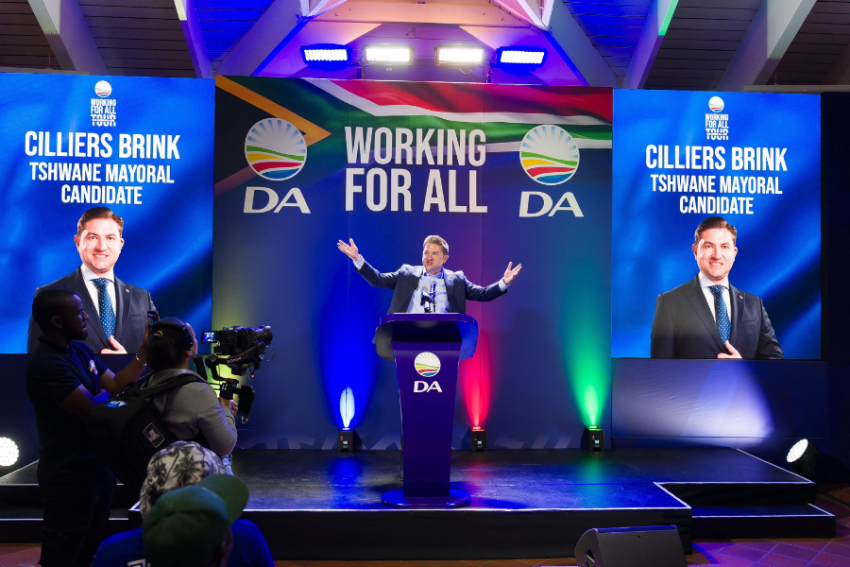
DA Tshwane mayoral candidate Cilliers Brink says the current city administration is behind the collapse of Tshwane and that the metro was “taken” from the DA by a government of “tsotsis”.
He has promised to restore the city if his party regains control in November.
Addressing DA supporters in Pretoria on Tuesday evening as part of the party’s “Working for All” tour ahead of the local government elections, Brink said Tshwane was facing deteriorating infrastructure, failing basic services, corruption and a loss of economic opportunities.
“We were overtaken by government of tsotsis. And you know what? We are gonna take it back, and we are gonna get it working,” Brink said.
Brink, who previously served as Tshwane executive mayor before being removed from office in September 2024, said the city’s problems extended beyond service delivery and were affecting residents’ livelihoods.
He claimed that Tshwane lost 85 000 jobs between April 2025 and April 2026, attributing the losses to power and water cuts, what he described as the misspending of public money and rates and taxes that failed to deliver value to residents.
“While this government is falling apart and arguing about swimming pools and tenders and water tankers, you know what? The city is falling apart. They have forgotten about ordinary people,” he said.
Brink’s remarks come amid renewed political battles in Tshwane ahead of the November local government elections, with the DA seeking to regain control of the metro after its multi-party administration collapsed in 2024.
He also returned to allegations involving Tshwane Mayor Nasiphi Moya’s private residence, where questions have been raised over work allegedly carried out by a company doing business with the municipality.
Moya has denied that the company, Tlopo Construction, worked on her property, saying she paid for the construction of her swimming pool and subsequent paving herself and has documentation to substantiate her version.
Brink, however, challenged the mayor to make the documents public.
“Who paid for the pool at the mayor’s house? … She says no, she paid for it herself. We say, show us the invoices and the story goes away. So why doesn’t she?” he said.
Brink also criticised Moya for retaining Deputy mayor and MMC for Finance Eugene Modise, whom the DA has accused of unlawfully benefiting from a municipal contract.
He said the allegations and political disputes within the city government were taking attention away from Tshwane residents’ concerns.
But Brink said the DA’s campaign would not only focus on criticising the current administration, outlining three key commitments should the party return to power.
The first, he said, would be to tackle corruption by removing corrupt officials and establishing what he described as a “corruption hit squad” to identify wrongdoing within the municipality.
“We will fire corrupt officials, and we will set up a corruption hit squad, not to ask people questions before a commission, but to catch them while they are stealing fuel,” Brink said.
He said the DA would also target corruption in recruitment and municipal systems, arguing that restoring trust in government was a prerequisite for fixing the city.
“Unless we take a strong stand against corruption, unless we shut down the comrades, the cadres and the tenderpreneurs, no other plan for the city is going to work,” he said.
Brink said the DA’s second priority would be to use technology to improve policing and public safety.
He criticised Tshwane’s deployment of its approximately 4 200 metro police officers, arguing that residents often did not know where officers were deployed or whether they were responding effectively to crime.
“If we cannot control where our men and women in blue are going and what they are doing, the people carrying badges and guns are a danger to society, not something that keeps us safe,” he said.
The DA would use cameras, control rooms and other technology to track deployments and work with private and community security structures, he said.
Brink said the approach would also focus on practical problems such as broken street lights and unsafe areas, including routes between public transport stops and residential areas.
“We can actually make our streets safe. We can make it safe in the CBD. We can make it safe to walk from the bus stop to your house. We can get the street lights working,” he said.
The third pillar would involve greater use of private-sector partnerships to improve electricity, water, public lighting and waste collection.
Brink argued that residents were effectively paying twice for basic services because they were forced to turn to private alternatives when municipalities failed.
“You pay your rates and taxes, and then you still have to get a generator when the power goes off. You pay what you need to, but then you have to get a private water tank,” he said.
He said the DA would move away from what he described as a system of “tenders and tender friendships” and instead introduce performance-based contracts.
Under such agreements, contractors would be paid according to whether services actually worked, rather than simply being paid to carry out repairs, he said.
“Instead of paying a contractor to fix every street light that is broken, pay the contractor for the street lights that work,” Brink said.
He argued that residents were less concerned about whether government or a private company carried out the work than whether services were actually delivered.
“South Africans don’t care who actually fixes the pipes, who fixes the electricity. They don’t care. They just want those services to work. And they want value for the money that they are already paying,” he said.
Brink said the DA would need a strong electoral mandate to implement its programme, calling on supporters to help the party secure at least 50% of the vote.
He said returning the DA to government in Tshwane would be about more than removing the current leadership.
“We are not just here to criticise and complain and point fingers. We are here to take responsibility for the future of our city,” Brink said.
“We are gonna get this city working for all of its people.”
He said a functioning city could also become an engine for job creation and economic growth.
“A city that can work is a city that can create work,” Brink said.