
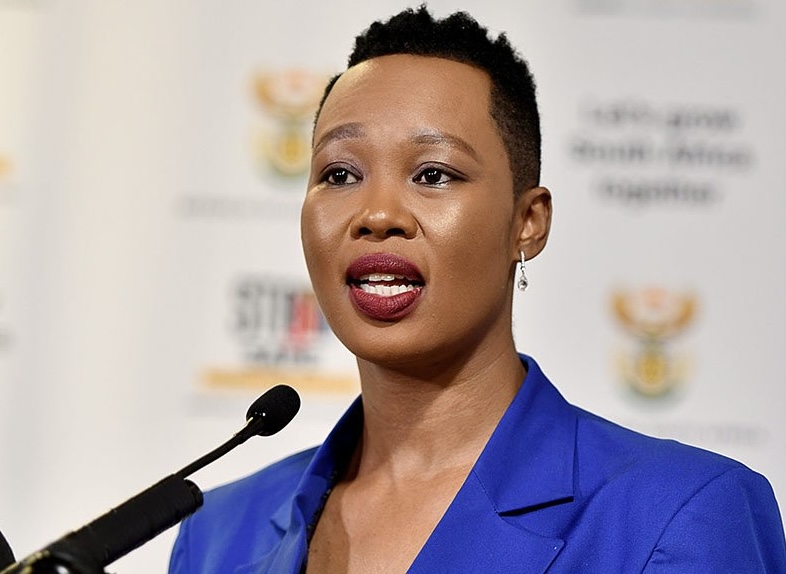
The ANC says it is not scared of the Democratic Alliance’s bid to reclaim Johannesburg and other Gauteng municipalities, while appealing to voters to give the governing party another opportunity to correct its failures and improve service delivery.
ANC Local Government Intervention Task Team chairperson Stella Ndabeni said the party was confident in its record and believed it had learnt from the weaknesses that had affected municipalities over the past five years.
“We’re not scared,” Ndabeni said during an ANC manifesto review media briefing on Wednesday.
“We’re not scared because the DA governed here earlier. The city was led by Mr Mashaba at the time after they took over from Comrade Parks Tau.”
Ndabeni pointed to the DA’s tenure in Johannesburg after the ANC lost its majority in 2016, claiming the city had been in a stronger financial position before the DA took over and subsequently governed in coalition with the Economic Freedom Fighters (EFF).
Herman Mashaba, who served as the DA’s mayor during that period, is now ActionSA’s Johannesburg mayoral candidate.
Ndabeni made the remarks as the ANC prepares to contest the 2026 Local Government Elections and seeks to regain control of municipalities where it has lost power.
Ndabeni also acknowledged that the ANC could not claim to have a flawless record in local government.
“We’re not saying we are not facing challenges. We’re not saying we’ve not failed in certain areas,” she said.
She said the party’s review of its 2021 Local Government Elections Manifesto had identified weaknesses in accountability, governance and service delivery, which it now intended to address through a series of interventions and reforms.
“This is why we give account. That is why we acknowledge that where we have not acted decisively, we have compromised service delivery, including the improvements that could have been done.”
Ndabeni said the ANC had concluded that interventions needed to happen earlier and more decisively when municipalities began showing signs of dysfunction.
“We have learned, we have seen. Therefore, in 2026, this is why we’re saying in our own judgment, that we are committing to improve.”
She said the party was not starting from scratch, but was strengthening existing accountability mechanisms based on lessons from its experience in government.
Ndabeni also acknowledged that political instability and infighting could have a direct impact on service delivery.
“If you are not ensuring that there’s political stability, it is bound to have an impact on service delivery,” she said.
“Because once there is infighting, whether it’s because of different parties or within the same party, then it tells you that there’s going to be poor attention in terms of the oversight that must be provided over the executives.”
The ANC has increasingly blamed coalition governments for governance failures in municipalities where it lost its outright majority, with party leaders arguing that political instability has contributed to deteriorating services and financial mismanagement.
But Ndabeni said the ANC itself had identified areas where it needed to improve, including ensuring that its public representatives were more responsive to communities.
She said engagements with residents ahead of the elections had highlighted instances where communities raised issues that could not be addressed by senior ANC leaders and required intervention by ward councillors.
“We did observe that there has been gaps in terms of the attendance of the needs of the communities, and this is why we then said everyone must make sure that there’s constant engagement with the communities.”
The party has therefore sought to strengthen the role of councillors and improve engagement between public representatives and the communities they serve.
Ndabeni said the ANC also wanted to strengthen cooperation between councillors, traditional leaders and Khoi-San leadership as part of efforts to ensure that communities’ concerns were communicated to government.
She said the ANC was not approaching the elections as though it had no shortcomings.
“Don’t judge us by how we look. Judge us by what we have done,” she said.
“And yes, we acknowledge fully that we have failed in certain instances.”
She said the party was instead asking South Africans to consider its record while recognising the lessons it had drawn from its failures.
“This is why we are appealing to South Africans to say, ‘Give us another time to improve when we have done well. Give us another time to fix the mistakes that we have made.’”
Ndabeni said the ANC’s experience in government had also changed the nature of some of the challenges facing municipalities.
She pointed to increased access to basic services, including water and electricity, while acknowledging that maintaining existing infrastructure had become a growing challenge.
“The challenge is maintenance, because now everybody knows that I must have electricity that they do not have access,” she said.
“So we’re no longer arguing for access. We’re arguing for maintenance of the existing infrastructure.”
She said the funding model for municipalities was also being reviewed, with the National Treasury, the Department of Cooperative Governance and Traditional Affairs and the Presidency involved in the process.
Ndabeni said the ANC believed its experience in government gave it an advantage over parties seeking to take control of municipalities.
“The time that South Africans, which we are grateful for, that they’ve entrusted us with the responsibility to deliver the service to them, is what is making us better off than any other person,” she said.
The ANC is expected to use its 2026 manifesto to set out its plans for improving municipal governance, strengthening accountability and addressing infrastructure and service-delivery challenges.
Ndabeni said the party was confident that voters would consider both its record and the reforms it was proposing when they go to the polls in November.