
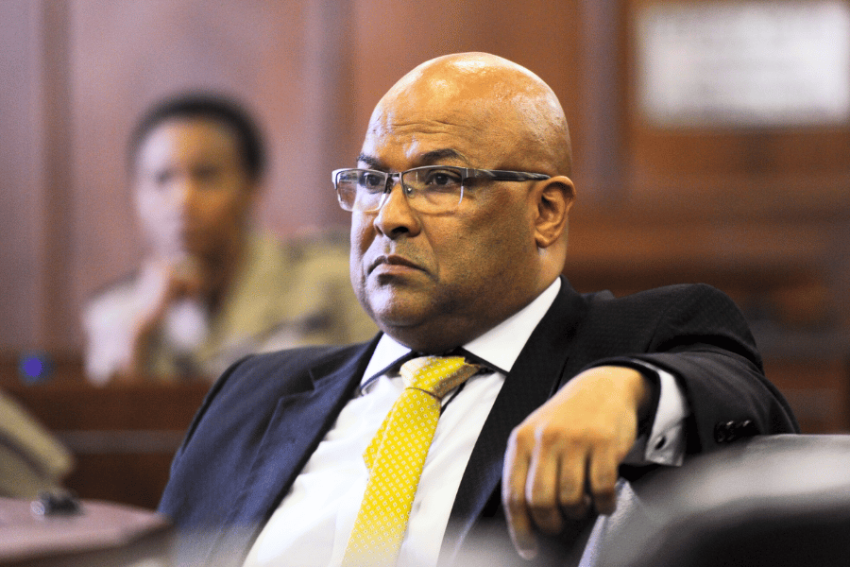
Former intelligence boss Arthur Fraser, struggle veteran Reverend Dr Allan Boesak, senior advocate Dr Muzi Sikhakhane and Professor Isaac Shai have launched Vuka Azania, a new decolonial think tank aimed at advancing what its founders describe as the unfinished struggle for Black emancipation in South Africa.
The organisation says the country’s democratic settlement failed to dismantle colonial power structures and is calling for a national Black People’s Convention, land restoration and the adoption of a post-colonial constitution.
Launched on Friday as a non-profit company rather than a political party, the organisation says it intends influencing national debate through research, policy development, strategic litigation, civic mobilisation and public education, while advocating for African sovereignty, economic justice, decolonised education and legal reform.
The founding directors said Vuka Azania was established in response to what they described as the country’s “unfinished struggle” against settler colonialism, apartheid and racial capitalism.
In its founding statement, the organisation argues that while South Africa achieved political democracy, colonial systems of land ownership, economic exclusion, legal structures and cultural domination remain largely intact.
“Land remains alienated from the indigenous people. The economy remains racially concentrated. African histories and knowledge systems remain marginalised. Black poverty remains normalised,” the statement reads.
The organisation describes itself as a decolonial advocacy entity committed to addressing what it calls “the Black Condition” through programmes focused on land restoration, redistribution of wealth, community-owned enterprises, youth development, food sovereignty, decolonised education, African knowledge systems and cultural healing.
Addressing the media at the launch, Sikhakhane stressed that Vuka Azania would not contest elections, arguing that meaningful change required educating and mobilising communities beyond the confines of electoral politics.
“We are not a political party,” Sikhakhane said.
“Not because that space is not great, but because we think our people need education and healing.”
He said the organisation believed fundamental change would only occur when black South Africans recognised their own agency and understood that political parties were not the only vehicles capable of advancing black interests.
“It is not only political parties that are capable of pursuing the interests of black people. It is us working with them to do what they do.”
One of Vuka Azania’s first major initiatives will be convening what it calls a Black People’s Convention, bringing together black South Africans from across political, religious and professional backgrounds to discuss the country’s future.
Sikhakhane said the convention would create a space for black South Africans to engage one another without what he described as interference from those responsible for creating many of the country’s historical problems.
“The aim of the convention is to create a long absent but much-needed space for black people to have a conversation amongst themselves,” he said.
“To discuss ourselves, our condition, why we hate each other, why we do not want anything that seeks to liberate us.”
He argued that black South Africans continued to suffer the psychological consequences of colonialism and apartheid, saying one of the organisation’s primary goals was restoring dignity, confidence and self-belief.
“Our people are sick. Our people are ill. Our people have a psychosis of self-hate, of hating everything that seeks to liberate them, and we need healing.”
Sikhakhane also criticised sections of South African civil society, accusing some organisations of using constitutional litigation and the language of accountability to frustrate policies aimed at advancing black South Africans.
“A lot of these organisations use the language of accountability, good governance, constitutionalism and the rule of law to effectively advance neoliberal politics and policies,” he said.
“Some have effectively adopted a posture that every progressive policy that may potentially benefit black people must be taken to court.”
He said Vuka Azania intended engaging these organisations directly through advocacy and strategic litigation.
The organisation also announced strict principles governing its funding, saying it would reject financial support from individuals or organisations seeking to influence its political or ideological direction.
“We state unequivocally that we will neither consider nor accept funding from sources whose aim… is to control or influence our approach to the liberation of black people,” Sikhakhane said.
He added that the organisation wanted to demonstrate that black-led institutions could operate transparently and without corruption.
“We must prove to our people that the lie that we are not capable of running our lives, of dealing with resources effectively, efficiently, without corruption, is a lie.”
Boesak said years of travelling across South Africa had convinced him that communities understood the country’s challenges but lacked a platform to collectively develop solutions.
“We thought that the time was right,” Boesak said.
“I have been travelling across the country for the last three years… and we have come to the conclusion that all over the country everybody understands the crises that we find ourselves facing at this point.”
He said the proposed Black People’s Convention would help develop a shared programme for addressing those challenges.
“Out of that coming together of the people, a programme will emerge.”
Boesak also rejected suggestions that Vuka Azania could eventually evolve into another political party.
“We are very, very clear that this is not a political party,” he said.
“For myself, I have long ago determined that every path taken by political parties in the last few years has turned out to be a dead-end street.”
“Another political party is not going to solve the problem. Another political party will, in fact, add to the fragmentation of the black vote that we already have.”
Among the organisation’s longer-term objectives is advocating for what it describes as a genuinely post-colonial constitution capable of dismantling the remaining structures of colonial domination.
It also intends promoting debate on replacing the country’s name with “Azania”, arguing that a liberated people should have the right to define themselves beyond colonial geography.
“We will also call for a national debate regarding the adoption of the name Azania to replace the colonial name South Africa,” Sikhakhane said.
“We must have our own nam as a country. A liberated people must have that right.”
Vuka Azania says it hopes to work with communities, traditional leaders, faith organisations, professionals, academics, students and civic organisations as it pursues what it describes as the complete emancipation of African people beyond the structures of electoral politics.